
Cicadas have a unique mouthpart for feeding known as a beak. Its four stylets are used for piercing small twigs in trees and bushes to withdraw sap. When a cicada is not feeding, this beak rests between its legs. (Photos by Mary Holland)
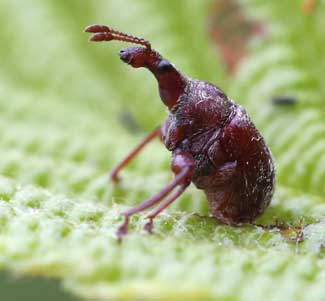
Weevils have a distinct narrow beak or rostrum extending in front of their heads. The chewing mouthparts they use on wood, seeds, and grain are at the tip of this rostrum.
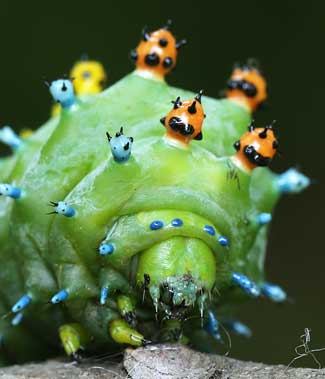
Cecropia caterpillar: Adult butterflies and moths have siphoning mouthparts, but in their larval stage, the only stage when they chew and eat vegetation, they have chewing mouthparts.

Honeybee.

Tachinid fly.
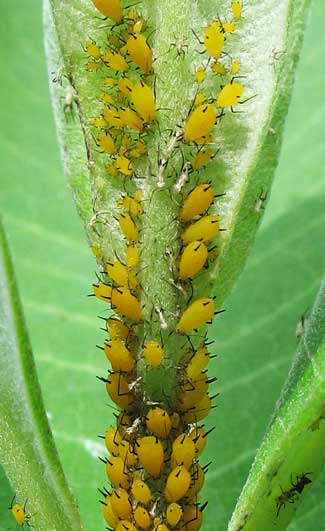
Aphid nymphs.

Grasshopper.
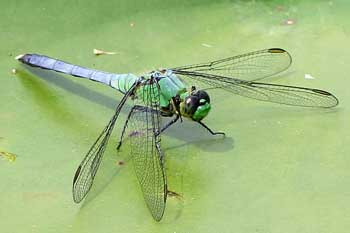
Dragonfly.
Insects and flowering plants (angiosperms) are so evidently made for each other that scientists have long assumed it was the emergence of plants with flowers 125 million years ago that led to the sudden expansion and diversification of insects. However, it turns out insects began to flourish and diversify 120 million years before the advent of angiosperms. Thus, flowers evolved into a world already full of insect crushers, piercers, chewers, sippers, and borers. Co-evolution occurred with insects and nonflowering plants such as ferns and conifers. Most of the insect mouthparts for eating, though now used to secure food from flowering plants, evolved to handle pre-angiosperm consumption, chewing on leaves, boring into stems, or siphoning aquatic invertebrates.
Regardless of how they originated, insect mouthparts vary tremendously in size, shape, and form. Their function, to obtain and consume food, is the same, but they achieve it in very different ways. A familiarity with the individual mouthparts of most insects is helpful.
Chewing Mouthparts
The earliest insects had chewing mouthparts, typically large mandibles with which they grasped, cut, tore, crushed, and chewed their food. Examples of modern-day chewing insects include dragonflies, grasshoppers, ants, and beetles. Some insects do not have chewing mouthparts as adults but do as larvae, such as moths and butterflies.
Grasshoppers have a pair of hard, horny, large mandibles with jagged inner edges that move horizontally and crush food between them. If you look closely at a grasshopper’s mouth, you can see tiny, fingerlike appendages. These are sensory palps used to choose and manipulate the food before it enters the grasshopper’s mouth.
Piercing and sucking
Specialization of insect mouthparts has mostly been for piercing and sucking. Mosquitoes and aphids both pierce and suck—the former for animal blood, the latter for plant sap.
In female mosquitoes, the labium encloses all other mouthparts like a sheath. The labrum forms the main feeding tube, through which blood is sucked. Paired mandibles and maxillae together form the stylet, which is used to pierce an animal’s skin. During piercing, the labium remains outside the food item’s skin, folding away from the stylet. Saliva containing anticoagulants is injected into the food item and blood sucked out, each through different tubes.
Aphid nymphs and adults feed in the same way. Their mouthparts consist of a slender tube with two sharp stylets running down each side. These are enclosed in a sheathlike labium and are held horizontally below the thorax when not in use. During feeding the labium is bent and shortened as the stylets and central tube are pushed through the epidermis of the leaf or stem until they reach the phloem. Saliva is injected through the puncture to begin the digestion of the sap and cytoplasm, and the fluids are then pumped up into the alimentary canal.
Sponging
The housefly is a typical sponging insect with mouthparts that consist of a fleshy labium, at the end of which are large, spongelike lobes called the labella, which are fused together. The labella is a complex structure that consists of many grooves and sops up liquids much as a sponge does. The housefly is able to eat solid food by secreting digestive juices and dabbing them over the food item. As the juices dissolve the food, the solution is then drawn up into the mouth as a liquid.
Siphoning
The mandibles of butterflies and moths have disappeared altogether. The remaining mouthparts form an elongated sucking tube called the proboscis. The long maxillae have channels along their surfaces that are held together by hooks and spines to form a strawlike sucking tube or siphon. This tube is coiled up under the insect’s head when not in use.
Filtering
Black fly larvae, living in fast-flowing streams, possess mouthparts that consist of tiny serrated mandibles and toothed flaps that form “labral fans” that project forward, filtering small invertebrates out of the water current.
Lapping and chewing
A honeybee’s mandibles are very small (suitable for molding wax), while the labium is curved downward and inward, forming a tube used for sucking up nectar as well as a tongue. The tongue, or glossa, is long, cylindrical, and covered with hairs. When the honeybee dips its tongue into a flower’s nectar, the hairs erect and trap the nectar.
As is obvious to the naked eye, insects exhibit a range of mouthparts, adapted to particular modes of feeding. A few minutes observing the visitors of goldenrod will provide you with many examples.
Glossary: Insect Mouthparts
There are five basic structures found among insects: the labrum, mandibles, maxillae, labium, and hypopharynx.
- Labrum: A cover that may be loosely referred to as the upper lip.
- Mandibles: Hard, powerful, cutting jaws, typically the largest mouthparts of chewing insects.
- Maxillae: “Pincers” that are less powerful than the mandibles and are located below them. They are used to steady and manipulate the food.
- Labium: The lower cover, often referred to as the lower lip or floor of the mouth. With the maxillae, it assists manipulation of food during mastication or chewing.
- Hypopharynx: A tonguelike structure in the floor of the mouth. The salivary glands discharge saliva through it, and it helps an insect swallow.
Former Harvard resident Mary Holland is a naturalist, wildlife photographer, columnist, and author of books for both adults and children. Read Holland’s natural history blog at www.naturallycuriouswithmaryholland.wordpress.com.