Many of us aspire to be the kind of person who observes the natural world and doesn’t just pass through it. But it’s easy to get distracted. Julie Zickefoose’s “Letters From Eden” is a wonderful reminder of the delight and wisdom that come from being a close observer of nature. Zickefoose, an acclaimed speaker, artist, and nature writer, will be at Fruitlands Museum Wednesday, July 22, at 7 p.m. to give readings from her book. Copies of “Letters From Eden” and some of her other books will be for sale.
Zickefoose takes the reader through the four seasons at her home 80-acre southern Ohio home, meshing factual information with personal reflection, all told with wit and earnestness in a very readable style. Exquisite watercolors of birds and flowers accompany the text. The result is a book that inspires the reader to take some time, maybe grab binoculars, go outside, and look, really look, at the bit of Eden that’s in our own backyards. Says Zickefoose of her experiences, “It’s simply because I am looking, and seeing, and present for these things that happen everywhere, all the time.”
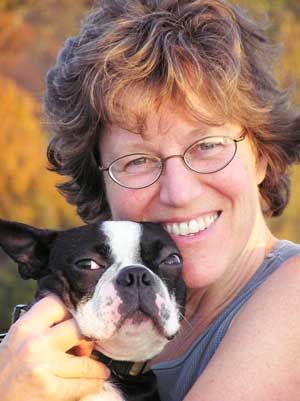
Author Julie Zickefoose and her Boston terrier Chet Baker. (Courtesy photo)
Not content to simply notice the increased number of Carolina wrens early one summer, Zickefoose set about to keep count of the number of offspring in the various nests close to her house. Toward the end of summer, checking the last nest needed her husband’s help with a stepladder for the right vantage point. To his mutter that she didn’t always have to know, her silent answer was, ”But I do,” noting that he knew when he married her that she was a “science monkey.” She got the final count (26), but only after the nest fell and she had to catch it and place the babies back in, nearly tumbling off the ladder in the process.
This is the woman who, as a college freshman, kidnapped a baby chick from a science lab where it was about to undergo an experiment. Being newly hatched, he imprinted on her as his mother and followed her around, “a chicken in Harvard Yard.” She kept him in her dorm suite until he was an adolescent, when she knew midnight crowing was not far off and she needed to find a farm for him.
Zickefoose’s compassion extended to a bird caught in a supermarket, where the computer-generated round-the-clock lighting made it impossible to entice the bird outside. Baiting a trap and patiently changing the bait location, Zickefoose finally lured the bird far enough into the cage to spring it shut. The employees cheered as she carried the caged bird out to freedom.
Once, passing a store window, she noticed a butterfly trapped between the glass and a row of jam jars. She went into the store, reached in the window, carefully pinched the butterfly’s wings together, carried it out, and released it.
But Zickefoose can be hard-nosed when she needs to be. When a friend gave her a pickle jar with five bullfrog tadpoles, Zickefoose was elated, thinking they would be perfect for the small pond her husband had built in the yard. It soon became clear that one of the five was larger than the rest, and Zickefoose began to hand feed him mealworms. (Once, when he mistook her pinky finger for a mealworm, she “got a flash of what it must be like to be prey.”) Soon Big Fergus (there were Medium Fergus, Small Fergus, etc.) had become a pet and allowed himself to be picked up, when he would give “his froggy grin.” One day Zickefoose noticed that a plant at pond’s edge, always loaded with butterflies, had been eaten away on the side facing the water; she was horrified to realize that she had planted a “death garden for butterflies.” Worse was the day she noticed feathers on the water surface and after close observation realized that Fergus was eating hummingbirds. She knew there was no way she could limit the bullfrog’s diet to mealworms and grasshoppers. Big Fergus—and all the other Ferguses—had to be relocated.
In reviewing what had happened, Zickefoose reflected that she had tried to create an ecosystem and control it, but nature had other ideas. “I’m humbled by it all, hit by the realization that nature will assert itself whatever we wish or plan.” This same idea was reaffirmed after a “surge” of cicadas. While others used pesticides, Zickefoose marveled at the tens of thousands of insects that swarmed her property, a result of a bizarre life cycle. While the constant din got on her nerves, she “still loved the Brood V hatch experience, the way I love big surf, thunderstorms, and oversized rat snakes. They’re all reminders that nature is bigger, far bigger, and more powerful than we usually care to admit.”
The land connects Zickefoose with other humans as well as with wildlife. A day when she heard a mockingbird for the first time in Ohio reminded her of herself as a child, “waking up on a summer midmorning in Virginia to the drone of lawnmowers and the song of mockingbirds.” Going to the garage for the garden plow, she always recalls its first owner, her German grandmother, “dressed in hose, a flowered dress, and beat-up pumps, pushing it through the rich, dark soil of her Iowa garden.”
“Why does that tree look like a monster hand?” Zickefoose’s 5-year-old daughter Phoebe (now a college sophomore) asked one day, pointing at a tree in the yard. “Because it’s covered in wisteria vine,” answered her mother. Phoebe replied, “No wonder they call it mysterious vine.” A few minutes later Phoebe excitedly called, “Mommy! More of your viruses are blooming!” Zickefoose looked to see the child standing by a gladiola taller than she was. These child names are the stuff of future family stories.
Zickefoose is a true naturalist. One summer, while delighted to join a family summer reunion at the shore, Zickefoose couldn’t stop worrying about having left her birds and plants in the hands of a sitter. To make it worse, the vacation spot was so commercialized that there were no natural habitats for her to visit. Planes towing advertising banners disturbed the quiet. Sensing Zickefoose’s unease, her mother said to her, “A vacation is to make you appreciate home.”