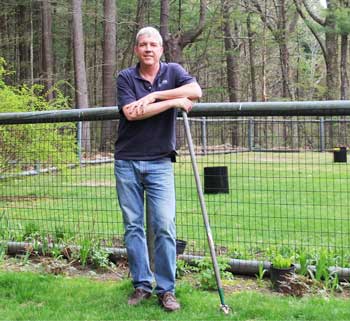
Matt Flanagan in his backyard. (Courtesy photo)
Matt Flanagan’s perennial flower beds on Woodside Road are a poster garden for the Garden Club of Harvard’s annual plant sale, this year to be held on Saturday, May 16, from 9 a.m. to noon on the Common. The various perennial borders and island beds on his property have been developed almost exclusively from plants Flanagan has purchased at the garden club sales over the years. When he started, he bought some perennials from nurseries, and although he paid attention to the zone recommendations, he found they rarely survived. Flanagan soon became a devoted fan of the annual May sale, where he could purchase reliable plants that had happily thrived year after year in Harvard gardens.
Flanagan and his family moved to Harvard in 1999. The backyard had a swimming pool, trees, beds of juniper ground cover, and other low-maintenance plants—and lots and lots of heavy mulch. Flanagan grew up helping his dad in the vegetable garden and had been on the steering committee of Green Grows of Waltham, a community garden where he also had a plot. But he realized pretty quickly that he wasn’t going to be able to grow vegetables at the Harvard site (although the chives he brought from his Waltham garden are still thriving).
Wanting some color and variety in the yard, Flanagan ripped out much of what existed and cut down trees. His mom, an avid perennial gardener in Connecticut, gave him divisions of her plants, among them allium and day lilies, and he experimented with plants from nurseries. A couple of years later he discovered the annual plant sale in town, and he became a regular customer. “I love the concept of getting plants with a history of growing successfully locally,” Flanagan said.

Solomon’s seal is an early spring arrival.
(Courtesy photo)
One of his favorite plants is Solomon’s seal, which he loves because it is so easy to grow and comes up early in the spring. He has divided that first plant from the sale and now has Solomon’s seal growing in various rock-lined beds. He says that his wife, Alison, likes to have flowers in the house all summer long, and she uses the green of Solomon’s seal in arrangements. Adding to the original allium from his mom, he purchased short pink and midsize and tall purple, all of which have spread in his gardens.
One year, Flanagan said, a Garden Club “saleswoman” assembled a collection of seven or eight different kinds of Siberian iris for him. Now, every spring, one border makes a spectacular show of white, blue, and purple blooms.
Flanagan said Alison received peonies from her grandmother’s garden, and he got some from his mother. To these he has added specimens from the plant sale, so that he now has quite a number of peony plants. One garden bed is reserved for spreaders, such as gooseneck loosestrife and other species, the names of which Flanagan has forgotten, though he knows the colors and heights. He hastens to say that he was forewarned that they can be invasive, so he has put them where they can’t encroach on other plants.
Because he isn’t wary of dividing plants, Flanagan has created lush beds from a few varieties. He likes the challenge of figuring out where things grow best. And he loves plants with a history—the forsythia from a neighbor down the street, the tiny purple iris from a woman in the Garden Club, the Japanese maple from his dad, the peonies from relatives. And, of course, all the plants from the Garden Club sales.
Everywhere in his gardens are “old friends,” Harvard plants that delight him—May apple with its white flower hiding under the large leaf, hosta that comes up early and stays late; the small, daisy-like flower of the feverfew, which thrives anywhere; the delicate, white Japanese anemone that flowers late in summer; hardy geraniums; and lady’s mantle, whose scalloped green leaves hold the raindrops.
Matt Flanagan’s garden is a poster-perfect example of how one can create thriving perennial flower beds firmly rooted in the Garden Club of Harvard’s plant sale.
Carlene Phillips is a member of the Garden Club of Harvard