Harvard kids face the same risks, temptations, and stresses as middle and high school students in other nearby communities. And Harvard students respond in ways that endanger themselves just as often as other kids do—sometimes even more often in the case of drinking and drug use.
It’s still important for parents to know … your kids are doing this! Don’t pretend it’s not happening.
—Susan Downing
school psychologist
That was the message at the heart of recently released results from the Youth Risk Behavior Survey that asked students about self-harm, suicide, stress, drug use, and sexual activity. Students in grades 6, 8, and 9–12 took the survey anonymously in spring 2014, so the report reflects students at their last year’s grade level. Overall, 83 percent of the students in those grades took part, with the lowest rate of participation at 12th grade.
Bromfield Principal Jim O’Shea and guidance counselor Drew Skrocki reported selected results from the survey to the School Committee April 13. While the results are important and some look shocking, Skrocki said, the findings for Harvard are generally similar to those for other schools in the area.
“We are not outliers,” O’Shea said.
O’Shea also said he plans to schedule a public forum in May to discuss the results with parents and community members. Although there was not yet a firm date, O’Shea said the forum would take place before Bromfield holds its prom.
The Youth Risk Behavior Survey began in 1998 with funding from Emerson Hospital and has been conducted every two years since then. The Harvard School District first took part in 2012. For the 2014 survey, Harvard is part of an aggregate that includes Acton-Boxborough, Concord, Concord-Carlisle, Groton-Dunstable, Littleton, Maynard, Nashoba, and Westford.
High stress rates connect to other issues
Perhaps unsurprisingly, the problem reported by the largest percentage of Bromfield students was stress from the pressure to do well academically. The share of students who felt stressed by the demands of schoolwork rose steadily, grade by grade, to a whopping 78 percent in 12th grade. The biggest jump was between grade 6 (16 percent) and grade 8 (41 percent).

CLICK GRAPH TO ENLARGE
School psychologist Susan Downing said in a phone conversation that eighth grade is a high-stress year for many students, because they are facing the transition to high school and worry about meeting the new demands. Likewise, she said, 11th- and 12th-graders are anxious about the transition to college.
Downing said stress at these grades also shows up in other parts of the survey, such as the 21 percent of eighth-graders who reported cutting, burning, or bruising themselves on purpose at least once in the previous year. That was the highest rate of such behavior at any grade and was nearly double the rate for the aggregate group of schools in the survey.
At the upper grades, stress levels may have been reflected in students who have seriously considered or attempted suicide in the past year. Numbers for both those categories peaked in 11th grade, with 21 percent having considered suicide and 11 percent having attempted it.
Alarming as those numbers appeared on their own, comparing them to the 2012 survey was even more worrisome. In 2012, 11th-graders were also the group with the highest figures for attempted suicides, but the share who had done so stood at 7 percent, 4 percentage points lower than in 2014.
Downing said social stress—from bullying, for example—and stress at home are also major factors in teen life. She emphasized that problems facing Harvard teens extend beyond the school and into the community.
Alcohol use higher than in nearby towns
At nearly every grade level in the survey, Harvard students were more likely to report having consumed alcohol, either in the past 30 days or ever, than students in the aggregate of other towns in the survey.

CLICK GRAPH TO ENLARGE
CLICK GRAPH TO ENLARGE
CLICK GRAPH TO ENLARGE
By grade 12, 83 percent of Harvard students reported having had an alcoholic drink other than for religious purposes at some time in their lives, while 56 percent had done so in the past 30 days. For comparison, the figures for the aggregate of other towns were 70 percent and 44 percent.
The survey also asked about recent binge-drinking events, defined as having had five or more drinks within a couple of hours. For Harvard students, the incidence of binge drinking appeared to begin in 10th grade at 15 percent, rising to 25 percent in 11th grade and 28 percent in 12th grade. Both boys and girls engaged in binge drinking, but boys were more likely to do so.
By their senior year, more than half of Bromfield students in 2014 had attended parties within the past year at homes where teens were allowed to have alcoholic drinks. About 20 percent of 10th- or 11th-graders had been at such parties.
Lifetime experience with alcohol changed little between 2012 and 2014 for Harvard students at most grade levels. But the incidence of drinking within the past 30 days declined somewhat at all grades except grade 11, where it rose from 30 percent to 42 percent. The incidence of binge drinking at 11th grade also rose sharply between 2012 and 2014, from 16 percent to 25 percent.
Drug use, sexual activity increase
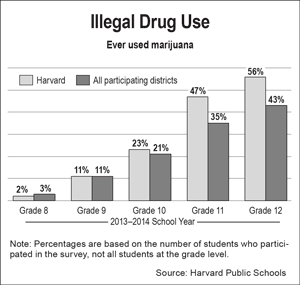
As with alcohol, Harvard students reported higher use of marijuana than students in other towns taking part in the survey. And the gap between use in Harvard and elsewhere grew wider grade by grade.
The big increase in marijuana use in Harvard appeared to take place between 10th grade, when 23 percent had tried it at one time or another, and 11th grade, when 47 percent—twice as many—had done so.
The figures for recent use showed an even steeper increase than those for lifetime use. About 12 percent of 2014 sophomores reported having used marijuana within the past month, while 30 percent of juniors and 38 percent of seniors did so.
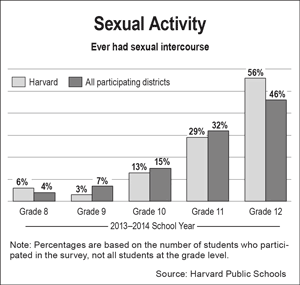
Sexual activity also increased by grade level, with 56 percent of Bromfield seniors in 2014 reporting they had engaged in sexual intercourse. But more important than the overall number, according to psychologist Downing, is that 11 percent reported having had four or more partners. At the same time, only 42 percent of 12th-graders had had a conversation with parents about the risk of AIDS.
‘Overlap’ areas are a special concern
“Parents need to be aware that their kids are exposed to, if not actually engaging in, these behaviors,” Downing said.
Downing was also particularly concerned about students who have overlapping areas of risk, such as binge drinking and engaging in sexual activity, or being bullied and thinking about suicide.
Downing said that families need to have conversations with their teens about what they will do in a range of situations: when they are at a party where their friends are drinking; when someone who has been drinking offers them a ride; when they feel pressured to do something that makes them uncomfortable. “We can help them think through their options,” she said.
Both O’Shea and Downing agreed that in general the numbers showed that Harvard students were comparable with those in the other districts that took part in the survey. But Downing emphasized, “It’s still important for parents to know … your kids are doing this! Don’t pretend it isn’t happening.”