
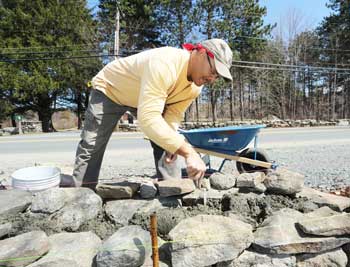
Bromfield graduate Joe Blue restores the wall along Mass. Ave. (Photos by Lisa Aciukewicz)
When stonemason Joe Blue was hired last summer to rebuild a section of the crumbling wall along Mass. Ave. in front of the library, it was much more than “a job” to him.
“Since I grew up in town, I definitely wanted to be part of that wall,” he said. Even more than that, it was a way for him to connect with his family artisans who are part of Harvard’s history and to “carry it on.” And he was anxious to replace the old wall with his clear vision for a more appropriate one: a wall that “fits into its country setting.”
Money for the work was appropriated in 2013 by Annual Town Meeting, which approved the Community Preservation Committee’s decision to allocate $55,000 for restoration of the wall, as requested by the Parks and Recreation Commission.
Starting with a ‘pilot’
Blue’s work started with a “pilot” to determine what kind of time, materials, and cost the restoration would actually involve. The test section was an almost 40-foot stretch of wall running north from the post at the driveway to Old Bromfield. Blue said that as he began the work, he found what he was hoping for. First, the base of the wall was undisturbed, so he could build up without having to do excavation work. Second, he was able to use almost all of the stones that came out of the wall, with only a small amount of new stone from salvage.
The old stones are New England granite fieldstones, with what Blue called “a nice blend of sizes and coloring.”
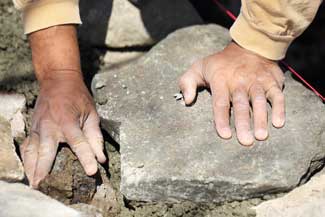
Joe Blue carefully nestles a stone into cement.
To fit Blue’s vision of a country wall, the reconstructed wall would be more “dry” than the old one, meaning it would have less mortar between the stones. There is still cement in the wall, but it is inside rather than outside the rock surface. This makes for a more natural-looking wall, which is what Blue wanted for the setting.
A wall with less cement is also easier to repair because if it’s hit—say by a snowplow—rather than cracking, the stones give way and can be reused. The wall is capped by granite slabs that will weather over time and look more natural. They are also more durable than concrete and will make for better sitting, he said.
Recently, Blue began working on the next stage of the project, starting at the other end by the driveway to the high school and working south. As with the first section, this part of the wall has a good footing. Blue said he was surprised at all the old wall is “giving up,” all the stones that are reusable. When this stretch of more than 120 feet is finished, about 200 feet of old wall will remain, a section that Blue said is in the worst shape of all. He said he has not heard what the plan is for that long stretch.
Patching hides its age
Blue said there is no way of knowing how old the wall is because it has been patched so many times. Rubble along the field side of the wall suggests that the wall may have been crude in the beginning. There is no evidence of a wall around the early mansion on the Bromfield site that burned in 1855. It’s possible the wall was constructed some 22 years later when Bromfield Academy was built.
Back in 1983, Blue started working with landscape architect Neil Jorgensen. He loved working outside and he liked working with stones. The more time he spent building stone walls, the more he came to realize what an art it is. And he also came to acknowledge that he has a gift for “seeing” how the stones need to go together.
A typical residential job, he said, starts with delivery of a pallet of stones. Then he starts visualizing, considering size, shape, and color and how it will all balance. “I just see it,” he said. He remarked that it makes all the difference to “work for people who appreciate what I do.”
It was only fairly recently that Blue discovered a reason why he took to stone work so readily and why he has been so successful. “It’s in my blood,” he said. When his father died, Blue started looking through some family history. He found a number of artisans among his ancestors and at least one relative who was a stonemason in Harvard. Knowing that, Blue feels a deeper connection to his art, he said, and it also makes this project more meaningful to him personally. Blue said he knew he had a gift for working with stone, and now he sees an explanation for it. “I’m born to stone,” he said with a smile.