In dogs as well as people and other animals, thyroid glands are located in the neck. There are two of them, one on each side of the trachea (windpipe). Their function is to produce hormones that have an effect on several organ systems. In cases of hypothyroidism, the thyroid glands shrink in size as the dog ages, resulting in inadequate amounts of thyroid hormone production and secretion.
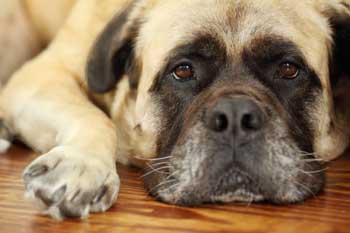
Lucy relaxes several weeks into thyroid treatment. (Photo by Lisa Aciukewicz)
Hypothyroidism usually occurs in middle-aged dogs. Medium and large breeds are more commonly affected, and certain breeds seem to have a higher incidence of the disease—golden retrievers, Doberman pinschers, Irish setters, and other larger breeds—but it can be seen in all breeds as well as in mixed-breed dogs.
The most common signs of decreased thyroid function reported by owners and seen on physical exams are thinning of the coat, most noticeably on the lower back, weight gain, a decreased energy level, and cold intolerance. Some dogs with this condition spend more time near wood stoves and heat registers. It is not uncommon for some dogs to have recurrent ear infections. Dilation of the esophagus (megaesophagus) and muscle weakness can also occur, but these symptoms are rare.
Diagnosing the condition
A definitive diagnosis is made by blood tests (blood counts and organ-function tests) and specific tests that measure the level of thyroid hormone in the blood. Sometimes the blood tests will show that the patient is anemic and has higher-than-normal levels of cholesterol.
Treatment is replacement thyroid hormone, in pill form, given once or twice daily for the remainder of the dog’s life. Usually a response is seen over four to six weeks. Owners see regrowth of fur and often comment about how much more energetic their dog has become.
Once again, our dog Lucy has a disease that serves as a topic for “Vetting It.” Lucy is a 6-year-old bull mastiff we adopted after she was abandoned in Fitchburg. Her nose and face are black, and the rest of her is fawn. She has the softest coat I have ever felt. She especially likes to be petted in the deep ridge between her beautiful, expressive brown eyes. She’s very shy with strangers, especially men. She very often doesn’t respond to commands and simply sits down and stares at us if it is something she’d rather not do, which is very frustrating at times. But she is really sweet, and we love her.
She has had surgery for torn ligaments (ruptured cruciates) on both knees as well as surgery on her left elbow for a bone chip (fragmented coronoid).
A unexpected clue
I wrote about her previously in an article about gastric torsion (commonly called bloat), which is a true surgical emergency. This twisting of her stomach and subsequent surgery occurred on Memorial Day 2014.
It was the slow regrowth of her fur following surgery that made me think she could have a thyroid condition, because after nine months, her fur still hadn’t regrown except for a few isolated tufts. She seemed otherwise healthy, though, so I hadn’t thought too much of it. To prep for gastric torsion surgery, the fur is clipped from above the sternum all the way to the groin. Typically, fur grows back in six to eight weeks after surgical procedures.
About a month ago, I was thinking about the lack of fur on her belly and recalled a lecture I’d attended where the speaker mentioned that delayed regrowth of fur may be an unusual sign of hypothyroidism. That is to say, slow regrowth of fur in a dog showing no other signs of the disease may be due to hypothyroidism.
Blood tests confirmed the diagnosis, and I started her on thyroid supplementation medication about three weeks ago. Although her fur isn’t back to normal, she has turned into a puppy. She is more playful, jumps on the bed, and is livelier.
Thinking about her in hindsight, she probably was a little less energetic than normal, judging by her energy level since taking thyroid medication. I may have mistakenly attributed this to her becoming an “only” dog after we had to put down our other dog, Becky, because of to cancer.
Unfortunately, she still sits and stares at us when asked to comply with simple commands.
Fred Karotkin is a veterinarian and former Harvard resident who now lives in Stonington, Connecticut.