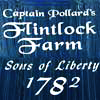

A sign on Still River Road announces the Pollard House. (Photos courtesy of Historic
New England unless otherwise noted.)
Early this month, the gray, gabled Pollard-Marshall House beside the giant sycamore on Still River Road became the first residence in Harvard to have its unique historical features—both inside and out—protected under a preservation restriction.
The house joins a select group of buildings. A March 3 vote by the Board of Selectmen allowed it to become part of Historic New England’s stewardship easement program. Only 95 properties in New England are registered in this program. These buildings remain private homes, unlike Historic New England’s more famous properties that are open to the public, such as the Codman Estate and the Gropius House in Lincoln.
Historic New England’s Joe Cornish called the Pollard House “a very intact and significant property” and said his group was happy to be involved in its preservation.
Cared for by generations
For a building well into its third century, the Pollard-Marshall House looks surprisingly youthful. Yet it was standing before George Washington became president, before the Constitution was written, perhaps before the Revolutionary War began.
With its Georgian-style symmetrical facade, the exterior of the house has altered little over the years. If its first owner, Captain Thaddeus Pollard, saw it today, he would find only slight modifications brought on by changing architectural styles, such as the addition of the gable during the Greek Revival period.

The Pollard House in the early 1900s. (Photo courtesy of the Harvard Historical Society)
Inside, Captain Pollard would still find door latches and hinges he forged by hand himself. (He was a prosperous blacksmith.) These latches are among the many features to be protected by the preservation restriction. The house’s 11 fireplaces, two colonial bake ovens, paneled doors, massive beams, and wide floorboards will also be protected in perpetuity.
Although the plaque on the Pollard-Marshall House says 1782, the exact date it was built is unknown. It was certainly there in 1782, as it is mentioned in the journal of Harvard Shaker Ahijah Worster. He writes that in that year he and other Shaker brethren were tied to the sycamore tree in front of Captain Thaddeus Pollard’s house and whipped harshly, in a violent display of religious intolerance.
That tree itself is believed to be about 400 years old, the fourth oldest sycamore in Massachusetts. So it was already substantial in the late 1700s, and the house must have been built deliberately in its shade.
A farming heritage
The Marshall family bought the house in 1869 and owned it for the next 85 years. Isaac Marshall was known as a scientific farmer of the mid-1800s, using commercial soil amendments and fertilizers to improve his crops.
Although the house remained virtually untouched over the centuries, the farmstead around it shrank as years went by. An 1864 deed described the property as “buildings and 90 acres,” with 15 of those acres across the road to the west. In 1954, Hortense (Marshall) Hull sold the farm, ending the Marshall family’s tenure there. At the time of that sale, the property comprised a little over 8 acres. Today the property covers about 16 acres, made up of two parcels.

The Pollard-Marshall house today, with its granite-block foundation and brick chimneys. (Photos courtesy of Historic New England).

The dining room shows some of the wood panelling that is a feature of the house.

An upstairs sleeping chamber.
John Harris, the Episcopal clergyman who lived in the house from 1959 to 1983, had a green thumb and worked hard at his garden, according to a contemporary newspaper article. He generously shared his harvest of fruits and vegetables with his neighbors.
Current owners Beth and Philip Wilson bought the property in 1994. They named it Flintlock Farm, partly in honor of Captain Pollard, who served in the Revolution. The flintlock musket was the most commonly used weapon of the era. The Wilsons’ passion for preserving history led to the creation of the Lost Arts Collaborative, a nonprofit entity to promote sustainable farming education and related life skills. Phil has offered courses on regenerative farming (farming practices that rebuild soil fertility).
Saving the barn
The Wilsons have also put a lot of time, energy, and money into preserving the 1830s barn next to the house. It is an example of the double-English style that came with the colonists from old England. Phil said it is also one of the earliest examples of a banked barn, meaning a barn built into a slope. Cattle and hay were brought in on the uphill side. Then manure could be pitched down into a wagon on the lower level and hauled away, saving effort for the farmer.
The Wilsons, who have lived in the house for more than 20 years now, began looking into preservation programs a couple of years ago. “We wanted to save our farmland,” Phil said. He said they were concerned that, if they sold the property, a developer might divide the acreage or even tear down the house.
The couple talked with several state agencies and preservation organizations. Eventually, they agreed that Historic New England (formerly called the Society for the Preservation of New England Antiquities) was the best fit for protecting the dwelling, the barn, and the land.
Taking this step was a major commitment for the Wilsons, as the preservation restriction limits potential buyers for the house to those who are also committed to preservation.
Three more in Harvard
Harvard Historical Commission Chairman Joe Theriault, who presented the project to the Board of Selectmen Feb. 24, said the new restriction affords the farm far more protection than being on the state and national registries of historic places, which he said are mainly honorary designations.
Theriault said that three other historical structures in Harvard are under preservation restrictions. None of them is a residence, however, and they are protected by a different organization. The Shaker stone barn on South Shaker Road, the Still River Baptist Meetinghouse that is home to the Harvard Historical Society, and Fruitlands Museum are all under historic preservation restrictions from the Massachusetts Historical Society.
Historic New England spent four days photographing the house and barn; the photos can be viewed through a link from the Harvard Historical Commission’s website.