Found money is almost always a good thing, but when that money belongs to an entire town, disagreements over how to use it are bound to erupt.
Such is the case for a recently discovered account containing about $120,000 that was returned to the town from a 2004 community development block grant program. Members of the Board of Selectmen and the Council on Aging disagree on whether to use the funds to lower the $1.26 million in excluded debt being requested for Hildreth House access, safety, and site improvements at Annual Town Meeting (Article 22) or for some other purpose. On March 17, the selectmen will hold a public hearing on the question.
Council on Aging weighs in
The Council on Aging (COA) became aware of the money last fall, and at a February 23 meeting discussed whether to request that at least some of the money be used for Hildreth House renovation, should voters approve funding for that project at Town Meeting. According to COA Co-Chairwoman Connie Larrabee, who was present, not everyone agreed on the best use of the money. Some members thought it should be used to help low-income homeowners with needed repairs, as the earlier block grant had done, and some felt it should be saved for when the town is looking to fund the proposed second phase of Hildreth House renovations. Several members said they felt rushed into a decision. When the discussion ended, members voted 4–3 against asking that the money be used to defray the cost of the project. Since that meeting, however, some members who voted against the request have said they are glad a hearing is being held to get public input.
Selectmen get wind of windfall
At the selectmen’s meeting the following night, Selectman Ken Swanton mentioned the funds during the board’s discussion of Article 22. He said he had spoken to Mark Southard, the deputy manager of the Department of Housing and Community Development, which oversees the block grant program. Southard said the funds could be used for Hildreth House renovation by simply holding a public hearing and by getting state approval.
CLICK IMAGE TO ENLARGE
Selectman Ron Ricci told the board that they should hold that hearing as quickly as possible, and Selectman Leo Blair agreed, saying that lowering the taxpayer bill for the renovation would help the article pass at Town Meeting. Swanton agreed, noting that $120,000 would lower the amount requested in Article 22 by about 10 percent.
But Selectwoman Lucy Wallace, who is the liaison to the COA, disagreed, saying that the board should be respectful of the issues raised during the COA’s discussion. As for the 10 percent cost reduction, the COA calculates that the requested $1.26 million in Article 22 would add about $55 to the average ($9,301) tax bill in the first year and less in subsequent years, so a 10 percent reduction would amount to only about $5 a year.

CLICK IMAGE TO ENLARGE
Board of Selectmen Chairman Stu Sklar sided with Wallace, saying the town should inform the public of the existence of the funds before a hearing is held. Finally, the board voted 3–2 to hold the public hearing on March 17. Sklar and Wallace voted nay. In the meantime, Swanton told the Press that he had received a letter from Southard approving the Hildreth House work as a qualified use for the funds, and that he will present that letter at the March 17 hearing, paving the way for the board to vote on releasing the funds for the Hildreth House project.
Where did the money come from?
The Community Development Block Grant (CDBG) Program uses funds from the U.S. Department of Housing and Urban Development to provide grants to qualifying small cities and towns for housing, community, and economic development projects. In 2004, Harvard teamed up with Lancaster, Sterling, and Lunenburg to apply for a CDBG grant for rehabilitation of low- and moderate-income housing. The grant was administered by the Montachusett Regional Planning Commission. Nine Harvard homeowners applied for the interest-free 15-year loans, which require repayment only if a homeowner sells his or her home before the 15 years are up. In that event, a payment equal to one-fifteenth of the total loan for each year shy of the 15-year end date is due immediately. Three Harvard grant recipients sold their houses before the 15-year deadline (which has not yet been reached), and the money returned after those sales amounted to about $120,000. Harvard received the money in 2012 from Lancaster, the lead town on the grant, and it has been in an interest-bearing restricted account since then.
What can the town use it for?
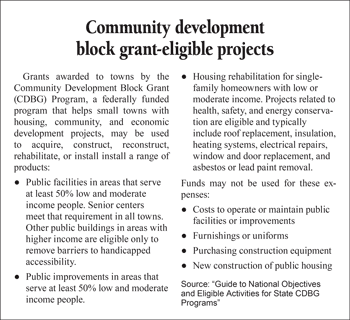
According to Town Planner Bill Scanlan, the grant money can be used only for CDBG-eligible projects such as public building repair or loans to low-income homeowners for repairs related to health and safety. (See sidebars.) The town is required to hold a public hearing and get approval from the state on how the money will be used. The selectmen must also vote to confirm that use. Scanlan said that the original program has ended and that using the money does not open up a new program, so once a project is approved as eligible, no additional paperwork or administration is required by the state. The Massachusetts Department of Community Development declined to speak to the Press when asked what the state administrative requirements would be if the funds were used for individual homeowner projects.
Administering the program
If a homeowner loan program can be administered by the town, some uses would require more administration than others. Scanlan said that a housing rehabilitation program, for example, would require income verification, application processing, and someone to make sure that the work being paid for is completed. Other uses, such as septic system repairs, would require fewer town resources, since those repairs are overseen by the Nashoba Associated Boards of Health. Harvard Board of Health clerk Paige O’Brien said that the recent septic system betterment loans administered by the Board of Health took up a “good chunk” of her time, but most of that time was spent dealing with state requirements for the loans, not with homeowner applications. If the funds are used for the Hildreth House renovation, no additional town administration would likely be necessary because strict oversight is already required for a public project. If the selectmen choose to allocate the funds for that renovation, they would vote to do so before Town Meeting in order to lower the excluded debt requested in Article 22. That decision is so far supported by Selectmen Blair, Swanton, and Ricci, who believe, as Blair said, “The lesser the amount requested, the greater the likelihood that it will pass.”