Parents whose children have missed more than 10 days of school at Bromfield this academic year may have been surprised recently to find a letter from Principal Jim O’Shea in their mailboxes, inviting them to meet with him to “jointly develop action steps to ensure your child’s attendance in the future.”
The reason is a change in Massachusetts law, effective July 1, 2014, that requires schools to notify parents when a child between six and 16 years of age has missed two or more class periods unexcused in five days, or five days unexcused in a school year. If statistics collected during the 2013–14 school year are any indication, the number of Bromfield upperclassmen in that category is likely to be high.
The new law gives schools three days to notify the parent or guardian. In addition, the amended statute requires a school’s principal to make a reasonable effort to meet with the parent or guardian of a student with five or more unexcused absences and to develop an “action plan.” In an email, Bromfield Principal Jim O’Shea said letters had gone out to the parents of 55 students at his school; letters have yet to be mailed to parents of elementary school children.
Policy changes?
“We’re a little behind,” School Superintendent Linda Dwight told School Committee members at their Jan. 23 meeting.
But the changes, she said, had “opened some questions” that her leadership team would be considering. At the top of her list is the need for a clearer definition—and perhaps some flexibility—in what is considered an excused absence. Also up for discussion are stiffer consequences for students whose number of unexcused absences is too high.
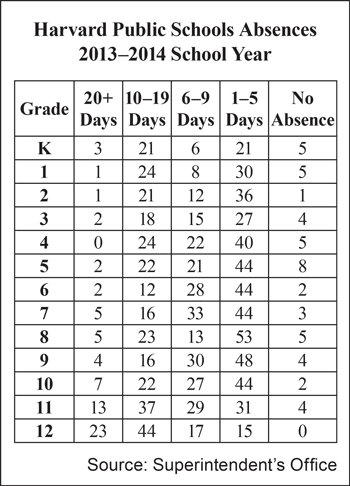
At the meeting, Dwight proposed two possible policy changes in addition to a stricter definition of an excused absence. One would be to make five days of unrestricted “vacation time” available during the school year that families could use at their discretion. School officials were shocked earlier this year when a review of excused and unexcused absences revealed that two-thirds of the class of 2014 had missed more than 10 days of school, and a quarter of the class had missed more than 20.
Excused absences
While each school district in the state is allowed to create its own definition of what constitutes an excused absence, Harvard’s are vague, said Dwight. Bromfield today allows absences for personal illness and medical appointments, a death in the family, religious holidays, and “absences which have been approved in advance by the principal or the associate principal,” according to the most recent Parent-Student Handbook.
Parents are asked to call the school when their child will be absent and to send a note upon the student’s return. Students absent for five days or longer require a doctor’s note. Students may also be excused from attending class while on a school field trip, participating in a school event, or attending an in-school meeting.
Committee member Bob Sullebarger wanted to know, “If a parent calls and says my child will not be in school today, that’s an excused absence?”
“Yes,” answered Dwight.
“So if I’m on vacation and I call you every day … ?” Sullebarger asked.
“If you say [your] child is sick, that’s excused,” answered Dwight. “That’s why we want to put a limit to that and say, if that goes beyond three days, there needs to be an accompanying note. Because we’re going to get up past five so fast with so many families [in Harvard] that we’re going to have a problem.”
Discretionary days
Dwight said that during her time as principal of Hildreth Elementary School she had observed instances “where a family would go on vacation with no prior notice to the teacher at all, hearing from another student that the student is in Florida or wherever.”
Still, family vacations and holidays are important to many households, Dwight said, and college visits are a necessary part of the junior and senior years at Bromfield. “There are [also] families who feel there is quite a bit of learning that happens outside of school.” One reason absenteeism has not been an issue for Harvard, she said, “is because we do perform very well. Students aren’t suffering. If you go to a low-performing school, the first thing you look at is attendance … [Here] it isn’t the case.”
Educational consequences
But Dwight and other members of the committee took note that high absentee rates had consequences for teachers and classmates as well as the away student.
“Schools of today aren’t like schools of yesterday,” said committee member Kirsten Wright. “[T]here’s group work, there’s a lot of discussion. It’s pretty rare that you see kids just sitting and working independently. If you have students … floating in and out of your class … or if you’re in a particular group and you can’t count on certain people being there, that’s kind of tough.”
Spending time helping a student make up for missed classes is also a “time-suck” for teachers, said Dwight, taking time away from planning and preparing for regular classes. “It is not an efficient use of time.”
While the availability of discretionary days might help lower the number of unexcused absences, Dwight said her team was considering a second policy change that would spell out consequences for students whose absences were excessive. One idea would be to penalize students who miss more than 10 percent of their classes in a subject by docking them one-half an academic credit. That percentage amounts to roughly 18 classes per year per subject. Students would need to make up the lost credit by attending summer school or by other means.
Next steps
Committee members voiced support for both proposals, though no vote was taken. Dwight’s leadership team of school principals and other administrators is reviewing its options and plans to recommend changes to school policy within the next few weeks.
At present, Dwight said, “There is no structure in place for how people report and what happens when they report, so it’s very loose. We have to get some different family understanding, and then we have to create structure … and then we need to blend them together in a positive way that benefits everyone.”