In January, local physician Patty Ruze traveled to Sierra Leone on a volunteer medical mission to the center of the Ebola outbreak. Dr. Ruze has been sending updates about her experience on assignment at the Maforki Ebola Treatment Unit in Port Loko. Last week, Dr. Ruze shared some firsthand experiences with patients. This week, she shows us what life outside the treatment unit is like for the volunteers working there.
The following piece was written in February, when Dr. Ruze was in the middle of her six-week assignment. She returned safely home on March 12. She says, “I’m happy to be back home with John, Nicky, Paul, and our dogs, Beni and Max. It is not true that I missed the entire winter! Thanks for saving some for me. I am in voluntary home self-surveillance. This means that I send twice-daily temperatures to my doctor as well as a video clip describing my health. I am permitted to go shopping, walking, and have visitors. However I am told not to attend any public gatherings nor ride on public transport.”
Shortly after her return to Massachusetts, 10 volunteers still in Sierra Leone were medically evacuated after they were believed to have been exposed in varying degrees to Ebola. One of Dr. Ruze’s volunteer colleagues was confirmed to have the disease. She writes, “I am deeply saddened by the illness of my friend and colleague at Partners In Health who was diagnosed with Ebola shortly after my departure. He is getting state-of-the-art care at the National Institutes of Health, and we are all hoping for a speedy recovery.”
I eat and sleep in an alternate universe called “Tent City.” It’s a small town built in just 10 days out of canvas, plywood, and PVC piping by the International Humanitarian Partnership. It provides housing for international Ebola volunteers and staff. The white canvas tents have individual “rooms” and much-appreciated air conditioning. There are flush toilets and a chef who prepares excellent Western-style food. I sleep on a clean cot in a comfortable sleeping bag liner.
The clientele includes development workers from almost everywhere in the world. We have plenty of North Americans and Danes, but also Ethiopians, Sierra Leoneans, and many other Africans. Several days ago I shared a drink with a UN worker from Serbia. In addition to the diversity of my neighbors, another great thing about Tent City is “La Vida Loko.”
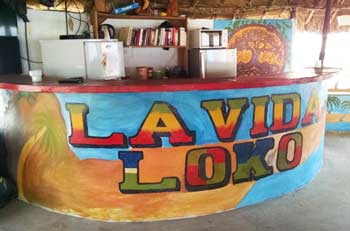
The social hub of Tent City, La Vida Loko. (Courtesy photo)
La Vida Loko is a one-room thatched cabana, the social hub of Tent City. They named it La Vida Loko only partially because of its location in the town of Port Loko. La Vida Loko serves as a dining area, conference hall, and movie theater. Mostly, however, La Vida Loko is a bar.
A missing stout
Most of us work long hours under difficult and uncomfortable conditions. To come “home” to a cold beer is pure pleasure. The shared refrigerators behind the bar at La Vida Loko sometimes make this a challenge. When I arrived, I was advised to label and date anything I put in the refrigerator. I quickly learned that this was no guarantee that my long-awaited cold beer or guava juice would be waiting for me at shift’s end.
When my first drink went missing, I supposed a case of mistaken identity, or perhaps blurred vision on the part of a thirsty Dane at a third beverage. My forgiving attitude deteriorated, however, when two special bottles of duty-free wine, still in their Brussels airport packaging, disappeared. The wine was intended for my birthday celebration and had been expensive, partly because of the importance of the occasion, but also because of my faulty math in converting euros to dollars.
Drinks in the shared refrigerator are now labeled with the owner’s name or warnings such as “don’t drink this” or “poison,” with a skull and crossbones. Some people wrap cans elaborately in multiple layers of plastic bags and medical tape in futile attempts to frustrate the thieves. Suspicious glares over dinner threaten international relations. After work, a few of us are resigned to stopping at the kiosks along the street to pick up a cold one from their beach coolers.
Striking a deal
My colleague, Nurse Becky, always the organizer, struck up a deal with a local woman selling her wares at the entrance to Tent City: “You get some cold beer for your cooler and I’ll buy one from you every night.” Becky is a solid citizen, true to her word, so even though some nights she didn’t want a beer, a deal was a deal. One evening she fished out a particularly icy stout from the bottom of the cooler, opened it up, and took her first sip before realizing that her colleague’s name, Dr. Quy, was written in permanent marker on the can. Assuming that Quy had “reserved” that particular beer for purchase from the street vendor, Becky stepped up to apologize. The two of them quickly realized that, in fact, Quy’s beer had been previously purchased by him, placed in the shared refrigerator and, somehow, had made its way back to the vendor’s cooler outside.
Making a living in Sierra Leone has always been hard, but since the start of the Ebola outbreak, economic life has deteriorated. The epidemic has created many young orphans and killed off many in service professions who were family breadwinners. My nurse colleagues make approximately 800,000 leones ($160) per month. Despite an outpouring of international support toward Ebola relief, many of them report no pay since December and erratic pay throughout the entire epidemic.
It is hard to come by post-Ebola economic statistics, but pre-Ebola things were already looking pretty bad. The United Nations Development Program reports that poverty remains widespread, with 60 percent of the population here living on less than $1.25 per day. A 2013 study reported youth unemployment at about 70 percent, the highest in sub-Saharan Africa.
This is certainly worth considering before complaining about a few missing beers. At least the mystery of the missing stout has been solved for now.