Most mammals, unlike humans, do not have the luxury of being able to conceive on a regular basis throughout the year. Their reproductive system is often regulated by lengthening daylight, which triggers hormonal activity that results in infrequent mating. The courtship and breeding behavior of different species of mammals has many similarities but also exhibits individualized rituals. During March, many of these rituals take place, revealing different species’ idiosyncratic traits.

An Eastern chipmunk. (Photos by Mary Holland)

The Virginia opossum has a forked penis (see inset).

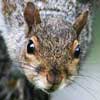
Eyeball to eyeball with a gray squirrel.
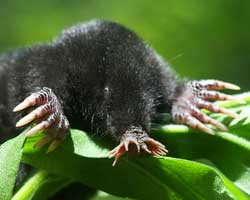
A star-nosed mole.
Eastern chipmunk
Eastern chipmunks breed twice a year, typically in March and in June. Males emerge from their winter torpor in search of receptive females, engaging in mock battles with any males whose paths they happen to cross. Females, emerging a few weeks after males, are in estrus for a few days or a week, but they are receptive for only seven hours. If approached before she is receptive, a female will drive off any male suitors. If a female is receptive, the courting male will trill and nudge her affectionately. His intentions are indicated by his up-and-down tail movements. At all other times, chipmunks move their tails only from side to side. Occasionally, several males pursue one female, and there is great pandemonium as they vie for her attention and madly chase her until one prevails. A female may mate 10 to 20 times within six to seven hours, not necessarily with the same male.
Virginia opossum
The peak of opossum breeding takes place in February and March. Physically, both male and female opossums have unusual anatomical reproductive traits. Males have a forked penis, and females have two uteruses and two vaginas. The female is receptive for about 36 hours every three to five days until she conceives. During this time, if she allows a male to mount her, they soon fall over together onto their right sides. It appears that this fall to the right is an integral part of their breeding process, as no sperm has been found inside a female when the two opossums failed to fall or fell to the left.
North American river otter
Otters have a prolonged breeding season, from December to April, but may only reproduce every two years in the northern part of their range. When a male and female pair up, they proceed to wrestle, mock fight, and chase each other in and out of the water. When he reaches her, the male, as is common with other members of the weasel family, grabs the back of the female’s neck with his teeth, often wounding her, while he proceeds to breed with her, usually in the water. Otters are what are called “induced ovulators”: if the female is sufficiently stimulated, the act of copulation releases an egg from her ovary.
Eastern gray squirrel
Most gray squirrels breed sometime between May and July, but some do breed at this time of year. Females are in estrus between eight and twelve hours, and during this time males gather from as far away as half a mile. The males are constantly fighting for dominance as they relentlessly chase the female. The most dominant males are closest to the female, and when she is ready to mate, the most dominant male approaches and copulation takes place. As an adaptation to assure the male’s paternity, his semen forms a gelatinous plug in her vagina that reduces the success rate of later matings and ensures that the first mating fertilizes most of her eggs. However, following copulation, both male and female squirrels typically clean their genital areas, and in so doing, the female usually removes the plug, occasionally eating it. So much for foolproof fatherhood.
Star-nosed moles
Beginning in late February, female star-nosed moles enter estrus repeatedly if they have not bred. Once mated, star-nosed moles share a breeding characteristic with eastern gray squirrels: the males leave a copulatory plug in the females after mating with them. Secretions from glands in the male moles create this plug, which prohibits other males from mating with the female.
Deer mice
Typically, the breeding of deer mice coincides with vegetation growth and insect activity. In the Northeast, mating takes place once a month from March to September. During years when the food supply is scarce, the fertility of both male and female mice is restricted. When food is adequate or ample, courtship takes place, with males and receptive females sniffing each other and often coming nose to nose. As their heads approach each other, they bring their noses and mouths together in a position called “kissing.” Gestures we would be tempted to call affectionate often follow; these include grooming, nibbling, and licking each other.
Fisher
March is the peak of the fisher breeding season, and this becomes very obvious to anyone looking for signs of this animal in the woods. Scent markings and tracks are everywhere, as males pursue females for miles around. Both males and females engage in scent marking with their urine and scat, and signs where they have rubbed on saplings are usually abundant. A male and female travel and interact together for a week or two prior to copulation. The male produces sperm only for about six weeks, and the female is in estrus for six to eight days. After fertilization, implantation of the egg is delayed until February the following year. Young are born in March, and three to nine days later breeding takes place.
While none of these examples is as dramatic as that of the fall-breeding male porcupine, which sprays his mate with urine before breeding with her, the courtship and mating behavior of every species of animal reveals individualized rituals and traits. Tail wagging, forked penises, falling to the right, biting, “kissing,” vaginal plugs, induced ovulation, delayed implantation, and pheromones all serve to make March a most unique month for mating.
Much of the information in this article came from Mark Elbroch and Kurt Rinehart’s Peterson Reference Guide, Behavior of North American Mammals.
Mary Holland is the author of “Naturally Curious: A Photo-graphic Field Guide and Month-by-Month Journey Through the Fields, Woods, and Marshes of New England”; “Milkweed Visitors”; “Ferdinand Fox’s First Summer”; and “The Beavers’ Busy Year.” The first of a series of children’s books about animal parts, “Animal Eyes,” was released last month. Holland has a natural history blog that can be found at www.naturallycuriouswithmaryholland.wordpress.com.