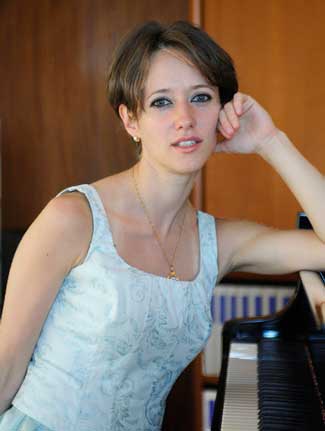
Sonya Ovrutsky Fensome. (Courtesy photo)
On Feb. 8 internationally acclaimed pianist and new Harvard resident Sonya Ovrutsky Fensome will perform a concert at the Chapman-Ruze home on Willow Road. The concert will benefit Fanfare, the organization that supports music programs at the Hildreth and Bromfield schools.
As a Julliard-trained pianist who has won many awards, Ovrutsky Fensome’s performance promises to impress seasoned classical music lovers as well as first-time listeners. But while she enjoys performing for all audience members, it is those less experienced listeners she really yearns to reach. “It’s much more interesting for me to see a person after a concert who has never heard classical music before and who changed his mind after listening. I want to make music a part of more people’s lives,” she says.
A lifework
Bringing music to people is a lifework for Ovrutsky Fensome. She began with performance, taking piano lessons early in life and experiencing early success; at the age of 15 she won the International Piano Competition in Senigalia, Italy. She credits her parents for her love of music. “My father was teaching me music even before I could realize I was taking lessons,” she says. “ It felt like he was just doing pretend with me. We sang, we danced, we named the notes, we named the rhythms.” She describes the playful approach her parents took to music as an excellent foundation for her later lessons. “By the time I started official piano lessons at the age of four, I was so prepared.”
Teaching and performing
Even as a young student, Ovrutsky Fensome was aware that teaching was an essential component of her musical studies. “Ever since I remember, whenever I’d learn something new, I felt in the back of my mind that I haven’t completely learned it unless I can actually explain it to someone else, how it’s done.” Ovrutsky Fensome understands the importance of a nurturing, passionate teacher to a student’s own enjoyment of music, and she tries to offer her students the same kind of joyful opportunities she had. As someone who was taught well and is deeply passionate, she feels, “It is my duty to pass on. They have to know how great music is!”
Ovrutsky Fensome has pursued her musical education duties as seriously as she has pursued her performance career. More than a decade ago, she opened a music school for children outside Philadelphia, called the Main Line Music Academy. As the founder of the school and its lead teacher, she says she “followed [her] intuition and sense” to create the music education program. Creating the music school was a lifelong dream, but a series of relocations required her to step back from the school, though she is proud that it continues to function well, independent of her leadership.
An affinity for Steinways
This fall her passion led her to a new teaching endeavor when she was named director of the Steinert Piano Academy in Natick. The impeccable quality of the Steinway pianos first attracted Ovrutsky Fensome to work with the company. Even before she was named director, she says she used to come to the showroom at the Natick Mall just to play. “I love Steinways,” she smiles. “What attracted me is you get to teach on the highest quality instruments. On a 6-foot concert grand, you can show all the nuances of what a piano can do. It is very rewarding.”
Ovrutsky Fensome especially identifies with the school’s mission “to make piano education available to everyone, regardless of what exact place music has in their life.” She believes in the idea that music education benefits everyone, not just professional musicians. “Lots of my students do not have plans to become professionals. They like doing it just for the sake of making beautiful sounds. I give my students skills and choices of how much, or how little, they are going to be involved in music and what they are going to get out of that.”
Her belief in the benefits of musical education led Ovrutsky Fensome to join the board at Fanfare. As a new board member, Ovrutsky Fensome works to promote music education as an integral component in helping students become well-rounded individuals. “It’s no secret that children equipped with musical knowledge and training do better in other subjects as well. We have to understand the tremendous benefit of music education brought to them right at their own school. That is why helping organizations such as Fanfare should be on our priority list—every parent, every music lover, every educator, everyone who believes in building a better future for our children.”
Start with something romantic
In her teaching, Ovrutsky Fensome often encounters students who are not familiar with classical music as a genre. She observes that these students might need to practice learning how to listen. She advises new listeners to start with something that sounds familiar and feels accessible. “Think of the movies. Start with something romantic and closer to Hollywood—Rachmaninoff, Tchaikovsky. Or, surprisingly, to J. S. Bach. Bach is timeless, genre-less. It would sound great on electric guitar.”
For the program on Feb. 8, Ovrutsky Fensome says all the pieces she has chosen are in some way inspired by dance. “Music was originally meant as an accompaniment to dance, but then it emerged and had a life of its own. How did that happen? For example, take Bach. I think about the dances for which it was created. People don’t dance like this anymore. But people still play Bach’s music. That is how universal it is, what a long life it can live.”
Tickets for the Feb. 8 performance are available to purchase on the Fanfare website, fanfareformusic.tix.com.