As part of a pilot program, all fifth-grade students at Hildreth Elementary started the academic year with a new piece of technology at their fingertips: iPads. After six months, the program has enhanced the fifth-grade curriculum, engaged students, taught them important life skills, and avoided the pitfalls about which many parents had concerns.
The program was born of a survey of Bromfield graduates showing that many of them believed Harvard schools had adequately prepared them for college academically but had not given them a strong foundation in technology. In pursuit of a more perfect education, fifth-grade teachers at Hildreth Elementary led the charge to better weave technology into the curriculum. Their tool of choice was iPads. Students, who have been using the iPads for group activities, writing and editing, presentations, research, and homework, are excited about the program.
Classroom successes
The benefits students and teachers see include better organizational skills, less paper use, easier research, more collaboration, easier editing, and more independence and personal responsibility.
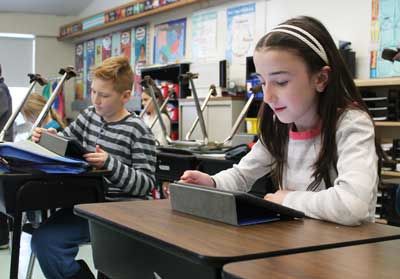
Logan Smith (left) and Megan Hoggins sync their iPads at the start of the day in Ms. Marya’s class. (Photo by Andrea D’Eramo)
Every day when students get to school, they sit down at their desks and sync their iPads. Their assignments are color-coded, showing whether they are complete, due soon, or off in the future. Parents can see this, too, to get an idea of how their kids are doing, explains fifth-grade teacher Sangita Marya. She says incorporating the iPads into the curriculum has been easier than she imagined. “Once you understand them and you dig into the programs, you start to realize how much they help you in school,” says fifth-grade student Fletcher Goodell.
Take writing and editing, for example. Marya has found Apple’s Siri speech recognition program to be one of the device’s most powerful tools. Students can have their work read out loud to them so they can hear their mistakes and edit their work. Research has also become easier with the iPads, she says, because students don’t have to leave the classroom.
An app called Go Math! walks students through any problem, explains fifth-grade student Analee Carroll. The app fosters independence and resourcefulness because it can help students try to solve their own problems before going to teachers for help. In fact, fifth-grade teacher Cynthia Ambrosino says her students are becoming more self-sufficient and capable because of her “Ask 3, then me” iPad policy, which encourages students to look to one another for help before going to the teacher. She says she’s seeing more collaboration and teamwork when her students use the iPads.
Sophie Thompson, a fifth-grade student, explained an app called Notability that organizes all their class notes into folders. She believes it’s helping her and her classmates be more organized because it’s almost impossible to lose notes.
Responsibility
The iPad program has also taught Harvard’s fifth-graders a great deal about personal responsibility and accountability. “At the beginning of the year, they had a lot to learn about digital citizenship,” says Hildreth Elementary School Principal Sue Frederick, “and all the students have to agree to terms.”
“There are expectations for us,” explains fifth-grade student Vera Soslavskiy. “We have to bring the iPads every day, they have to be fully charged, and there are restrictions on the Internet.”
“Plus, we have to report problems as soon as they happen so they don’t get worse,” adds Maddox Lizatte.
Also on the list of expectations: Students pledge to use their school email accounts only for positive communications about school-related topics; to surf the Internet only when instructed by a teacher to do so; and not to use the iPad in no-iPad zones, like the bus, hallways, cafeteria, and recess.
When a student fails to live up to the expectations, he or she gets an infraction. The school’s iPad policy dictates that after two infractions, students must meet with the administration; after three, students lose iPad privileges for two days. Having more than three infractions results in a meeting with the student’s parents and “possible loss of all iPad privileges.”
But most of the problems students have experienced haven’t been due to violation of expectations; rather, they are problems common to the majority of technology users. “One of the biggest challenges for the kids has been remembering their passcodes,” explains Marya. Another concern is simply protecting the technology from bumps and bruises.
“Nobody’s broken their iPad,” says fifth-grade teacher Rob Cullinane, “but they are insured.” And on top of the insurance purchased by the district, every student’s iPad has a protective case. “I took the case off to clean my iPad once and I realized the case was heavier than the iPad itself,” laughs Goodell.
Preparing for success
A large part of the success of the fifth-grade program is owing to the teachers, says Principal Frederick. “It’s been key for us and the program to have teachers who are ready and willing to learn how to use the technology.”
To prepare for the pilot year, fifth-grade teachers like Cullinane have been going to the iPad conference in Boston for the past three years. They’ve also taken a course called Google Infused Classroom and worked with teachers in Shrewsbury who already have an iPad program in place.
Shrewsbury’s iPad program has been around longer than Harvard’s, and it is distinctly different, says Ambrosino. For one, she explains, Harvard owns the iPads, which makes it much easier for teachers to maintain control and moderate their use. (Technically speaking, the school is renting the iPads, but it still maintains full control over the tablets.)
A cautious community
To alleviate parent concerns at the beginning of the program, key parts of Harvard’s roll-out plan called for starting gradually, learning from failure, and partnering with parents. Before the start of the year, before students were given their iPads, the fifth-grade team held a parent information and training session to teach iPad basics and address concerns. Part of the pilot program also includes surveying parents, teachers, and students three times throughout the first year.
“Many parents were concerned about screen time dramatically increasing, but it hasn’t much, if at all. Math is still on a worksheet, and most of their readings are in real books still,” says Marya. Cullinane adds that students are still welcome to complete assignments using pen and paper if that’s what they prefer.
The first survey was conducted in September, after only a month of iPad inclusion, but results pointed toward success. (Results of the survey can be found at https://sites.google.com/a/psharvard.org/hes-grade-5/ipad-1-world.)
The survey showed 78 percent of students said they use the iPad between 0 and 30 minutes at home every day.
Another parent concern had to do with device maintenance. “Our first concern was actually what if our child breaks it?” says Didi Chadran, father of fifth-grade student Bodhi Chadran. But he says his concern has been addressed by the school’s policies. “We’re quite pleased to see that the proper use, proper maintenance and care was being incorporated into the school curriculum. We were also glad to have an ally in the school system to teach our kids about safe use, safe practice, and self-restraint.”
Chadran is enthusiastic about his son’s future with the iPad program. “It has the potential to give him insights into how a computer is used in an academic setting—and by extension in a professional setting—and not just as a toy or gaming device,” he says.
Principal Frederick underscored the idea that an iPad is an educational tool. “We’re always making sure that we don’t have the iPads just for technology’s sake. We’re weaving them into the curriculum and making sure they enhance learning,” says Frederick. Her hope is that next year, the program will expand to include sixth-grade students, and from there, into grades 7 through 12.