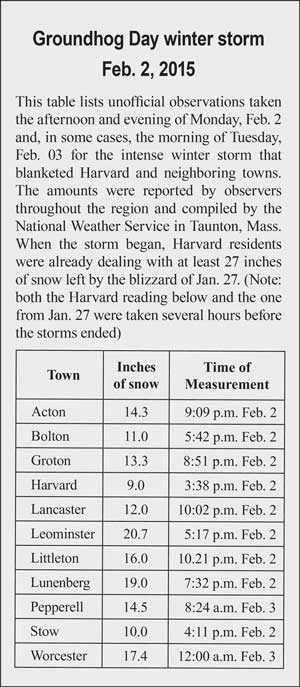
The record-breaking, back-to-back storms of the past 10 days left many Harvard residents in awe as first the historic blizzard of Jan. 27—dubbed Juno—and then a second major snowfall on Groundhog Day left as much as 55 inches of snow on Harvard roads, driveways, and parking lots. Both storms shut down the town for 24 hours. But within days, residents’ awe had given way in some quarters to disgruntlement.
Three days after the first storm, a passionate discussion of the town’s road-clearing efforts erupted online at Nextdoor Harvard, often comparing Harvard’s roads unfavorably to those in nearby towns. And Department of Public Works Director Rich Nota and Board of Selectmen Chairman Stu Sklar weighed in to defend the highway department’s work in dealing with the snow emergency, first online and later at Tuesday’s Feb. 3 Board of Selectmen meeting. They cited the magnitude of the storms and the department’s policies, manpower, and storm-disabled equipment to explain Harvard’s response.
Residents praise or fault DPW efforts
“The clear pavement was orders of magnitude better” in Ayer and Boxborough than in Harvard, one resident commented on Nextdoor Havard. Another lamented that plowing had been better in past years: “Other towns used to try to keep up with us,” he wrote.
Complaints focused on several problems: delays in clearing the roads; roads that were too narrow for cars to pass safely; snow mounds that blocked visibility at intersections; and the perennial issue of downed mailboxes. Some residents advocated the use of more salt to clear roads all the way down to pavement, rather than leaving a layer of snow.
A number of commenters rebutted the complaints, however. They praised the DPW for putting in long hours in the face of difficult conditions and described the low-salt policy as environmentally sound. “I think the roads in Harvard are fine,” one person wrote. Others pointed out that it is only reasonable to drive more slowly and take extra care after such a storm.
Selectman Stu Sklar wrote, “Given the scope of the storm, I’m very satisfied with the performance of the DPW. They deserve our appreciation for the hours they put in this week.”
DPW Director Rich Nota weighed in on the discussion several hours after it began. At that point, Nota wrote, DPW crews had been working for 72 hours. Town Administrator Tim Bragan later explained to the selectmen that the crews had had short rest periods for safety’s sake, but they had stayed on the job without going home the whole time.
Nota explained that Harvard is one of the few towns that does not hire outside subcontractors. “Although this cost-effective approach works well for us in most winter storms,” Nota wrote, “this record-breaking storm did overwhelm our plowing program.”
In a later conversation, Nota said that the decision to use subcontractors can’t be made on a storm-by-storm basis. Rather, the town would have to commit to using them for the full year. “You can’t just call them up when you need them,” he said, “or they’ll go elsewhere.”
In response to residents who asked for more salt on the roads, Nota said that Harvard has a low-salt policy to protect private wells from salt contamination. Ayer, for one, uses salt more extensively, but Ayer has a much larger public water supply.
Nota estimated that Harvard uses about half the salt of other communities nearby and that the savings to the town is about $50,000 a year.
How many trucks are enough?
The DPW generally sends out 11 or 12 pieces of equipment to deal with a big storm, Nota explained. Harvard has nine plow routes, so nine of the 10 full-time employees work on those routes, some in heavy trucks, some in lighter ones. The lighter trucks can’t plow the roads as widely as the big ones, so those routes have to be widened later.

The snowbanks dwarf the cars at this Oak Hill Road home. (Photos by Lisa Aciukewicz) MORE PHOTOS

Even the street signs seem to have surrendered. MORE PHOTOS
The 10th employee drives one of the DPW’s front-end loaders to assist the other crews with snow removal. A second loader stays at DPW headquarters, to be used by drivers as they come in to reload their trucks with sand-salt mix.
Nota also calls on one or two part-timers for help with severe snow and ice. Usually one driver clears the public safety parking lots so that police and fire vehicles are ready to go.
Storm damage
When the first storm began, five of the DPW’s six large trucks were up and running. (The sixth truck had a heater that didn’t work, making it impossible to keep the windshield clear of snow and ice.) By the time the second storm ended, Nota said, three of those six trucks were unusable, with a blown clutch, a broken axle, and frozen brake lines. One of the lighter trucks was out of service as well. “The big drifts took a toll on the trucks,” he explained.
Nota recounted these truck woes during a retrospective on the storm with the Board of Selectmen Tuesday evening. Selectwoman Lucy Wallace asked whether the disabled trucks could be repaired before the next predicted snowfall on Thursday. Nota said he believed that two of them could probably be fixed.
Selectman Ken Swanton recalled that the DPW will be asking Town Meeting for $175,000 for a new, heavy-weight truck. “The last 10 days have been a really good advertisement for that,” he said, drawing chuckles from other board members.
Wallace also asked whether snow fencing could cut down on the wind-blown drifts that have plagued roads near open fields. Nota responded that the fencing would barely be high enough to have any effect with snow this deep. While such fencing was popular in the 1960s and 1970s, he said, it is time-consuming and expensive to install; and the more powerful snowplows used today make it unnecessary.
‘We run very lean in this town’
All the selectmen expressed their gratitude to the DPW workers for their long hours under harsh conditions. Town Administrator Tim Bragan said that the DPW was also grateful to everyone who stayed off the roads so the crews could get their work done.
Still, the selectmen acknowledged that a number of residents had been dissatisfied with the pace of snow removal. “Despite everyone’s best efforts,” Selectman Ron Ricci said, “the roads are not where they should be.”
Nota admitted that the DPW program could always be strengthened. “We run very lean in this town,” he said. “It comes down to how much patience do people have. Other towns can do it quicker, but they spend twice as much.”