The blizzard that roared through town on Tuesday this week dumped more than 2 feet of fine, easy-to-shovel snow on Harvard and shut down most of its institutions, leaving a transformed landscape but little damage in its wake.
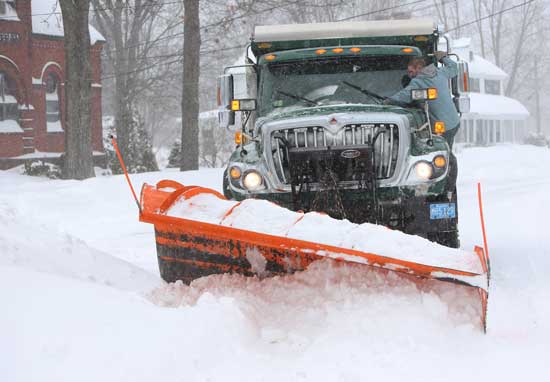
Ben Gilbert of the Harvard Department of Public Works clears the ice and snow off his wipers as he pauses from plowing Fairbank Street in the center of town. (Photos by Lisa Aciukewicz)
According to the National Weather Service, the official snow total for Harvard was 27 inches, though it was easy enough to find 3-foot drifts or, as an Old Littleton Road resident reported, even an occasional spot of bare ground. Early Wednesday morning, NWS announced that the storm had broken Worcester’s 18-year-old all-time record with a snowfall total of 34.5 inches.
Unlike the Halloween storm of October 2011 that left residents without electricity for days, there were no reported outages in Harvard at any time during the storm, according to a National Grid web page that tracked such problems. Cities and towns in Worcester and neighboring Middlesex counties were virtually incident-free, unlike Nantucket and Gloucester where most of the state’s outages occurred.
Town prepares for worst
As the storm approached on Monday, the town started to shut down. Shortly before noon, Massachusetts Governor Charlie Baker declared a state of emergency and signed an executive order banning nonessential travel after midnight. Harvard’s emergency management team, chaired by Fire Chief Rick Sicard, met at 1 p.m. and declared a street parking ban throughout Harvard, effective at 10 p.m. that night.
The fire, police, highway, and ambulance services implemented staffing plans to provide 24-hour coverage and discussed how they would handle emergencies. In case of a fire or a medical emergency in a home, the DPW crews were prepared to drop what they were doing and assist emergency personnel in reaching the house. Fortunately, according to Police Chief Ed Denmark, the need did not arise.
The schools, Town Hall, the library, the Council on Aging, and even the General Store announced they would be closed on Tuesday.
All five members of the Board of Selectmen—plus Chairman Stu Sklar’s pug and boxer—met briefly in the Town Hall meeting room at 4 p.m. to declare a state of emergency for Harvard. Such a declaration allows a town to more easily purchase supplies that would otherwise be subject to state procurement rules.
Workers and volunteers get ready
With the state of emergency in place, the town was “on autopilot,” Town Administrator Tim Bragan told the Press. Messages were posted on the town website, Nextdoor Harvard, and on the Harvard Press Facebook page. Residents were urged to sign up for Connect Cty to receive emergency messages on their phones, should the power fail.

With multiple vehicles plowing, Ayer Road is passable but narrow Tuesday morning.
As the storm gathered force Monday evening, a group of workers met at the DPW headquarters next to the Transfer Station, getting ready for what they expected to be a long night. Ron Gilbert, the foreman, was on duty. So was a group of young men who laughingly identified themselves as “the Finnish crew,” the Ammesmaki brothers (Nick and Ryan) and Craig Tiilikkala. The group was expecting more DPW personnel to appear at any minute.
Asked how long they expected to work, Nick Ammesmaki said, “We’ll stay all the way through.”
A little later several members of the DPW crew stopped by the General Store to fuel up on coffee while waiting for the snow to start. The coffee was “on the house.”
The DPW was well supplied with salt and sand, having a half-shed full of salt and a shed full of sand, according to the group waiting to start work. The DPW had also restocked the pile of sand available to residents. Still River Depot Road resident Lorin Johnson was already there, shoveling sand onto the back of one of his trucks. “This is for weight,” he said, explaining that this truck was lighter than the one he usually used for plowing.
On Tuesday morning the town awoke to silence. A fine, almost fog-like snow fell steadily. There was little buildup on tree limbs or power lines. There was no sound of generators. Only the roar of an occasional town plow broke the spell. With both electricity and the Internet available, residents could stay inside and let road crews get on with their plowing.
Predawn hours the worst
According to plow driver Ben Gilbert, who spoke with Press photographer Lisa Aciukewicz on Tuesday morning, the crew began work around midnight and had been plowing continuously since then.
Gilbert told Aciukewicz that 3 to 7 a.m. had been the hardest as the snow was falling quickly and visibility was very poor. He said the town had nine plows out, basically all of its working equipment. One of the plows was sidelined early on after its heating system quit. Without heat, there’s no way to keep the windshield clear, Gilbert said. The DPW crew was joined for part of the day by Bragan and DPW Director Rich Nota, who took turns operating plows.

Icicles hang from a roof on Depot Road.
By Tuesday evening the worst of the storm had passed, though parts of town received another 2 to 6 inches overnight. The state lifted its travel ban at midnight. By Wednesday morning, town offices and the General Store were once again open. The schools remained closed until Thursday, as did the COA. The library, which had not yet been plowed, opened briefly, then closed. Librarian Mary Wilson said she expected the building to get back on regular hours by Thursday.
Looking back at the storm on Wednesday morning, Denmark said the town had come through it pretty well. “The utilities did a good job at preparing,” he said, citing tree trimming over the past months to protect power lines. “And we’ve been through this several times now, so people are personally well prepared to deal with it.”
Lingering safety concerns
Denmark said that the parking ban in Harvard would remain in effect until the DPW finishes clearing the roads.
Denmark has two big safety concerns now, he said. The first is poor visibility for drivers at intersections, because of the towering mounds of snow at almost every corner. The second is the danger to people who stand at the edge of the road in a misguided effort to prevent snowplows from heaping snow at the ends of their driveways.