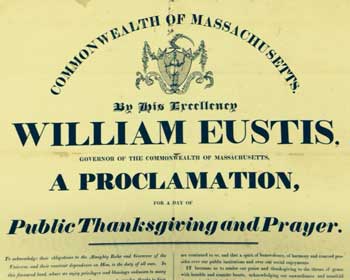
An 1820 proclamation shows that states set their own thanksgiving days, as had earlier colonies.
(Photo courtesy of Harvard Historical Society))
One day last summer at Fruitlands farmhouse, where I work as an interpreter, I noticed one woman in particular who was listening to me with rapt attention. As she was leaving, she looked at me directly. “You are so historical,” she said and walked out. I’ve been trying ever since to put a positive spin on her comment.
I do have an interest in history, and, given the time of year, this led me to wonder about Thanksgivings past and how they were celebrated, starting with the first Thanksgiving. I think I knew this in third grade, but that was a long time ago so I was grateful for Google.
Though not without dispute, the first Thanksgiving is generally reported to have been held in November of 1621, when the 53 (out of 100) surviving Pilgrims at Plymouth invited their Wampanoag neighbors to a three-day celebration of the autumn harvest. The four surviving adult women were in charge of the cooking. (I’m thankful for women’s lib.)
A fowl mission
According to an account by Plymouth resident Edward Winslow, Governor Bradford sent four men on “a fowling mission” for the event. Wild turkey was plentiful, but it is likely other birds were served as well, such as ducks, geese, and swans. There would not have been bread stuffing, but instead, a stuffing of herbs, onions, and nuts. The Wampanoags brought five deer, which they roasted on a spit over a smoldering fire. There was no doubt seafood—mussels, lobster, bass, clams, and oysters.
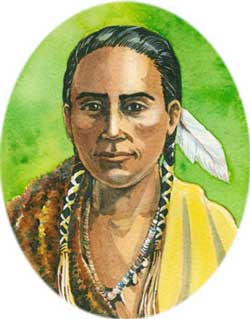
Squanto was a Patuxet Indian who taught the Pilgrims how to catch eels. (Courtesy photo)
Eels were likely on the table at that first Thanksgiving. Squanto, a Patuxet Indian who knew English, had taught the Pilgrims how to catch eels. Winslow wrote that Squanto had once brought as many eels, “fat and sweet,” as he could lift with his hand. “He trod them out with his feet and so caught them with his hands without any other instrument.” Winslow points out that eels proved essential to the survival of the Pilgrims.
Although I can cite no written evidence, I believe that eels, like many other fish, were plentiful in the Nashua River and that they graced many a Thanksgiving table in Harvard during the last centuries. Eels were caught with a fork-like spear that pinned the eel between its tines. A tall wicker basket held the captured fish. Fruitlands Museum displays such a spear and basket on the porch of the farmhouse. (I would not have been thankful for eels.)
The Pilgrims would have had onions, beans, lettuce, spinach, cabbage, squash, carrots, and perhaps peas. Corn would have been served, but in a rich mush, like a porridge, perhaps sweetened with molasses. Alas, there were no mashed potatoes.
No cranberries
They would have had fruits—blueberries, plums, grapes, gooseberries, and raspberries—but they would not have eaten cranberries. While the Indians used cranberries for dye, there was no sugar available to sweeten the tart fruit for eating. It would be 50 years before cranberry sauce or relish would be on the table. And pies, so much a part of later holidays, would not have been part of the first Thanksgiving. After that first year, there was no butter or wheat flour left with which to make a crust. And there was no oven for baking. (I’m grateful for pies.)
This first Thanksgiving day was followed by other days of thanksgiving, held on various days of the year in different colonies. George Washington declared a thanksgiving day in December of 1777 in celebration of the defeat of the British at Saratoga, and other presidents proclaimed days of thanksgiving. But it wasn’t until 1863 that President Lincoln declared Thanksgiving a national holiday, to be held on the last Thursday in November.
It’s hard not to see modern parallels in the political bickering that arose in 1939 over the date for Thanksgiving. November had five Thursdays that year. Because the nation was still suffering from the Great Depression, Franklin Roosevelt moved Thanksgiving to the fourth Thursday of the month to allow one more week for merchants to profit from Christmas shoppers. This added week would have been especially important back then since commercial advertising for Christmas before Thanksgiving was deemed inappropriate. (So thankful if that were still true!)
Two holidays, then one
Republicans denounced the change of date, calling it an affront to the memory of Lincoln. November 30 became referred to as the Republican Thanksgiving and November 23 as the Democratic Thanksgiving or “Franksgiving.” As the president’s decision could not be enforced, 23 states chose to celebrate Thanksgiving on November 23, and 22 chose November 30. Texas took both Thursdays as government holidays. (Grateful not to be a Texan.) In 1941 it became federal law that Thanksgiving be held the fourth Thursday of November.
I wanted to find out about Thanksgiving in Harvard in the last centuries, but I could find only one source: the diaries of Still River resident Louisa Bateman from the mid-1800s. Historical Society board member Tammy Alfano sent me pertinent excerpts. (The Bateman diaries, purchased by HHS two years ago, are being transcribed by volunteers. If interested, contact tammyalfano@charter.net)
Louisa’s entry from Dec. 7, 1865 leaves me thinking that Lincoln’s proclamation had not yet taken hold. She writes: “Thanksgiving. Snowing fast. All the family went to father’s.” Two years later, Thanksgiving seems to have been observed on the fourth Thursday of November, but in 1869 it was November 18. From then on, Louisa’s entries show Thanksgiving on a date that seems clearly to have been the fourth Thursday.
Invariably, Louisa’s entries in the week leading to Thanksgiving are about making pies. Although she talks about squash, apple, and pumpkin, the mince pie is the most often mentioned. Dating to the 13th century when Crusaders brought back Middle Eastern recipes containing meats, fruit, and spices, the minced meat pie was popular in England. The Victorian recipe called for a sweeter filling, the addition of distilled spirits, and often the omission of meat, making the mince pie more of a dessert. One can well understand that Louisa had to start days in advance to mince dried fruits and peels and allow time for the spirits to work their fermentation.
Though she is still making mince pies in 1882, Louisa has added a ribbon cake to the desserts. She mentions stuffing a chicken a couple of times, and once a turkey. In the midst of her preparations in 1886, Louisa writes that she went to Clinton in p.m. “and got my tooth put in that came out.”
The weather, then as now, was a topic of importance. On the 11 Thanksgivings between 1865 and 1882 represented in the excerpts I read, it snowed four times and rained five on the day itself or a day or so before. It was never sunny and pleasant on Thanksgiving day in those years.
Though a few times Louisa writes that she stayed at home with “no one here but our own family,” more often there was company and even more frequently “all the family [was] at father’s.” In addition to being a day to spend with family and friends, Thanksgiving seems to have been a popular day to get married. Louisa mentions three different weddings in these 11 entries.
Here is where that woman visitor to Fruitlands would find me over-the-top “historical”: I was delighted to read that two of the weddings involved people I “knew.” In 1865 Alfred Haskell married Jane Tracy. I know Haskell because at the age of 13 he officiated at the mock wedding between his playmates, 11-year-old Louisa May Alcott and Walter Gardner, who were neighbors for several months when the Alcotts rented Brick Ends in Still River after leaving Fruitlands. On Thanksgiving 1888 Arthur Turner was married. I “met” Arthur recently because he played the drum in the Harvard Cornet Band. Often, I’m thankful to be “historical.”