Beavers, as ecosystem engineers, are one, if not the only, species capable of changing the geological, chemical, and biological properties of the landscape to suit their needs. These changes lead to greater plant and animal diversity.. (Photos by Mary Holland)
Wetlands are crucial—roughly 85 percent of all native North American wildlife relies on them—and throughout most of North America wetlands are highly correlated with beavers. Before the European settlement of North America, beavers numbered between 60 and 400 million. The estimated number of beaver ponds at that time ranged from a low of 15 million to a high of 250 million. According to biologist Thomas Slabe, beaver wetlands at that time could easily have covered more than 85,000 square miles, a combined area equal to Lakes Superior, Huron, Michigan, and Ontario.
When the beaver population plummeted (because of the fur trade) in the 18th and 19th centuries, the number of beaver wetlands did as well. Today beavers number around 6 to 12 million, and the number of ponds is estimated to be between 1.5 and 7.7 million.
This reduction has had an enormous impact on the flora and fauna in and around these wetlands, changing the distribution and abundance of many plants and animals.
Vegetation
Studies have shown that by increasing the diversity of habitats, beavers increase the number of species of herbaceous plants. By expanding wetland habitat, beavers provide an ecological opportunity for new plant species. The riparian vegetation, that which is next to the pond, not only increases in number of species, but the vegetation becomes denser as a result of beaver activity.
When the beaver pond is created, water covers the roots of trees that formerly stood along the stream bank as well as farther into the woods. This eventually kills the trees that remain for years as standing snags in the pond. These snags provide habitat for birds, insects, and mammals.
Foraging by beavers can significantly alter nearby forest composition and plant succession. Beavers select certain species of trees (alder, willow, birch) for their bark (and subsequent building material). The succession of plants that would have taken place in this forest is altered by their selection, and the woods may be dominated by different species of trees (often conifers) than existed before the beaver pond was created. In the gaps left by the harvested trees, new species of bushes and saplings that require lots of sunlight establish themselves, attracting new species of wildlife.
When beavers abandon a pond because they have exhausted the available sources of food, a new habitat is created. What once, prior to beaver habitation, was a shaded forest stream becomes a flat, open beaver meadow of grasses and sedges growing in rich soil. Eventually species of trees tolerant of moist soil and full sun, such as birches and poplars, will move in, to be replaced by shade-tolerant species.
Insects
A beaver dam slows the current of a stream and increases deposition of nutrient-rich sediment and organic material in the water. This plays a key role in the development of insect life. The variety and density of species increases, providing more food for fish, birds, and mammals.
Although one would think that the presence of a beaver pond might increase the number of mosquito larvae, it actually reduces the mosquito population. Conditions are right for some species of mosquitoes, but not for others. One of the species most associated with West Nile virus, for instance, cannot survive in the permanent water of a beaver pond.
Fish
As one would expect, there is a shift in fish species, just as there is in insect species, as the rapidly flowing stream is converted to the stillness and increased warmth of a pond. Studies have shown that fish species variety increases with the size of a pond, but very small beaver ponds can have higher than expected richness compared to ponds of a similar size not impounded by beaver dams.
Contrary to popular belief, beaver ponds have a beneficial effect on trout and salmon populations. Loss of beaver ponds is correlated with a significant reduction in salmon production. Beaver dams are typically not barriers to fish—they find ways of passing through them, except when stream levels are very low.
While it is true that the increased temperature of beaver ponds may render them intolerable to trout, a study of the thermal effects of beaver dams found no consistent relationship between size or number of beaver ponds and degree of downstream warming. Large ponds may act as thermal buffers, decreasing daily fluctuations in water temperature and only slightly raising downstream temperatures. The practice of removing dams to benefit the trout may actually have negative consequences on trout populations, as it results in fewer invertebrates.

Painted turtles enjoy the sun’s warmth.
Amphibians and reptiles
Beaver ponds create an ideal habitat for amphibians. Reptiles also fare well in beaver ponds, especially older ponds. There is greater species diversity of snakes and turtles in older ponds than in younger ones, but even younger beaver ponds usually have more species than do undammed streams.
Mammals
A wide variety and number of mammals use the lush vegetation around beaver ponds as food and cover. An increased production of woody plants (vigorous shoot growth at beaver-cut stumps) and aquatic vegetation attracts browsing moose and deer. Water-loving muskrats, otters, raccoons, and mink frequent beaver ponds for food and shelter.
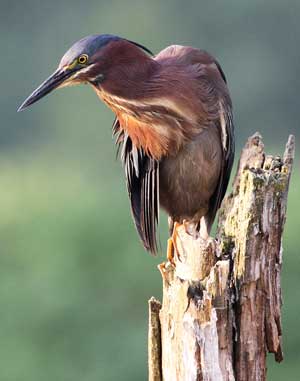
A green heron looks for food.
Birds
The creation of an aquatic habitat necessarily will attract different species of birds than a forest habitat does. Significantly more bird species and a greater average number of bird species have been found at active beaver ponds than at abandoned beaver ponds and control sites with no history of beaver occupation. Waterfowl use beaver ponds for nesting and rearing young, as well as stopover sites during migration. The rich invertebrate population contributes to the success of many birds that nest in wetlands, including mergansers, red-winged blackbirds, flycatchers, common snipe, spotted sandpipers, and American kestrels. Standing dead trees provide nest sites for woodpeckers, whose cavities in turn provide nest sites for other birds, including wood ducks, tree swallows, and American kestrels. The vegetative growth that occurs as a result of beaver foraging is also preferred habitat for many breeding birds, and the surface of a beaver lodge is known to be preferred nesting habitat for Canada geese.
Humans may disagree about the advantages and disadvantages of having beavers as neighbors, but there is no disputing the fact that beavers play an important role in preserving biological diversity. From 1780 to 1980, wetland loss occurred at a rate of 60 acres per hour. The U.S. Fish and Wildlife Service reports that this has slowed considerably, but even so, wetlands are particularly vulnerable to loss and degradation. More beaver ponds means greater diversity of both plants and animals, and greater species diversity ensures natural sustainability for all life forms.
Mary Holland is the author of “Naturally Curious: A Photographic Field Guide and Month-by-Month Journey Through the Fields, Woods, and Marshes of New England,” “Milkweed Visitors,” “Ferdinand Fox’s First Summer,” and “The Beavers’ Busy Year.” Her next children’s book, “Animal Eyes,” is due out in the fall. Mary has a natural history blog that can be found at www.naturallycuriouswithmaryholland.wordpress.com.