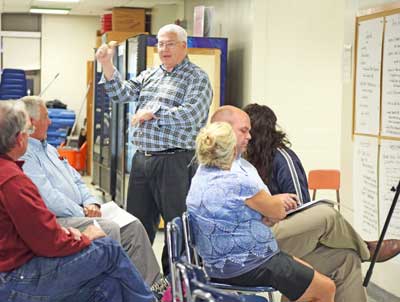
Harbor Master Bob O’Shea addresses citizens at a forum in the Bromfield cafeteria, Sept. 22. (Photo by Lisa Aciukewicz)
Residents who followed the contentious negotiations between the Bare Hill Rowing Association, the selectmen, and the Parks and Recreation Commission this summer over use of the town beach were treated to a refreshingly different perspective last week, one best characterized, perhaps, as a dip in the pond.
The occasion was a first-ever harbor master’s forum, sponsored by the Bare Hill Pond Watershed Management Committee. The meeting was held at the Bromfield School cafeteria on Monday evening, Sept. 22, and attended by more than 50 pond abutters, beach staff, rowers, boaters, town officials, and other interested parties. The meeting lasted nearly three hours, but this time the focus was not on the crew dock, beach parking, or boat storage, but on the activities of boaters and swimmers on the open water. And clearly what preoccupied attendees was concern over what abutters perceive as excessive noise when rowers are on the water and the danger posed by the proximity of crew shells, canoes, kayaks, and power boats during certain times of the day.
Applause for a well-led meeting
The meeting was led by Harvard Harbor Master Bob O’Shea, who received a round of applause when the meeting adjourned right on time shortly before 10 p.m. O’Shea had come prepared with enlarged maps of the pond, a tablecloth-sized matrix of state and town laws, handouts, colored post-it notes, and his own guidelines for maintaining civil discourse. Among his rules: topics other than water safety or the shared use of the pond would be noted on a post-it and sent to “the parking lot,” a blank sheet of paper he had hung to the right of his other presentation materials. To avoid beating an issue to death, he insisted that any topic discussed more than three times would be off-limits for the rest of the forum.
In his opening presentation of state and town bylaws, O’Shea said most of his powers derive from a state law that requires “anything that goes into the water” to have a permit, “whether it’s a dock or any boat over 14 feet long.” O’Shea issues his permits on behalf of the state, and by attaching his own conditions, he can exert control over certain aspects of use, and could implement changes that the town might be reluctant to pursue through changes to its bylaws.
Everybody has a right of access
“Because it’s a great pond, everybody in the state has access if they can get somebody to let them through,” said O’Shea. “You have to get a landowner’s permission to cross the land. But once you do, everybody in the state can be out on the water.” Most land abutting the pond is privately owned. But the town beach and Thurston Cove are owned by the town of Harvard. By regulating such matters as the hours the beach is open, the number of boats permitted to launch, and the amount of parking available, Harvard is able to prevent overuse. But these are not matters that O’Shea controls.
However, the town does need a permit from O’Shea to put its docks, swim lines, and other beach paraphernalia into the water. The current permit expired June 17, 2014. It allowed a maximum of 62 berths at the town dock and a maximum of 24 ski boats in those berths. It also limited the number of water ski boats that can be launched from the town ramp at the beach to six boats per day.
The town itself, O’Shea explained, is allowed to regulate certain other aspects of a pond, such as maximum allowable boat speed and direction of travel. This is done through its town bylaw, which was passed at Town Meeting by a near-unanimous vote in 2002.
Noise and safety are big issues
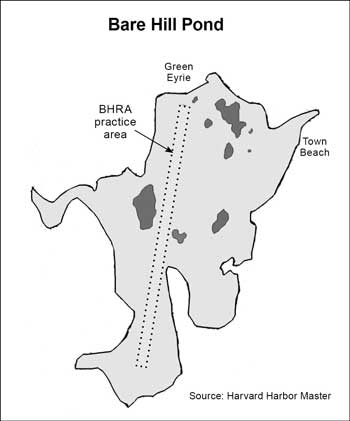
It was noise and the risk to safety of too many boats on the pond that were on the minds of attendees. The use of megaphones by the crew team during early morning training sessions this spring and summer brought repeated complaints from those living near the pond. The topography of the pond and its varying depth have forced crew to do much of its training in a narrow 1,500-meter channel that stretches from the northern to southern ends of lake. Because the crew boats tend to congregate at each end of the channel after a practice run and because the summer crew program has traditionally started at 7 a.m., homes located near Shoreline Drive and Turner Lane have been subject to the greatest early morning disruption.
The town has no noise bylaw, O’Shea noted, and the noise problem was one that needed to be worked out between residents and the BHRA, he said. But during a later give-and-take, it seemed that a technical solution might be available in which megaphones could be replaced by walkie-talkies that broadcast to speakers in the boats themselves.
The other major issue raised at the meeting was the potential for accidents between power boats and crews and other wind- or human-powered boats when they are traveling in the same section of the pond. The problem is not unique to the rowers; “learn to” programs run by Parks and Rec after 10 a.m. also run the risk of collisions with other craft. Bill Johnson of Warren Avenue suggested that perhaps the simplest solution would be to separate lake use by the hour of day. Assuming the noise problem could be solved, he said, why not move all crew training and “learn to” programs to to the 7 a.m. to 10 a.m. slot and leave the pond open for everyone else after 10 a.m. Steve Gordon observed that this would conflict with BHRA’s desire to expand its training hours until noon in the summer.
A call for conversation and closure
“I don’t think we’re going to reach closure on any of these issues tonight,” said pond committee Chairman Bruce Leicher. He suggested a followup meeting in January. But he encouraged the various stakeholders at the meeting to begin talking with each other and come up with some proposals. “After you’ve had a chance to have those conversations, we might be able to come to some solutions,” Leicher continued, “because I don’t know how you’re going to determine your next steps if we don’t bring people back after they talk and say what’re we’re going to do.”
The discussion throughout the evening was civil and not without a few laughs. The loudest came when Mike Taylor asked, “ I’m thinking of getting a sea plane. Where can I land that?”
“Don’t laugh,” said O’Shea. “It’s been done.”