Responding to remarks made recently by Finance Committee Chairwoman Alice von Loesecke, Board of Selectman Chairman Stu Sklar said last week that he doubts the town could get by without an annual 2½ percent increase in property taxes to fund the town’s omnibus budget.
“At some point, we need the state to step up to the plate. The state formula for aid is broken. “
—Stu Sklar, Board of Selectmen
“It’s not a view I share,” Sklar said, reacting to an assertion by von Loesecke that Harvard’s longstanding practice of increasing the property tax levy by 2½ percent annually to fund town operations is not sustainable.
As reported in the Sept. 26 edition of the Press, von Loesecke suggested last month during a Finance Committee meeting that the town needs to find ways to keep annual budget increases under 2½ percent unless new sources of revenue are found. Rising property taxes, she said, could ultimately price many people out of town.
Town operations and expenses such as debt repayments are primarily funded with revenues from local property taxes, with state aid making up the second largest source of town funding.
Revenue is the problem
In an Oct. 7 interview Sklar maintained that given cuts in state aid in recent years and rising costs of debt service, health care, retirement benefits, education, and other expenses, even a 2 ½ percent annual increase in the omnibus budget may not be sufficient.
“We have a revenue problem, not a spending problem,” he said. “We don’t spend more than we have to spend.”
During their September meeting, Finance Committee members discussed a Harvard Press projection showing the average property tax bill increasing by more than 64 percent over the next 20 years. The Press later refined and updated the projection, which now shows the average Harvard property tax bill rising from $9,341 in fiscal 2014 to $15,376 in fiscal 2036, an average increase of about 2.3 percent per year. The paper’s projection is based, in part, on an assumption that the automatic 2.5 percent increase in the tax levy will continue to fund both town operations and debt payments for the next 20 years.
No room to cut
In the interview, Sklar maintained that there isn’t much room in the town budget to make cuts and says that “a lot of the budget is pre-ordained,” meaning costs are built into it that cannot be changed. Those costs include town employee retirement benefits and health care and principal and interest payments on town debt.
“Looking at spending and capital needs over a longer term than we have in the past (10 years instead of five years) is a good thing to do.”
—Alice Von Loesceke
Finance Committee
Sklar also argued that Harvard is well managed and doesn’t “spend extravagantly.” He pointed out that the town has not authorized a Proposition 2½ tax override to fund budget operations in seven years. Harvard’s spending on education is below the state average, he said. “We don’t pay anyone [who works for the town] lavishly.”
But in an email exchange with the Press, von Loesecke said that the need to pay pre-determined costs such as debt and health benefits is exactly the reason to look for cuts elsewhere in the town budget. “It may not be possible to keep the budget from rising 2½ percent every year, but if you automatically plan a 2½ percent increase in the budget, we’ll never challenge ourselves to do otherwise,” she said.
Loss of state aid is to blame
Sklar contended that phased cuts in the state income tax rate beginning in 1998 coupled with declines in state revenues from the recession that began in 2007 have resulted in a major drop in state aid to Harvard. That decline in state aid has forced the town to rely on property taxes to make up the difference, he said. Since fiscal 2001, said Sklar, state aid to Harvard has dropped by more than $2 million in inflation-adjusted terms.
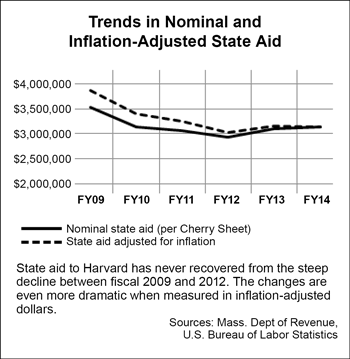

When funding amounts from previous years are adjusted to today’s dollars for inflation, those previous funding amounts appear even higher (see chart showing nominal and adjusted state aid from fiscal 2009 to 2014). It’s the same principle as buying a radio in 2001 and calculating what it would cost if purchased today.
“At some point, we need the state to step up to the plate,” Sklar said. “The state aid formula is broken.”
In her email response, however, von Loesecke noted that about $2.1 million of the $2.6 million decline in state aid receipts from fiscal 2001 to fiscal 2014 cited by Sklar was due to the loss of infusions of state money for school construction between fiscal 2001 and 2003. That was one-time money, and when it is excluded, von Loesecke said, 2009 emerges as the real peak year for state aid. Since then, state aid has declined by approximately $730,000 in fiscal 2014 dollars, putting pressure on the town’s operational budget.
Von Loesecke also noted that funding to Harvard for accepting students from Devens increased from zero in fiscal 2006 to $1.1 million in 2014, which has helped to offset costs within the school budget.
In a follow-up email, Sklar conceded von Loesecke’s point that fiscal 2009 was a better year to use when considering Harvard’s decline in state aid, but he contended that starting with 2009 does not change his overall point. “The level of state aid needs to go up to stop an over-reliance on property taxes, which I believe are inherently unfair,” he said.
Sklar, who formerly served on the School Committee, added, “I’m intimately aware of the Devens money, so what is the point? It’s the reason we haven’t had a budget override in seven years. Where would our tax rate be now if we didn’t have that contract? I shudder to think of the cuts to services or of the overrides that would have been necessary if we didn’t have that money.”
Working together
Von Loesecke said she recently met with Sklar and Debbie Ricci, chair of the Capital Planning and Investment Committee, and that the three agree that “looking at spending and capital needs over a longer term than we have in the past (10 years instead of five years) is a good thing to do.”
“We’ll continue to work together to vet capital requests and phase them as best we can,” said von Loesecke. “For example, by timing new debt when old debt is coming off the books [we can] minimize the tax impact.”