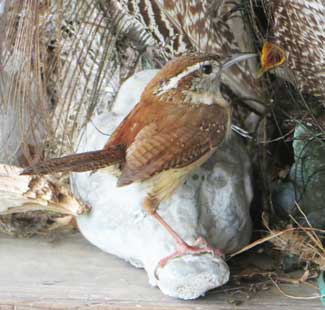
An adult California wren feeds its young. (Photos by David Durrant)

Carolina wrens about to fly.
I keep a diary of when our migrating birds return, and it is uncanny how they often return within a day or two of their arrival in previous years. I checked my diary for when the orioles returned last year and put orange halves out the day before that date this year (May 4); the next day I had an oriole on the oranges. Likewise, I set my hummingbird feeder out and within two days my hummingbirds were back.
The barn swallows are back; and my neighbor, Connie, has heard her chimney swifts chattering in her chimney.
I cleaned out all the nest boxes of old bluebird, tree swallow, house wren, and house sparrow nests and turfed out three field mice nests. The bluebirds began exploring the boxes, and on April 12 we had a pair of tree swallows return, which was a few days earlier than last year. Our earliest returning migrant was the phoebe on April 2. On that same day a couple of turkey vultures streamed by.
The allure of Bolton Flats and Oxbow
Birders come from all over to visit Bolton Flats and the Oxbow. We are lucky to be so close to those good birding areas as it allows us to get a couple of hours of birding in early before we start our work day. On a walk down the tank road or onto Bolton Flats, you will usually find birders. If you are unfamiliar with birds, do not hesitate to ask one of the birders for an identification; most birders are a friendly lot and usually love to share their knowledge of birds. If you are unable to walk far, we invariably find the best birding can be right in the parking lots.
On recent trips to these areas, we have seen yellow warblers, magnolia warblers, yellow-rumped warblers, common yellowthroat, and redstarts.
A pair of blue-gray gnatcatchers is building a nest of layers of lichen on a branch over the tank road. I was able to get reasonable photos of the nest over several days as both the male and female worked on building it. Nearby we spotted an oriole weaving its hanging nest high in an oak. The turnpike at Oxbow is a great place to find swamp sparrows. We have seen six to eight white-throated sparrows in the same area, and there is usually a kingfisher in the pond there. Further on down toward the river, one invariably hears the “teacher teacher” call of the ovenbird. If you are lucky you may get to see this perky little secretive forest-floor dweller.
On the flooded cornfields at Bolton Flats, we have seen greater and lesser yellowlegs, solitary sandpipers, spotted sandpipers, killdeer, blue-winged teal, and green-winged teal. We have not, as of yet, heard the familiar “thump” of the bittern, but I am sure he will make an appearance soon in the wetlands just off the path leading from the parking lot.
A pair of Carolina wrens has built a nest right by our back door in a collection of feathers that we have on a shelf not two feet from the door. Sitting on our terrace we can easily see the wrens gleaning bugs off the oak and flying to the nest to feed their three chicks. On one visit the male passed a bug to the female, who took it into the nest and immediately returned with a fecal sack, flying off to drop it a distance from the nest. This past weekend the Carolina wrens fledged. Luckily I was around to see them fluttering about and attempting to fly. They successfully returned to the nest, one even landing on my outstretched hand. This Monday morning they have left the nest, though we frequently hear their call.
A ‘fall-out’ of warblers
About six one morning, I went outside and heard the familiar call of the redstart as well as a lot of song in the oak and sugar maple on our terrace. I went back into the house to get my “bins” (binoculars) and tell Pam that it appeared we were experiencing a “fall-out” of warblers. During the next half-hour or so, we saw black-throated green, magnolia, pine, and black and white warblers and American redstarts. Lying back on our chaise eased the strain on our necks as most of the birds were up fairly high. If I could make a habit of birding like that, why travel?
The noisiest bird that morning was the great-crested flycatcher, which was calling from the very top of the trees, and the most spectacular was the arrival of a scarlet tanager, which Pam ably spotted.
David Durrant lives with his wife, Pamela, on East Bare Hill Road at Micheldever Farm, where they watch birds—their own peacocks, chickens and visiting wild birds.