Forty-four years and counting—Dr. Joe Connelly has been a school administrator since he first became a principal at the youthful age of 25. With accolades from parents, teachers, and School Committee members, Connelly leaves Harvard this month after three years as the district’s interim superintendent. But he is not quite ready to retire yet.
“I still have the energy, and I still love the job,” Connelly told the Press when asked if he might now fully retire. When pressed, he admitted that he probably would not even take a year off. With so much changing in education and so many new state mandates to deal with, he explained, it would be almost impossible to keep up to date if he were away from the job for any significant time.
New systems for long-term planning
Asked what he sees as his legacy here, Connelly said he was most pleased with several new systems that have been established during his tenure. First, he brought out the massive binder known as “the budget book,” saying it held the answers to any financial question one might ask about the district. Connelly said he was confident that the transparent, zero-based budgeting system now in place would continue.
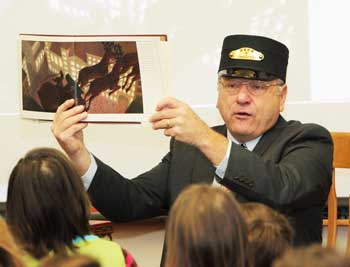
Superintendent Joe Connelly reads “The Polar Express” to third-graders, an annual traditon that he instituted. (Photo by Lisa Aciukewicz)
Second, Connelly cited the staffing system in which administrators post a “teaching design” each spring, identifying potential vacancies for the following school year. Only after teachers within the district have had a chance to apply for those openings do administrators begin to look outside for new hires. This policy gives veteran teachers a chance to refresh and renew their careers by moving to a new position or a different grade level, Connelly says.
Connelly also looks back with pride on the detailed enrollment projection study, the five-year capital plan, and the five-year curriculum plan. All are examples of careful, long-term projections that Connelly expects to pay dividends for the school district down the road.
The place of testing
Asked about the growing concern with test scores, Connelly says he does not foresee more testing, but he does believe there will be an increasing emphasis on using test results to identify areas where students need more work–a process called data-driven instruction.
While Harvard celebrates its good results on tests such as MCAS and PARRC, Connelly says he does not think parents or teachers here are disproportionately concerned with test scores.
Though he recognizes that many teachers believe there is too much emphasis on testing, Connelly says there is still flexibility and space for creativity in teaching. He estimates that teachers have the latitude to devote about 20 percent of their class time to “that special unit on volcanoes,” as an example.
‘An amazing cadre of teachers’
Connelly credits “an amazing cadre of teachers” with producing the good educational results that have boosted the reputation of Harvard’s schools.
“What retains and attracts quality teachers,” Connelly says, “is fostering a very good quality, positive environment … If [teachers] feel valued and respected and supported by the community, that supports longevity” in careers and prevents burn-out.
Connelly’s leadership contributed strongly to that positive environment. According to his School Committee performance review, a teacher survey showed “an impressive increase … in positive feelings related to school climate and culture.”
Looking to the future of Harvard schools, Connelly also praises the strong administrative team that is in place. He gives high marks to recent arrivals, including Chris Boyle, director of technology, and Dr. Marie Harrington, director of pupil services. He says he is confident that incoming Hildreth Elementary School Principal Sue Frederick will do a fine job. And as for Dr. Linda Dwight, who will take over his position in July, Connelly says, “There will never be a more prepared superintendent.”
Challenges ahead
Asked what challenges he sees ahead for the Harvard school system, Connelly immediately identified the trend of declining enrollment. When the Class of 2014 graduated, he says, 101 students left the system; so far, fewer than 50 new kindergarteners have enrolled for next year.
Connelly points out that Harvard will have three sections of kindergarten next year instead of the four it has had in the recent past. One kindergarten teaching position has been cut for 2014-15.
Having four class sections at each grade level has been ideal, Connelly says. It’s a number that allows for teamwork among teachers and for matching teaching and learning styles in class assignments. Yet Harvard might be faced with cutting a position or two each year, he notes.
In the face of this trend, Connelly emphasizes the importance of the Devens contract, both to keep enough students at each grade to support a rich curriculum and to supplement the school budget.
Connelly also pointed out that the savings from the need for fewer classroom teachers at some grades could be used to enrich the curriculum and build in other learning opportunities.
A positive impression
The School Committee reviewed Connelly’s job performance in May, and the review was peppered with superlatives:
- “Dr. Connelly’s communication and relationship skills are unparalleled … He is caring, thoughtful and fair in his handling of even the most contentious issues.”
- “Dr. Connelly leads by example in setting an expectation for excellence … Joe is respected and liked throughout the community and has received praise from parents, faculty, administrators and town volunteers for his professionalism.”
- “Joe excels at effective management and operations.”
- “Joe has set a new standard for our district for competent, thoughtful, and respectful management and leadership … It has been an absolute pleasure to work with him.”
In turn, Connelly says he has been impressed with Harvard’s commitment to education. He cited the numerous working committees and volunteer groups whose members have put in long hours to support many projects related to the schools. “You see their generosity with their time and energy in everything to do with the schools,” he said.
After three years, Connelly says his impression of Harvard is “extremely positive.” The same can be said about Harvard’s impression of him.