We moved to Elm Street in Harvard in 1988. At our first Annual Town Meeting, $5,000 in the omnibus budget for the Elm Commission occasioned lively debate, prompting my first letter to the editor (of the old Harvard Post). I said, “We are fortunate to live on one of the few of hundreds of Elm Streets in the northeast from which one can see mature elms,” and went on to praise our new town for making that possible. Soon after the paper came out, I got a call from Anne Phair, beginning a friendship that lasted until she and her husband Bill died, within a few weeks of each other, in 2000 (Anne a week shy of her 79th birthday, Bill at 82).
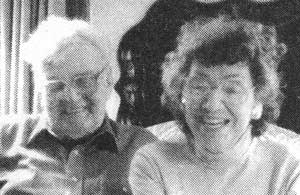
Bill and Anne Phair (Photo by Carol Estes from 1995 Annual Town Report)
As noted in last week’s Press, Anne had the driving interest in saving the elms.Bill made the key scientific contributions, however. Anne was also the public face of the Elm Commission—an appropriate choice, as those who knew Bill will attest; (“cantankerous” is a word some have used.) Bill was a hydrologist, digging wells and helping water flow. He realized that the critical problem in treating elm trees was hydrological: delivering chemicals all the way up to the elms’ growing tips. He analyzed fluid flow in the trees, relating it to temperature and, crucially, to the timing of leaf buds. And, with Yankee persistence, he figured out when and how to administer treatments.
A few years after his methods were adopted and proven successful in Harvard, he got ill. Concerned that his innovations would die with him, or at best remain confined to Harvard, he reached out to the academic community. A young botanist at Tufts, George Ellmore, was interested enough to drive out to town. What he found amazed him. He and Bill wrote several articles that appeared in the scientific literature, quite an achievement for a nonacademic. (Search for “Ellmore Phair” to find them. Professor Ellmore is still at Tufts.) Thankfully, Bill survived that illness.
When our house burned down in 1995, one of the first calls I got was from Anne, almost crying, sorry that there was nothing she could do, but reassured to know we were fine. I soon began visiting them periodically, in their colonial house just off the Common on Oak Hill Road, with doorways so low that they had to duck to get through them, as they were both over 6 feet tall. At my first visit, and every one thereafter, they had a pitcher of Manhattans waiting. (Old-timers who have heard this story laugh knowingly, unsurprised and delighted.)
Every six months or so I would stumble home through the New England dusk, marveling at the dedication and perseverance of two of the unique people who shaped the town we are still fortunate to live in.
Billy Salter has resided on Elm Street since 1988.