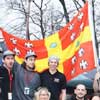

The team from Université Laval crowds around as the canoe is taken to the water. The boat would prove to be the fastest on the pond, winning every race category. (Photo by Lisa Aciukewicz) MORE PHOTOS
To most people, “paddling a concrete canoe” might sound like a metaphor for a doomed course of action. But every spring, thousands of engineering students across the country spend thousands of hours designing and constructing concrete canoes for the National Concrete Canoe Competition sponsored by the American Society of Civil Engineers (ASCE).
This year’s New England Regional Competition was hosted by UMass Lowell, which chose Bare Hill Pond as the site of the racing portion of the intercollegiate face-off. On Sunday, April 27, 12 teams crowded into Harvard to compete in this final event for a spot in the Nationals. Despite the damp and chilly weather, the unusual race drew a few hundred spectators. At the end of the day, Université Laval of Quebec emerged victorious, qualifying for Nationals for the 12th time.
Passing the ‘swamp test’
Before competing in the races, each canoe must pass a “swamp test” to demonstrate that it can float near the surface of the water after being submerged. Once all boats have proven seaworthy, the five races begin: men’s and women’s endurance; men’s and women’s sprint; and coed sprint.
At the competition on Sunday, all the boats passed the swamp test, but not all made it through the races. One capsized, and a few didn’t navigate the buoys correctly. By the end of the races, several boats had cracks in the concrete from the stress of the races. In the final race, the four-person coed sprint, cracks in the University of Maine’s boat caused it to start taking on water. But, in a testament to the spirit of this event, the Maine team continued to give it their all with three people paddling and one person bailing. They finished third.
5,000 man-hours, boatloads of dollars
The first concrete canoe ever created, dubbed “Misled,” was built by engineering students at the University of Illinois. Purdue students got word of the project, built their own version, and challenged Illinois to a race. After Purdue’s lighter weight boat proved difficult to handle, capsizing in the final heat, Illinois took home the first-place trophy: a concrete canoe atop a wooden base. As runner-up, Purdue received a concrete lifesaver. The popularity of concrete canoe races grew in engineering schools across the U.S. and Canada, and the first official ASCE-sanctioned competition was held in 1989.
The canoes are built of concrete, reinforcement materials, and optional flotation material, which must be encased in concrete. No air cavities are allowed. Everything from the composition of the concrete mixture to the size of the letters on the side of the canoe is strictly regulated, and points are deducted for any deviation. Concrete canoes take roughly 5,000 man-hours to build, and the cost varies from hundreds to thousands of dollars depending on the techniques used. In their design presentation, Université Laval team members revealed that they had spent about $30,000 on their boat. By comparison, UMass Lowell spent about $850.
Teams compete in four categories: a detailed technical design paper, a formal oral presentation highlighting features of the canoe’s design and construction, a “final product,” which includes the workmanship and aesthetics of the canoe itself, and the results of the five races. Judging in the non-race categories took place the day before at the Tsongas Center at UMass Lowell.
Next stop, Nationals
On Sunday, after the races, contestants and faculty headed to the General Store for the awards ceremony and dinner. The first-place trophy, built by the host school, UMass Lowell, was once again a concrete canoe affixed to a wooden base. But due to the damp weather, the canoe kept falling off its base, despite last-minute interventions with epoxy glue. Presenters joked that the winners would “get to fix your trophy yourselves.”
Regional winners will compete in the 27th Annual ASCE National Concrete Canoe Competition, to be held June 19–21 at the University of Pittsburgh at Johnstown in Johnstown, Pa. For more information, visit www.concretecanoe.org.