
Ask any of the gardeners at the Harvard Community Garden what they value most about the venture and they’ll tell you it’s not just the organically grown produce, it’s also the sense of community.
The garden, located on Littleton Road across from Orchard Hill, consists of two and a half acres of conservation land, divided into 24 plots. The land was approved for use as a community garden by the Conservation Commission, and while some gardeners come and go, staying only a season or two, many of the larger plots have been tended by the same people since the garden opened in 2009.

Steve Abrams admires his just-planted broccoli at the community garden on Littleton Road. (Photo by Katy Sharko)
Harvard vegetable gardeners frequently fight a losing battle with shade and critters. The community garden provides full sun and is enclosed by an electric fence to keep out the likes of deer and woodchucks. In the beginning, water had to be brought from a nearby stream, but Joe D’Eramo, one of the founding members, developed a pumping system that delivers water from that same stream. Wheelbarrows and gardening tools are available for common use.
Plots come in 10 by 10, 10 by 20, and 20 by 20 feet. Most gardeners, like Abbe Alpert, start small. “I’ve gone from hesitantly growing a few things to growing way, way more vegetables than a human being could consume,” said Alpert.
Greens are one of the most successful crops, everything from lettuces to chard and kale. Leeks and onions are also popular, as are beets, beans, tomatoes, and peas. Some gardeners branch out into more adventurous crops. This year Alpert is growing bok choy; Ann Whitney is growing edamame; and Nancy Holden and Paul Niemira are growing tomatillos. The first time they planted tomatillos, they didn’t know much about them. “The plant took over,” said Niemira. “It flopped over and put out roots. It took over the whole center of the garden.” Holden added, “It was a tomatillo jungle. I think we still have some in the freezer.”
In addition to vegetables, many gardeners grow strawberries, and one gardener, Lillian Burkart, grows blueberries. “I have to net them to protect them from the birds, but it’s a small price to pay,” said Burkart. “I had a beautiful harvest last year.” Birds are also a problem for beans and peas, and even for tomatoes. According to Holden, “When it’s dry, birds come in and peck at the tomatoes to drink the liquid.” Many gardeners hang aluminum pie plates to scare the birds away.
Organic only
The Community Garden is strictly organic, so crops that are invaded by pests or blight tend not to do as well. Squash and cucumbers have proven difficult, and the success of tomatoes varies from year to year. “We’re all learning each year,” said Burkart. “We’re out there gardening organically every year, and we bring new information back to the table.” An email group keeps everyone informed of what’s invading, and ideas to combat the problem circulate. “We do share ideas and try to conquer,” said Whitney.
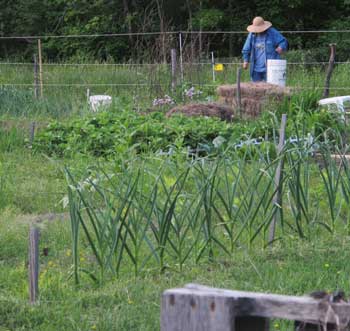
Community garden plots stretch across a 2½-acre field on Littleton Road. (Photo by Lisa Aciukewicz)
The season generally begins in early May, when people start turning over the soil, either by hand or with a rototiller. Work in the spring is intensive, but once everything is planted, the work drops off to weeding and watering once or twice a week. And, of course, harvesting. “Once setup work is done, everyone just enjoys the harvest,” said Burkart. “I stop off every morning on my way to work to harvest salad.”
The experience at the garden is “as private or social as you want it to be,” according to Burkart. One evening each week during the growing season, members gather at the garden to walk and talk, sharing stories and advice. Some gardeners enjoy family involvement. When Ann Whitney started, she shared a plot with another mother, and their sons helped design their gardens. “We ended up with really creative plots that I got a lot of compliments about,” said Whitney. “It’s great to have the kids involved. This year my son helped fork over the soil in the spring.” Friendships often develop, sometimes in strange ways. Abbe Alpert recalled a day when she was fairly new to the garden. “I was gardening away, and a woman who’s a master gardener came up to me and said, ‘I have a present for you.’ She gave me a giant cup filled with worms.”
Sense of community
When the garden opens in the spring, people pitch in to set up the electric fence and get the pump working. “There’s no job chart,” said Alpert, “but things get done. If the pump breaks, somebody who knows how to fix it will fix it.” “It’s a community of people who love to spend time there,” said Burkart. “We collectively help each other out, sharing vegetables, sharing rototillers.” Holden added, “Most people start from seeds, and if they have excess plants, they give them to other gardeners. Same with crops; there’s always lots of kale, Swiss chard, and leeks.” Some gardeners give their excess crops to charities such as Loaves & Fishes or the Harvard Farmers’ Market ‘Farm to Friend’ program. Ann Whitney entered her crops as a prize in a fundraiser auction and will be supplying the winning family with a weekly bounty of crops from her plot.
When the Press asked if any of the gardeners felt competitive with their fellow gardeners, only one owned up to it. “I can’t speak for other people,” said Abbe Alpert, “but I certainly get competitive. I’ll walk around the garden and think, ‘His broccoli looks better than mine; let’s see, what’s he doing?’”
Plots of all three sizes are still available for this season. Contact Carolena McCauley at hcgmembership@gmail.com for more information.