For three days next month Harvard will pay tribute to the men and women who served in the Civil War—many of whom gave their lives in that effort—in a unique series of events on and around the Common.
Scheduled for June 6-8, Harvard’s Civil War weekend will include an encampment of re-enactors, a tour of veterans’ graves in the old burying ground, an exhibit of Civil War artifacts, a performance of period music, and a re-dedication of the town’s Civil War monument.
Bromfield eighth-grade history teacher Kristin McManus is the “mover and shaker” behind the weekend events. Last year McManus, with the help of Chef Paul Correnty, engaged her students in a Civil War soldiers’ meal and, sparked by its success, pursued a grant from the Harvard Schools Trust to bring the 28th Massachusetts Volunteer Infantry to the Common this year. About 25 re-enactors, soldiers, and some civilians, will set up camp on the Common and carry out the routines of a Civil War regiment.
The Harvard Historical Society has joined McManus’ efforts and is sponsoring additional events to broaden understanding of Harvard’s role in the war. A number of volunteers from Bromfield and the greater community are helping out in various ways.
Here is a guide to the weekend’s events:
Civil War re-enactors camp on Common
Tents of rough canvas, a small cook-fire, and logs for seats–these will be the comforts of “home” on the Common to the re-enactors of Company H, 28th Massachusetts Volunteer Infantry, on June 7 and 8.
This company of Civil War re-enactors will do a special “living history” presentation to Harvard eighth-graders on Friday, June 6, from noon to 2 p.m. Bromfield teacher Kristin McManus and her students organized the event with support from the Harvard Schools Trust. The public can visit the encampment on Saturday, June 7, from 9 a.m. to 5 p.m., and Sunday, June 8, from 9 a.m. to noon.

Re-enactor Capt. Thomas Higgins of the 28th Massachusetts Volunteer Infantry. (Courtesy photo)
Re-enactor Captain Tom Higgins wrote in an email to the Press, “A stroll through our camp will provide visitors with a glimpse into the daily life of the common foot soldier in the Union Army, doing the things he did when he wasn’t marching long distances–often upwards of 20 miles a day, carrying 30 pounds of more of gear–or fighting in battles or skirmishes.
“The men of the 28th Massachusetts will fall in for roll call and inspection, take the field for company drill, fire musket volleys, clean their weapons, collect their pay, and cook meals over a fire. In their leisure time, they will write letters home, play games of chance, smoke tobacco, and do one of their favorite things of all: sleep.”
Musket volleys: never on Sunday
Higgins noted that musket volleys will take place only during the school visit or between 10 a.m. and 4 p.m. on Saturday, out of consideration for those who live nearby. There will be no volleys on Sunday.
Higgins said, “Members of the unit are always happy to answer questions and share what they know about Civil War history in general, and the 28th Massachusetts in particular.”
Re-enactor Tracie Wilkins wrote that the encampment will have special activities for children. “At the civilian end of the encampment, children will be encouraged to step into the lives of their 19th-century counterparts, with a variety of hands-on activities including toys and games of the period such as Jacob’s Ladders and the Game of Graces. Children were a great help to the adults who remained at home during the war years, and assisted the relief effort by rolling bandages and ‘picking lint’ for army hospitals. Visitors to the camp can try their hand at these tasks, and those interested in the military will be able to participate in mock drills with wooden muskets led by one of the soldiers throughout the day.”
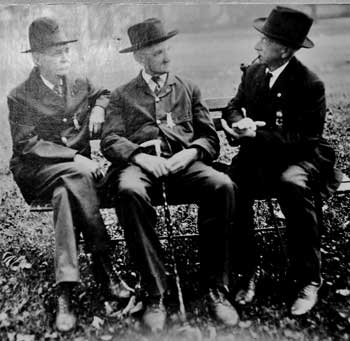
The area’s last three surviving Civil War veterans at the Ayer Grand Army of the Republic Post probably in the 1920s. (Courtesy photo)
The 28th Mass. re-enactors have been active since 1984. The nonprofit group is based in Attleboro, has members from all six New England states, and includes both military and civilian members. According to their website, their purpose is “accurately portraying the life of the common solider in the Union army.” Much more information is available at www.28thmass.org.
Living history tour
The Historical Society will present a living history tour of the old burying ground, so-called until it was referred to as Center Cemetery sometime after Belleview Cemetery opened in 1892. Eighth-grade classes will walk the cemetery on Friday, June 6, and on Saturday the public is invited from 11 a.m. to 1 p.m. or so, with a tour starting about every 15 minutes. Attendees are asked to enter the cemetery only from Still River Road, where there will be a volunteer to start the tour.
In preparation for this event, Bromfield eighth-graders identified the graves of Civil War participants. McManus created a grid of the old burying ground and a list of Civil War veterans and other participants. She took classes to the cemetery and set the students off to match names with grave sites.

The grave of William Savage. (Photo by Lisa Aciukewicz)
On the tour, several Civil War “participants” or their relatives will speak about their roles in battle or as civilians. William Henry Savage will share the highlights of his adventurous life, including his wounding at Gettysburg. Sarah Sprague of Still River will read excerpts from several letters she received from her brother Charles in which he discussed the hardships of war. A volunteer nurse, Flora Burt Haskell, will talk of what she saw on the battlefield. Arathusa Atherton, a renowned “do-gooder,” has tales of her father’s role in the Underground Railroad, and Mrs. Haynes will tell of her husband’s involvement in the war.
On Friday these five former Harvard residents will be portrayed by current community members. They will be joined on Saturday by Chef Paul Correnty, who will be Forrest Dadmun, a vet wounded at The Wilderness. A couple of Bromfield students will join the interpreters, depicting young Harvard residents involved in the war.
Doug Cregar researched the lives of these men and women and provided biographies to the role-players. Pat Hatch furnished the costumes.
Civil War artifacts
Cregar, with help from Tammy Alfano, has selected Civil War artifacts from the Historical Society collection to create an exhibit at the Center on the Common. On Friday the eighth grade will visit the display during the day, and it will be open to the public from 1 to 5 p.m. On Saturday the exhibit will run from 9 a.m. to 5 p.m. Charles E. Whitney was the owner of several items on display: a Confederate cavalry saber that he captured, an adjutant’s sword, a shadow box that includes art work created by prisoners, hardtack, and several other souvenirs of his experience. The exhibit will also feature clothing worn by Harvard soldiers, canteens and a mess kit, small artillery balls, rifles, and ephemera such as posters, certificates of achievement, and furlough papers. Pictures, the letters of Charles Sprague to his sister Sarah, and a scrapbook of Civil War newspaper articles will also be on view. In addition to local artifacts, the Historical Society owns some Civil War memorial posters and Confederate currency.
The Historical Society is grateful to Fruitlands Museum for the loan of four display cases and to the Center on the Common for its security during the exhibit.
Re-dedication of memorial
On Saturday, June 7, at 10 a.m. Kristin McManus will be master of ceremonies at a re-dedication of the Civil War memorial on the Common. The service will take place on a temporary stage set up near the statue. Rev. Dr. Gregory Schmidt of the Congregational Church will give the blessing. Kevin Foster, Bromfield history teacher and Civil War aficionado, will talk about some general aspects of the war. Bromfield Music Director Tom Reynolds will play taps, and the 28th Massachusetts Volunteer Infantry will present colors.

The Civil War statue framed by chestnut blooms.
(Photo by Lisa Aciukewicz)
The original dedication of the monument was in 1888. The statue, a draped female figure in white marble, head downward, rising atop a polished granite pedestal on a square base of hammered granite, represents Memory in the act of strewing flowers upon the names of the soldiers inscribed below. Last spring the Parks and Recreation Commission funded the cleaning of the monument by Ivan Myjer Building and Monument Conservation of Arlington. During the cleaning, Myjer himself commented on the uniqueness of the monument, saying he had never seen one quite like it. He added that most other war memorials in Massachusetts are obelisks or a soldier figure representing all soldiers lost in the war. Memory is impressive in her uniqueness, and speaks poignantly of both the sorrow of the war and the lasting tribute to the fallen soldiers.
Prior to the cleaning last spring, members of the Garden Club of Harvard, under the leadership of Kathy Jackson, removed most of the hosta plants surrounding the monument, and Denis Wagner of Fine Gardening amended the soil. Jessie Panek, professional garden designer and Garden Club member, designed a new border around the base of the statue and last week replanted some of the original hostas and added new plantings.
Music and food
The Hardtacks, a Civil War folk music band, will be playing Saturday at 11 a.m. on the Common. They will also give a 2 p.m. performance on the temporary stage by the monument. Rain location is the Center on the Common. The Hardtacks—ask them how they chose their name!—will have a small table to sell their “Songster,” which includes sheet music and lyrics for Civil War-era music. Scott Hayward is planning to set up a grill outside at the General Store to sell food to visitors.
Marty Green contributed to this article.