A black bear attempts to empty a birdfeeder containing peanuts in a backyard off Jacob Gates Road, April 5. (Courtesy photos)
In the spring a young bear’s fancy lightly turns to thoughts of … food. As black bears emerge from their dens, filling their empty bellies is their primary objective, and Harvard’s backyard bird feeders seem to be the restaurants of choice for these hungry omnivores. One bear has visited the same residence on Jacob Gates Road four times in the past few weeks, and a similar-sized bear visited a Scott Road residence last week.
According to MassWildlife, black bears enter their dens late in the fall and emerge between early March and mid-April. Males appear first; females with cubs later. Unlike summer, when bears are active only at dawn and dusk, bears remain active all day long in springtime, looking for high-calorie food that won’t take a lot of energy to procure. Backyard bird feeders are the perfect source.
Strong and persistent, but clumsy
At the Peterson home on Jacob Gates Road, a black bear stole their peanut feeder last fall. In mid-March, a bear, possibly the same culprit, was spotted “inspecting” their bird feeders, and in a subsequent visit, stole it again. Last week the bear returned, and as the Petersons watched, he dug up the stolen feeder in the woods just off their property, where he had probably left it. He managed to open the end of the tube, but in the process, bent it badly enough to trap the last few peanuts inside. “The bear isn’t very skilled at opening things, just strong and persistent,” said David Peterson.
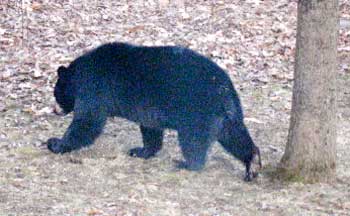
A similarly-sized black bear exits a Scott Road yard after emptying a birdfeeder.
At the Andrews house on Scott Road, a black bear climbed a flight of stairs to a small porch to raid their black oil sunflower seed feeder at the back door. “We heard banging noises at the bird feeder around 5 p.m.,” said Laura Andrews. “He ate most of the seeds in the feeder but left as soon as he could see us moving around taking pictures.”
Judging from the photographs snapped by residents, both of these bears are probably males. MassWildlife gives the average weights of Massachusetts black bears as 230 pounds for males, 140 pounds for females. In addition, at this time of year, most females would be with either newborn or yearling cubs.
Could it be just one bear that visited both locations? Pete Jackson of Jacob Gates Road, whose bird feeder was also targeted by the peanut thief, said, “If he’s the same bear, he gets around quickly.”