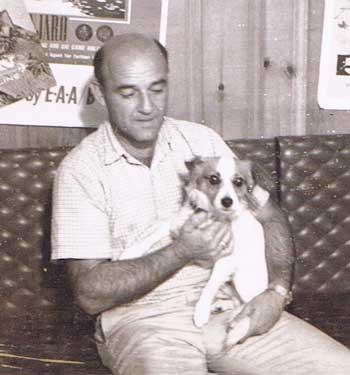
Sparky with the author’s father.
(Courtesy photo)
When my brothers and I were kids growing up in Connecticut, our parents made it clear that if an opportunity presented itself where we could help out elderly neighbors or earn money by doing chores, we were to make ourselves available. Mostly this consisted of mowing lawns in the summer and shoveling driveways in the winter. But all three of us had paper routes as well.
Compared to those of our friends, our parents were fairly strict: We had a clear sense of what was expected of us, and we very much wanted to please them. When asked about my childhood, I like to tell people I was raised by the Taliban.
Delivering the Hartford Times
I started delivering papers when I was nine or 10, and I kept my route until the age of 16. It was an evening newspaper (the Hartford Times), and I had 32 customers.
The papers were dropped off at the end of our driveway each afternoon after school. I would insert various circulars into each paper and then carefully put them into a large canvas over-the-shoulder sack or in large wire baskets on each side of the rear wheel of my bike. I would then set out delivering them to each customer’s front or side door. On nice days, when I walked the route, I took my dog Sparky, probably the cutest and best dog on the planet.
Sparky was popular with many of my customers, especially David Goldfarb. The Hartford Times cost five cents daily, and every Thursday, on collection day, I would ring each customer’s doorbell and collect 35 cents. When I arrived at the Goldfarbs’ modest brick house, Mrs. Goldfarb and her son David would answer the door.
Mrs. Goldfarb was a plain lady in her 60s. She was stocky, had a large mole on her chin, and always wore a frumpy housecoat. She had a thick eastern European accent. Each Thursday she handed me her 35 cents in pennies and nickels wrapped in a wrinkled Kleenex, and each week I would see the numbers tattooed on her forearm.
David was in his late teens or early twenties. He was about 6 feet tall and towered over his mom. He was very shy and socially awkward, and he rarely spoke. My guess is that using today’s diagnostic terminology, he would probably be classified as autistic, but those were the days before refined diagnoses like Asperger’s syndrome, ADHD, and the term “special needs,” In those days, young men like David were thought to be “retarded.”
A love of boy and dog
David loved Sparky, and Sparky loved David. David would smile from ear to ear and become animated at the sight of Sparky. He would talk to him, pet him, and truly become a whole different person. We usually spent 15 to 20 minutes with David, and often I would leave Sparky with him while I finished my route and collections, picking him up on my way home. It was also nice to see Mrs. Goldfarb smile as she watched David and Sparky interact.
As I look back, I certainly wonder how David made his way in life, but I also think about his mother—and what I learned from both of them about endurance.
East Bare Hill resident Fred Karotkin is a veterinarian.