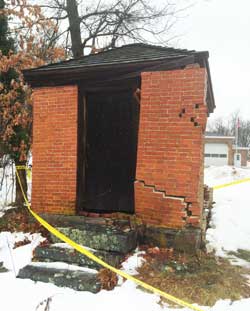
Current state of the powder house on Elm Street. (Courtesy photo)
While the town militia of revolutionary Harvard is long gone, help from other quarters may soon be on the way for Harvard’s iconic powder house.
The building was extensively damaged in October when a parked vehicle with unengaged parking brake rolled down from the firehouse parking area and struck it. Damage to the structure, the small brick building located on a hillside at the west edge of the Town Hall parking area, is extensive on all sides. The destruction to the thick brick walls is so severe that the building needs to be taken apart, its bricks cleaned, and then rebuilt when the weather gets warmer. Some new bricks will be needed to replace those that are too badly broken, and they will be used on the interior walls. But before it can be dismantled, the building needs to be carefully documented so that the mason can reconstruct it correctly; there are no blueprints for Harvard’s oldest surviving town building.
A local preservationist to the rescue
The Historical Commission, working with Town Administrator Tim Bragan, now hopes to begin the work of restoration soon, funded by insurance proceeds and a small contribution from the town. If all goes according to plan, the building will be restored within the next six months.
The town is indebted to historical preservationist Robert Adam, who volunteered to help with the powder house project. Adam, a former teacher at the North Bennet Street School in Boston and a longtime Shirley resident, where he served on the historical commission for 25 years, is no stranger to Harvard. He restored the Shaker Herb Drying House several years ago, and he is currently at work on the oldest house in Harvard, the Houghton house on West Bare Hill Road.
Late last year, at the request of the town, Adam prepared a description of the work needed to restore the building, which Bragan then sent to masons skilled in historical preservation for quotes. Adam has also volunteered to be the “clerk of the works” to oversee reconstruction. His only compensation: helping to save one of the state’s last powder houses.
The historical role of a powder house
Many residents are likely to be unaware of the role powder houses have played in our history. The American Revolution was ignited by a British decision to march to Concord in the middle of an April night to confiscate the gunpowder and arms stored in that town’s powder house. The previous fall, British troops had successfully raided a large powder house in what is now Somerville. After that, people were on the alert, and a subsequent raid on a New Hampshire powder house failed. It was the third British raid, on the Concord facility, that touched off the war.

Damage to the powder house goes down to the foundation. (Photo by Lisa Aciukewicz)
More than 200 powder houses were built in New England, and most were small, square, brick buildings like Harvard’s. Local militia companies used their contents for their twice yearly training exercises, designed to keep all able-bodied men between 16 and 50 prepared in case war broke out. Harvard’s powder house was built in 1812. Today, only 15 powder houses remain in the state, and Harvard’s is the largest of the traditional square variety.
The town has received two bids for the powder house reconstruction, one for $31,500 and the other for $14,501. The higher bid includes an amount for documenting the structure; the lower does not, but the town has received a separate $3,000 bid for that work from an expert who has documented other powder houses. Neither mason’s bid includes carpentry or any extra mason costs that the documentation might uncover. Bragan has sent the quotes to the insurance company and is working to secure funds.
The urgency of starting documentation now
While the damaged building does not appear to have deteriorated further since the accident, it could; it is also a risk to public safety. With this in mind, the Historical Commission will request $3,000 from the Finance Committee so it can document the building now rather than waiting for the insurance settlement. There is some risk the insurance company will argue that the lack of a plan of the building is not its problem. Town funding will enable the building to be documented now and then disassembled before further damage can occur.
The commission was scheduled to discuss next steps at its Wednesday, Jan. 8, meeting, and to make its request to the Finance Committee at that committee’s Saturday, Jan. 11, meeting.
For more on Harvard’s powder house check out the Historical Commission’s website. And an excellent book on the general subject is “Historic Powder Houses of New England: Arsenals of the Revolution,” by Matthew Thomas.
Ken Swanton is the chairman of the Harvard Historical Commission