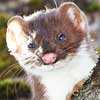

An excellent example of countershading in the summer, the long-tailed weasel is brown above and white below. In the fall long- and short-tailed weasels molt and grow in an all-white coat except for a black tail tip. (Photos by Mary Holland)
Hair (and a coat of hairs, or fur) is uniquely mammalian. No other creature possesses true hair, and at least some hair is found on all mammals at some time during their lives. In mammals, the hair, fur, or wool that covers the animal is called a pelage. The pelage provides insulation, concealment on land, buoyancy and streamlining in water, and may be modified for defense or display.
Evolution of hair
We do not know when hair evolved, as it is usually not preserved in fossils. The small body size (i.e. high surface-area-to-mass ratio and therefore propensity to lose heat) of the earliest mammals, and the possibility that they were endothermic (generated their own body heat) suggest that they could not have existed without a good covering of insulation. It’s very possible that these were the first animals to have hair.
The pelage of most mammals consists of more than one kind of hair. The most conspicuous hairs on most mammals are the guard hairs, which overlie the fur and serve to protect it from abrasion as well as moisture. The guard hairs are sometimes modified to form defensive spines (as in porcupines), bristles (long, firm hairs that grow continuously, such as those that make up the mane of a lion), and awns (hairs that do not grow continuously and which have an expanded tip on a narrower, weaker shaft). Beneath the guard hairs is usually a layer called the underfur, made up of wool (ever-growing hairs), fur (relatively short hairs with definitive growth), and/or velli (down or fuzz). Mammalian embryos (including humans) are often covered with a pelage, called lanugo, a form of velli.
Function of hair
The different animal hairs usually perform one of two basic functions. They may be either sensory (whiskers) or protective. Specialized whiskers provide a tactile sense that is used to locate prey or to navigate in total darkness.
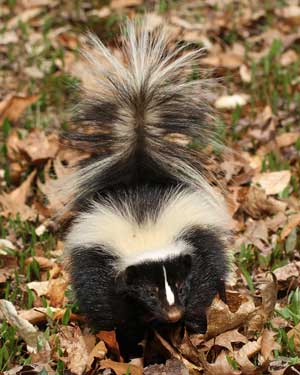
Any predator encountering a striped skunk will not soon forget its black-and-white striped pattern.
Most hair serves to insulate, to conceal, to signal, and to protect mammals. Thermoregulation is understood to be the main adaptive function of hair, with the degree of insulation dependent on its length and density. The color of the pelage of most species is usually cryptic, matching the animal’s background.
Many mammals have dark-colored backs and relatively pale undersides, a pattern called countershading. This makes sense in the case of aquatic or arboreal species (predators above look down on a dark coat, matching the forest floor below, while predators beneath the prey see the pale belly, against light streaming down from above).
Hair also provides by its color a means of signaling other members of one’s own species (e.g., the white tail of the white-tailed deer, flashed by a fleeing animal to signal danger) or members of other species (e.g., the contrasting pattern of a striped skunk, a warning to predators). The pelage also serves to protect the skin from abrasion and from excessive UV radiation.
Molting
Most hair is shed periodically in a process called molt. Molt may take place continuously, with a few hairs being replaced at any time, as in humans. More commonly, however, molt is restricted to certain seasons of the year or certain times of an animal’s life, at which time all hairs are replaced. Two main types of molt, or shedding, occur in most mammals: maturational and seasonal. The maturational molt (juvenile to adult), occurs when the pelage of a young animal, usually of fine texture, is shed and replaced with coarser hair.
The seasonal molt is triggered by secretions of the thyroid and pituitary glands in response to the lengthening or shortening periods of daylight (photoperiod). In temperate parts of the world, many mammals molt twice a year, in spring and in autumn. These molts often involve a change of fur color.
As daylight diminishes in autumn, many northern animals will begin to grow thicker and lighter-colored coats, some of which (ermine, snowshoe hare) eventually become completely white. (The cells of white hairs, lacking pigment, are filled instead with air, an excellent insulator.) In some cases, the structure of the hairs also changes with the seasons—white-tailed deer and moose hairs are solid in the summer, and their new winter coat consists of hollow, and therefore more insulating, hairs.

A porcupine erects its modified hairs (quills) when threatened.
As the days lengthen in spring, the winter coats of mammals are gradually shed and often replaced with a coat with colors or patterns that blend in with the animal’s surroundings.
A great deal of energy is expended when an animal is molting. As a result, it does not generally take place when other high-energy demands are made on an animal, such as giving birth or at a time of year when food is scarce.
The smaller the animal, the larger the surface-area-to-volume ratio, and the larger this ratio, the more heat loss occurs. Therefore, a small animal like a shrew or vole has a greater potential for losing heat from its body because of its relatively large surface area. Longer, denser coats are one way large mammals retain their body heat in the winter and avoid heat loss, but small mammals don’t have the option of growing a thicker, longer coat, as they couldn’t support its weight. As a result of their relatively thin winter coats, they rely heavily on the subnivean layer (between the snow and the ground) to protect them from the winter winds and cold temperatures.
Hair structure as identification tool
There are keys to help you identify just about anything in the natural world, and hair is no exception. While sensory hairs (whiskers) are not useful in hair identification (because their structural pattern is the same in all species), the structure of other hairs varies with species. The outer surface (cuticle) of a hair is covered with keratinous scales that either encircle the hair shaft or overlap one another. This pattern, combined with characteristics of the scales’ edges and the structure of the center of the hair (medulla), can tell you whether you’re examining the hair of a striped skunk, a raccoon, or a woodchuck. (A powerful microscope is needed to see these scales.)
The next time you are cold and covered with goose bumps, consider this. Although our body hair is relatively scarce, humans still retain one vestigial trait having to do with it: the involuntary raising of our body hair when we are cold. When this happens, we say we have goose bumps. Tiny muscles at the base of hairs contract, causing the hairs to become erect. If our hair were denser, this reflex would trap air next to our body, preventing much of our body heat from escaping into the air.
Mary Holland is the author of “Naturally Curious: A Photographic Field Guide and Month-by-Month Journey Through the Fields, Woods, and Marshes of New England,” “Milkweed Visitors,” and “Ferdinand Fox’s First Summer.” Follow her natural history blog at www.naturallycuriouswithmaryholland.wordpress.com.