
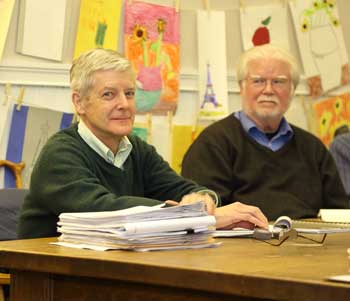
Town Planner Bill Scanlan (left) and Planning Board member Joe Hutchinson confer at a Planning Board Meeting, Jan. 27. (Photo by Lisa Aciukewicz)
It’s been about three months since Town Planner William “Bill” Scanlan settled into his office on the second floor of Town Hall. It’s a “hub of activity up here” he says, situated behind a large table filled with town maps and blueprints.
“There’s the Planning Board, the Conservation Commission, the Board of Health, building inspectors, and the Zoning Board of Appeals….”
It’s fitting that Scanlan is at the center of this activity. He describes his role as “responsible for overseeing the growth and development of the town and working with the community when they are faced with challenging issues.”
Harvard, like many neighboring towns, must negotiate the balance of retaining a quaint historical aesthetic and embracing new developments and opportunities for growth. While Harvard is overwhelmingly residential, with no industrial zones, there has been development within the town’s commercial district which extends from Route 2 north along Ayer Road.
Assessing potential for growth
Scanlan is interested in assessing the potential for commercial growth with community feedback, wondering: “How can we best utilize the land? Is there a need in the community for commercial services? Should we entice a supermarket? Do people want restaurants?” As town planner, Scanlan’s duties include analyzing existing conditions, recommending solutions to the planning board, engaging with the public in discussions and dialogue, forming a concession, and helping implement the proposed results.
Scanlon grew up in upstate New York and attended Boston College for his undergraduate degree and UMass Amherst for graduate work. He says that his work as an independent consultant dealing with commercial corridors has given him experience to address the needs of Harvard. While working on the Route. 140 corridor in Gardner and Winchendon, and the 146 Corridor through Sutton and Northbridge, he created an overlay of design standards to regulate the development, something that could benefit future commercial plans in Harvard.
First up, medical marijuana bylaw
At the Planning Board meeting on Monday, Scanlan and the board unveiled a proposal concerning the regulation of medical marijuana facilities. Many Massachusetts communities, including Harvard, have imposed a moratorium on allowing such facilities; however, that expires in October of this year. “We have decided to move forward with an amendment which would allow facilities that process or dispense such products in the Ayer commercial district,” Scanlan said. He notes that the proposal includes “setbacks and buffers from homes and parks to create separation from exposure.” This proposal will have a public hearing and require a two-thirds majority vote at town meeting in order to pass.
A similar concern for the Planning Board is commercial adult entertainment, which can be regulated by towns, but not prohibited, as it is protected by constitutional guarantees of freedom of speech. Massachusetts zoning ordinances allow towns to approve or deny special permits to such commercial ventures. Noting the aesthetic of Harvard, Scanlan and his board propose regulations that would allow one facility in town, and granting it a special permit would require a super majority of four out of five members of the Planning Board. Scanlan and the board are looking to “treat the bylaw as best they can” while “still having something acceptable” to both the town and the Attorney General.
While these are two of the most pressing concerns up for vote at town meeting, Scanlan has several other goals for his contracted term, which is 20 hours per week, as town planner. He notes the traffic and parking in the center of town has “been an issue for quite a while.” He wants to “look at traffic flow and parking and, after we develop the plan, reach out to the community” to figure out a means of fixing the busy center.
He would also like to come up with development and design standards for the Ayer Road commercial district. Such standards would require proposed ventures to meet certain aesthetic and land-use requirements in order to enhance the tax base.
“Zoning has an important effect on the development of the town,” Scanlan states. “It’s important to set the standards to tell the folks [developers and contractors] what you want; being clear is important.”
Further on the horizon, by 2032, the town has to make a decision whether or not to accept the Harvard portion of Devens. According to Scanlan, while there is an economic asset to accepting Devens, it would change the town both statistically and taxwise. Scanlan says he is “not trying to answer the question but frame the pros and cons so the town can move forward with the decision.”
Ultimately, says Scanlan, he and the Planning Board are looking to carry out Harvard’s Master Plan. The Master Plan is “an opportunity to look at the town growth comprehensively: economic development, affordable housing, land use, transportation … and identify options for growth.”
Scanlan says the Master Plan is a “very big project for volunteers,” and has “noticed that Harvard has a tremendous base of volunteerism, and a small town depends a lot on volunteers … There are a lot of different ways people can get involved and work on a project.” Scanlan encourages community involvement and feedback so the town and the Planning Board can continue “promoting growth while preserving character.”