
The fifth-floor reading room at the Boston Anthenaeum. (Courtesy photo)
Recently I found the perfect dating service. You simply call up and they provide you with your desired match, arrange for you to get together in an elegant venue, and guarantee you will be uninterrupted for the entire day. And it’s free!
The service is the Boston Athenaeum, located on Beacon Hill, and the match is any book you choose from the Athenaeum’s special collection. You and your “date” are shown into a large, comfortably furnished reading room, where absolute quiet is the rule. If you are not interested in a pre-arranged date, you may spend the day in a less intimate setting with a variety of less-exclusive “dates” you pick up that day.
I, along with several other interpreters from Fruitlands Museum, discovered (or rediscovered) this cultural gem—and its dating possibilities—on a recent trip to Boston to celebrate the 150th birthday of Clara Endicott Sears, the founder of Fruitlands. We knew that after the age of 50, Sears spent a great deal of time during the winter months at the Athenaeum, perhaps often walking there from her home at 132 Beacon Street. Here, on the fifth floor, she and two women writing friends each had private alcoves and spent several hours a day doing research and writing books. We also knew that Sears gave a copy of her first book, “Bronson Alcott’s Fruitlands,” to the Athenaeum.
Our Fruitlands group had arranged for a tour and learned all sorts of things we could not have discovered on our own. Our leader, Scott, ushered us into a “triangle room” on the first floor, where floor-to-ceiling windows on one side overlook the Granary Burying Ground, the third oldest cemetery in Boston. Here, he gave us what he called the “dry stuff,” but we found the historical information fascinating. He said that the Athenaeum had its origin in two friends who, around 1805, decided that they should meet each day and share the different newspaper to which each subscribed. They met in a building down the street from the current site. (One in our group later quipped that she thought it neat that such a cultural bastion began with “two guys sharing broadsides.”) Soon their number had grown, and members were sharing books and later, art. The art collection subsequently moved and became the Boston Museum of Fine Arts.
An 1805 beginning
My later website visit showed that in 1807 the Athenaeum officially began and moved to Scollay’s building on Tremont Street; in 1809 the trustees purchased the Rufus Amory House, at what was then the easternmost point of the Boston Common. In 1822 a mansion on Pearl Street was given to the Athenaeum by Trustee James Perkins, and in 1849 a three-story building designed by Edward Clarke Cabot opened at the present site on Beacon Street. Scott told us that from 1913 to 1914 two stories were added above the original three, but they were recessed to preserve the look of the original façade. Two lower floors and two triangle rooms were also added.
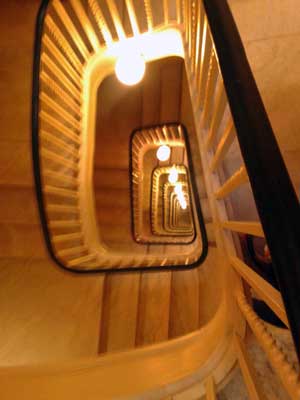
A staircase in the Boston Anthenaeum is just one of many architectural delights. (Courtesy photo)
For nearly a half century, the Athenaeum was the unchallenged center of intellectual life in Boston. It is easy to picture the great intellectuals of the 19th century studying and conversing within these walls—Bronson Alcott, Thomas Mann, William Channing, Elizabeth and Sophia Peabody, Nathaniel Hawthorne. By 1851 it had become one of the largest libraries in the United States. Currently, the Athenaeum has 600,000 volumes, collections with an emphasis on New England history, biography, English and American literature, and fine and decorative arts.
Our group reassembled in a large reading room, where Scott talked about the paintings and sculptures that share the room with shelves full of books, both at ground level and in balconies above. Scott talked about a number of inventors whose books are housed in the Athenaeum and who in some cases are honored in a sculpture. A self-professed “math guy,” Scott called our attention to a large statue of Nathaniel Bowditch, famous for his work on ocean navigation.
A debt to early librarians
Leaning toward the historical and literary, our group was more interested in a sculpture of Dickens’ Nell from “The Old Curiosity Shop.” (In the heady excitement of the moment, we vowed we would read and meet to discuss this Dickens novel.) Scott described the work of three of the institution’s early librarians: one created the book catalogue, another the call system, and a third “Poole’s Guide to Periodicals.”
On through another spacious room, with lovely large windows and, of course, more books, to a highlight of the visit: a ride to the top floor on an elevator about 100 years old. Our leader assured us that it has been “modernized” and that it “mostly” works fine. We found its wobble a bit unsettling.
The top floor has a large room for quiet research. We took stairs down to the next level, but before descending, we paused for one of the most incredible views imaginable. We could look straight down the stairwell to the very bottom of the building. It gave a dizzying sense of the multiple levels, all housing stacks and stacks (in the library sense) of books. Scott informed us that the Athenaeum acquires 3,000 books a year and that it never gets rid of anything! Scott explained that there are off-site storage spaces.
We had to move along fairly quickly, but one in our group had a knack for spotting unusual titles along the way. “Anecdotes of Eminent People” and “Mysteries of Iniquity” were a couple I might like to date sometime, though the possibilities are boundless. In the directors’ meeting room, one of us, knowledgeable about the Fruitlands landscape paintings, spotted a painting by Thomas Doughty of the Hudson River School. The rest of us recognized the more familiar portraits of George and Martha Washington. Flanking a bookcase of Washington’s collection, the paintings are copies of the Gilbert Stuart originals that once hung there but are now jointly owned by the National Gallery and the Boston MFA.
Backward-slanting script
On one of the two lower floors, we saw the old card catalogue using the Cutter classification system that many of us grew up with. The cabinets of long, narrow drawers hold typewritten and handwritten cards, as well as some dating to the earlier system of printing information and pasting it on cards. Librarians were taught to use a backward slanted script, which was deemed more legible. Also preserved are the original printed book catalogues. The first method of book borrowing was to sign out your book in a ledger. (We were intrigued with the idea that we could discover what “our Clara” might have read in the winter of 1913.) Every May saw the return of all books that had been borrowed that year. Later came the card inserted in a “jacket” on the back inside cover of the book on which you signed your name and the date it was due back to the library.
A trip to the Athenaeum is a great way to go back in history and to satisfy your curiosity on a multitude of subjects. It’s a delight to spend time in such a beautiful building surrounded by so much art, history, and literature—and some math. In the words of Gamaliel Bradford (Boston biographer, critic, poet, and dramatist) “No library anywhere has more of an atmosphere of its own, that none is more conducive to intellectual aspiration and spiritual peace.”
I’m looking forward to returning on my own, where I can spend the day in a quiet room with a fascinating older date, maybe of the 1830s vintage.