Comfortable temperatures, private meeting space, and more storage. Those three items highlight the renovation wish list of the employees that work in Harvard’s Town Hall, most of whom spend more than 30 hours a week in the building. Those wishes have changed little since employees were interviewed in 2007 as part of a facility assessment by Selectwoman Lucy Wallace, and again in 2010 by Town Hall Building Committee Chairman Pete Jackson. Since then, designs and financial support have come and gone, but Town Hall is still frosty in the winter, too public for a private conversation, and drowning in paper.
This month the Press surveyed Town Hall employees to hear their current feelings on office space, meeting space, storage space, and temperature, as well as their feelings about the office layout that was proposed in the most recent Town Hall design of 2012.
Temperature most pressing concern

An interior laser surface thermometer reading taken near a west-facing window registered 27 degrees Fahrenheit. (Photos by Lisa Aciukewicz)
The most pressing issue for employees is the temperature in the building, especially in winter. Those who sit next to walls with windows have the worst of it. On a recent 25-degree day, the Press visited Town Hall with a laser surface thermometer. Temperatures by the walls near windows on the east side of the building ranged from 35 degrees to 51 degrees. “It’s worst when it’s a windy day,” said Finance Director Lorraine Leonard. Last year, Leonard put duct tape over the entire bottom half of her window as well as the wall underneath it. “We thought it was our last winter here,” said Leonard. “I’ll be duct-taping it again this winter.”
On the other side of the room, Treasurer/Tax Collector Tammy Coller is in the same frigid boat. Temperatures taken near the windows on that side of the room ranged from 27 degrees to 44 degrees. Plastic put up at the window by Coller has done little to stop the cold. “I have to go and warm up my hands from time to time,” said Coller. Every single person on the first floor agreed that the cold temperatures bother them, including Accounting Officer Fred Aponte, who works only mornings.
The 27-degree reading was taken on the wall next to the desk used by the associate assessor from the Regional Resource Group, who works two days a week. “She’s cold,” said Assistant Assessor Sue Fitterman. Even the receptionist, who isn’t near a window, feels cold because heat from the radiators on the outside walls doesn’t reach the middle of the room where she sits.
Temperature is also an issue upstairs. Building Commissioner Gabe Vellante sits on the second floor next to a windowed wall. On the day of our temperature-reading visit, the Press found Gabe sitting at his desk wearing a parka. “The cold air comes right through the walls,” said Vellante. A measurement taken at Vellante’s chair yielded a temperature of 54 degrees. On the other side of the second floor in the Land Use and Board of Health (BOH) offices, it’s too warm in the winter due to a heating glitch in the building. Land Use Administrator Liz Allard and BOH Clerk Paige O’Brien thought the average temperature in that room in winter was around 80 degrees. A quick temperature reading yielded 71, but it was a very cold day. According to Town Administrator Tim Bragan, the town’s Energy Advisory Committee brought in engineers to try to figure out why that room was so warm. No one could. “It’s a quirk in the building, and it goes back for years,” said Bragan.
Bragan’s second floor office and that of his assistant are warm enough, according to him. The enclosed modular units that they both occupy have electric baseboard heaters. “I only use those heaters on Monday mornings to warm the room up quickly,” said Bragan. “Most of the time enough heat comes up from downstairs to keep the room warm.” But standing in the large area outside the modules, you can feel the breeze. During our visit, the temperature in front of the stage was 49 degrees.
Space: Too much, too little
Most employees are satisfied with the amount of office space that they currently have. In fact, Tim Bragan reported that both he and his assistant had more space than they needed. Lorraine Leonard also felt she had enough office space. She added, “Would I like more? Yes. Can I make this work? Yes.”
Employees who reported not having enough office space were Tammy Coller and Finance Assistant Susan Copeland. Coller and Copeland handle payroll, taxes, and a host of other financial transactions. They each sit in a small cubicle surrounded by file cabinets and boxes of paper, with little surface area to work on. Lack of privacy on phone calls is also a problem in these small cubicles, especially for Coller who receives calls from residents regarding taxes and benefits.
Whether or not the existing Town Hall has sufficient meeting space depends on whom you talk to and what type of meeting you’re talking about. Meetings with all employees are held in the break room, which employees agreed was adequate. Bragan and Leonard, who both have offices with doors, agreed that space for meeting with the public or a small group of employees in their offices was adequate. But for employees like Tammy Coller, meeting space with the public is just that—too public. “I get irate taxpayers,” said Coller. “It creates tension in the whole room, and it’s embarrassing to the taxpayer.”
Coller also frequently meets with residents to discuss sensitive issues such as benefits from the Taxation Aid Fund. If the break room is available, she takes residents there for some privacy, but that makes the break room unavailable for other meetings or employee use. The most recent Town Hall design included a small conference room on the first floor that could be used for private meetings with residents, which employees agreed was a necessary addition.
Storage is a problem
Storage is a problem for everyone, especially Gabe Vellante on the second floor. According to Vellante, the state requires that towns keep building plans for as long as a building exists, and those plans take up a lot of space. Building plans for houses are usually on ‘C’ size paper, which is about 18 by 24 inches. On the second floor balcony are boxes upon boxes of building plans from 1984 to the present. And the plans just keep on coming. “The state is just starting to accept electronically scanned documents,” said Vellante. “Some towns are starting to do that, but it’s expensive.” The balcony area is also being used to store old town warrants.
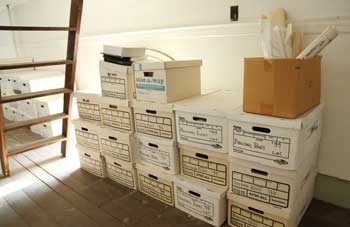
Boxes of documents crowd the floor on the second floor of Town Hall.
On the first floor, the storage issue is much the same. State requirements for keeping paper have resulted in stacks of boxes on floors and cabinets. For instance, the state requires that towns permanently keep payroll records for every person ever employed by the town. Assessment records for every property in town must also be kept forever. Even ballots from state and federal elections need to be kept for 22 months.
Because of the move that was to take place during the planned renovations, everyone has been purging whatever documents they can eliminate. Harvard got permission from the Massachusetts Secretary of State’s office to destroy some of them, and so far the staff has eliminated about 100 boxes of paper. But it’s a time-consuming task. According to Tim Bragan, “Bills from projects that we still carry debt on must be kept until the debt is paid off. So for instance, a box of bills from 2001 has to be gone through to see if any of them were from a project that we’re still paying for.”
More storage would eliminate town vault overflow
The town vault, currently housed in a separate building behind Town Hall, is supposed to be used to securely store permanent documents such as birth, death, and marriage records, as well as historic documents that require climate control. But the vault is currently used also to store the overflow of paper from Town Hall, such as the ballots from prior elections. Even paychecks are stored there because there is no secure storage inside Town Hall. The most recent Town Hall design did not include space for a vault, but Town Clerk Janet Vellante said that wasn’t an issue as far as she was concerned. “The vault is beyond capacity, but if we had a space for secure storage in the building, a lot of material could come in from the vault.” Vellante sees going outside to the vault as more of an inconvenience than a problem. When there’s bad weather, such as pouring rain, and someone asks for a copy of a birth certificate, she asks them to come back another day rather than risk damage to the document. “It doesn’t happen that often,” said Vellante.
The 2012 design called for a secure storage room, which all employees felt would alleviate the crowding problem in the vault and meet some of their own document storage needs.
No love for the ‘runway’
While employees would love to have an insulated building with a reliable heating and cooling system and enough space to do their jobs effectively, changing the design of the first floor from the current U-shaped layout is not something that employees want. The 2012 design called for a ‘through-corridor’ layout on the first floor, with offices in the main building located along the outer walls. “We call it ‘the runway,'” said Leonard.
First-floor employees like the present layout because there’s a lot of cross-departmental communication required in their jobs. The most recent design interferes with that and allots little space for additional staff. In fact, it designates no space for a receptionist. Leonard said that having regained that position this year, she doesn’t want to lose it again. Sue Fitterman agreed. “Having a receptionist is key. We need someone to direct people and to answer phones. People call Town Hall to ask all kinds of questions, like the date and time for trick-or-treating, or the hours the transfer station is open. And a receptionist is needed to give people good customer service.” The through-corridor of the 2012 design does not provide a suitable location, or recognize the role a receptionist position could play as the public face of Town Hall.
“What would people do?” asked Leonard. “Come in and shout ‘yoo-hoo’?”