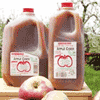
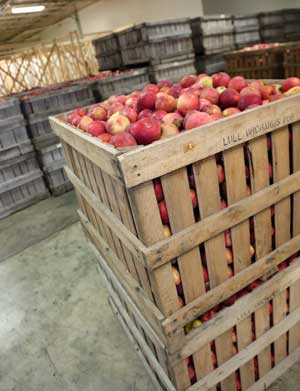
Crates and crates of apples in a chilled warehouse await their journey to becoming apple cider. (Photos by Lisa Aciukewicz)
This was a banner year for apples. Branches were loaded down with fruit, sometimes touching the ground. Local orchards’ coolers are still filled to the brim with apples. And that means it’s a good year for apple cider maker and Harvard resident Steve Rowse, president of New England Apple Products Co. at 320 Industrial Road in Leominster.
In 2011, Rowse bought Carlson Orchards’ apple cider business and moved the operation to Leominster. According to Frank Carlson, prior to the buyout, the Carlson brothers had added on to the cider processing area five different times. As a result, the operation had become inefficient. There was no more space for additional equipment. Without town water or sewer, wastewater from the cider mill had to be trucked away.
Increasing demand, limited support
And demand was increasing. They were turning away customers. “Steve did exactly what my brothers and I were talking about doing—moving the cider operation out of town—buying a building somewhere that had city water and sewer, so it could be the way it should be,” said Carlson.
Rowse was no stranger to the apple business. His family owned Veryfine until 2004, and he grew up in the business. When Rowse was a teenager, he worked in the production plant. After college, he worked in sales for five or six years, then marketing for 10 years, followed by a few years in operations. His younger brother, David Rowse, joined as chief operating officer in June of this year. “He knows operations, and I know sales and marketing,” said Rowse. “It’s pretty complementary.”
Rowse, who lives only about a mile and a half from Carlson’s, said the cider operation move from Harvard to Leominster went smoothly after a few bumps. He found a building in Leominster, but due to problems with the title, he couldn’t close on the building until mid-July. That left only six weeks until the start of cider season.
An ongoing partnership
They started moving equipment into the building Labor Day week. Frank Carlson was fielding calls from irate customers. “I kept having to tell them it would be a few more days,” Carlson said. “I told them they could put in a competitor’s product, but they all said they wanted to wait. That shows how loyal they were to our product.” By the end of September, pressing and bottling were fully operational, and Carlson’s cider hadn’t lost a single customer. Other than that initial delay, “it’s been a seamless transition,” said Carlson.
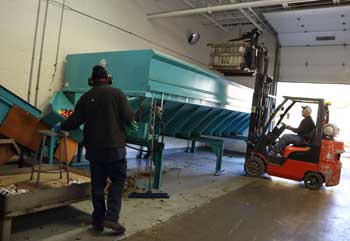
A fork-lift driver prepares to dump apples into the first bin of the cider-making process, where any debris (leaves, sticks, etc.) is removed from the stream.
Carlson is Rowse’s primary cider client, but he makes cider for other growers as well. When Rowse bought the cider operation, Carlson’s was bottling cider for about 12 different farms in New England, and Rowse continues to bottle cider for those farms. They include Davidian Brothers Farm and Tougas Family Farm in Northboro, as well as two of the oldest orchards in the country, Lyman Orchards in Middlefield, Conn. and Rogers Orchards in Southington, Conn. Carlson’s had also acquired “Rudy’s Blend,” originally made by Rudy Hetnar in Epping, N.H.; and Rowse continues to make Rudy’s Blend, which is sold primarily to Market Basket.
There’s no specific recipe for cider, but according to Frank Carlson, it’s not just a matter of dumping bins of one type of apple into the grinder. Before taking over the cider operation, Rowse spent a year at Carlson’s watching and learning. “He knows our formula,” said Carlson. “He knows it takes a good blend of varieties.” The varieties change during the season, typically starting with the more tart apples, and ending with the sweeter ones. Rowse elaborated, “Last week we had a lot of Cortlands. They don’t oxidize as quickly as some other apples, so the cider was about seven shades lighter. In about three weeks we’ll be using Red Delicious, which oxidize very quickly, so the cider will be darker.”
A variety of apples and growers
They use not only a variety of apples, but also apples from a variety of growers in each batch of cider. About five growers regularly supply apples to the mill. Harvard apples are well represented. In addition to Carlson Orchards apples, a small number of apples from Harvard’s Westward Orchards and Doe Orchards are used, as well as apples from Hazel U-Pick on Westcott Rd.

A ground apple slurry pours through spouts into a machine holding nylon bags that are then pressed to extract the juice.
Freshness is an important factor in Carlson’s cider. “What makes Carlson’s taste as fresh as it does is the method,” said Rowse. “We combine centuries’ old techniques with 21st-century technology. In the old days they ground up the apples, put cheesecloth on racks, and pressed the ground apples. That’s the way cider was made in backyards and cider mills for hundreds of years.”
On a recent November day, this reporter was given a tour of Rowse’s cider mill to see the techniques and technology. A forklift dumps bins of apples into a large tank, and the apples leave the tank on a conveyor belt. Workers pull out any bad apples, and the apples move on to the washing tank. Water is sprayed into the tank, and the apples are cleaned by bumping up against rotating brushes. From there, the apples go into a stainless steel grinder. Rice hulls, shipped here from Arkansas, are also put into the grinder to allow more juice to be extracted during pressing. The ground apples are pushed into nylon mesh bags, then pressed. Juice drains into a stainless-steel tray and is collected through a series of pipes into stainless-steel tanks.
Shipped as it’s made
Before bottling, the cider is pasteurized. To be considered pasteurized, the Food and Drug Administration requires that apple cider reach a minimum of 160 degrees Fahrenheit for a minimum of six seconds. The cider is then cooled down to a temperature of about 40 degrees Fahrenheit before it is put into bottles, labeled, and packed into boxes. The waste from the apples, called “apple pomace,” is used for animal feed. During apple season, it’s picked up once or twice a day. Rowse supplies pomace to a cattle farm in Dunstable and a pig farm in New Ipswich, N.H.
The cider that was being made on the day the Press visited was to be picked up the following morning by Robert Carlson and delivered to Roche Brothers Supermarket in Acton. Most days, the cider is shipped out the day after it’s made. That’s fresh! On a typical fall day, Rowse’s mill makes thousands of gallons of cider. It requires 10 full-time manufacturing workers and three temporary workers. The presses run from 7 a.m. until 6 p.m.; bottling starts at 8 a.m. and continues until everything pressed that day is bottled. The operation runs year-round, but off-season they press one day and bottle the next. In addition to apple cider, the plant produces cranberry-apple cider for Carlson’s, using cranberry juice from Decas Cranberry in Carver. They also make Carlson’s lemonade in the summer.
How has the 2013 bumper crop of apples affected Rowse’s business? “The phone’s been ringing a lot,” said Rowse. The fresh market is flooded with apples. In addition to New England, growers from Pennsylvania and Michigan are loaded. Smaller local growers are having a hard time finding a place to sell, so they’re looking to sell their apples for cider. That’s the opposite of last year—there were so few apples that by late spring, it was hard to find enough apples to keep the cider going.
Excess apples, but no excess cider
Prices have gone down this year as well, for both apples and cider. Last year, Rowse’s wholesale prices were over 50 percent higher than in 2011. This year, apple prices are back to about where they were in 2011, and Rowse’s wholesale prices are back to that level as well. But volume has jumped. “September this year was our biggest month so far, probably due to pent-up demand,” said Rowse. There’s no excess cider as a result of the bumper crop, though—it’s all made to order. The company ships to wholesale and retail companies in southern New England, as well as to one customer in metropolitan New York.

A machine squirts fresh cider into half-gallon containers.
Rowse usually talks to Frank Carlson several times a week on the phone, and he sees Robert Carlson, who hauls apples and cider to and from the mill, on a daily basis. Does Frank miss the cider operation? “I miss the camaraderie and dealing with the growers and buyers,” said Carlson. “I don’t miss fixing broken equipment and orders piled up over our heads.” It’s a change for Rowse as well. “It’s a much smaller operation than Veryfine. But the biggest difference is the product itself. It’s fresh, so the distribution channels are different. And it’s made to order.”
Evidence of a good year
The evidence that it’s a good year lies all around the cider mill. “This room was so full of apples this morning that you couldn’t even walk in,” said Rowse, as we walked through the apple staging area. Even the crooked and patched-up bins showed that the growers were using every bin that looked like it might hold together long enough to get their apples to the mill. “The first year, we were scrambling to put the plant together,” said Rowse. “The second year, there were hardly any apples. We finally got a good season.”