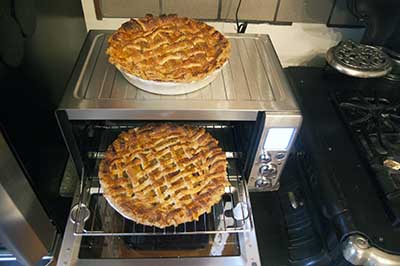
I’m putting a new kitchen gadget through its paces: a little Breville countertop oven. I think I like it, so far. It’s better than our other three ovens, which isn’t saying much. Pros: I think it keeps its temperature consistent and accurate, and if I shine my iPhone flashlight in the window, I can see what’s going on in there much better than I could in my other ovens. Cons, it is tiny, has no light, and I can only bake one pie at a time. It cooks a little hotter close to the door, so it’s not quite as miraculous as it thinks it is.
My pie life is going through a period of transition—one which I’ve eagerly been anticipating for about ten years, since I planted my first set of apple trees. Currently, my pies are probably a bit worse than they have been historically, but it’s a necessary phase. The issue is that my trees are finally producing fruit, so I’m working with new apple varieties, rather than Cortland, which have been my workhorse for the past ten years. Cortlands are really good pie apples: nice balance of sweetness and flavor, and they don’t turn brown when you cut them. When you cook them, they hold their shape. They are readily available at Carlson’s, Westward, Idyllwilde, and many other places close by. Probably, the trees are well adapted to our climate, why they so common. A sane, practical person need not bother with any other variety.
But why make it easy? I’m up to about twenty or so fruit trees now, and about eight of them are productive citizens. This year, I didn’t spray them at all, so the fruit needs work to join in polite society.
To learn how they behave, I’ve started precooking my apples, which adds a lot of time to my process, and changes a lot about my process, but it lets me see and taste what’s going on, so I’m doing it. Some pie bakers precook their apples anyway so that the filling doesn’t shrink so much during, which can lead to a big empty space under the top crust. (Horrors….)
Today, I tested six varieties from my backyard. Here’s what I know. And I’ll preface this by saying that some of my trees come from a disreputable vendor known for selling people the wrong variety, so it is possible that my results will vary from yours.
- Winesap: nice flavor when cooked, though it falls apart. Better for sauce than pie.
- Baldwin: ergh, I picked them too soon. But pretty good flavor, though it also gets a little mushy when you cook them. Browns fast. I know, I know, you can use lemon juice to prevent that, but I hate adding ingredients.
- Jonathan: Great flavor, and holds its shape and color nicely. Proud of my namesake on this test.
- Northern Spy. Holds its shape and color, but flavor is just a little boring. Hopefully, mixed with other varieties in the same pie, it will make a positive contribution to the filling community.
- Calville Blanc d’Hiver: Gets a little soft in cooking, but has a really exceptional flavor. I need to work more with this one to figure it out.
- Rhode Island Greening: I might have picked this one a little soon, as well. But it had a good, acidic flavor, and it holds its shape well.
- Conference Pears: Okay, okay, not an apple, but I’m becoming really fond of this tree. It’s interesting because the pears can be eaten soft or hard. Always a surprise, what the texture will be, and it cooks really nicely, adding a nice sweetness to the pies, and so I’ve been mixing them in with the apples.
My hope is that the new oven will improve my bottom crusts, as there is heat coming from the bottom and top, and it has convection, unlike my other ovens. Show time in a couple hours; looking forward to digging in!