Leaving the Nashua, we changed our route a little and arrived at Still River Village… just as the sun was setting. From this place… the prospect is beautiful and the grandeur of the mountain outlines unsurpassed. There was such a repose and quiet here at this hour, as if the very hillsides were enjoying the scene.
—Henry David Thoreau, "A Walk to Wachusett" (1843)

Along Still River Road in the 19th century. (Photos courtesy of Harvard Historical Society)
Named for a sluggish tributary of the Nashua, Still River is one of the oldest parts of Harvard, with deeds dating back to 1657. Today, people are drawn to Still River for the same qualities that drew people four centuries ago. The view to the mountains is spectacular; the land is fertile for farming; and the village has a strong sense of community. An additional lure for people today is the call of history: the old houses and the people who lived in them. Present-day residents will have the opportunity to visit some of these houses and meet their occupants at the Harvard Historical Society's Living History Tour of Still River Village on Sunday, Sept. 22, from 2 to 5 p.m. While the actual area to be walked is not extensive, people will be on their feet for over an hour. However, there is always the option of returning to the meetinghouse at any point.
Following the tour will be a facsimile of an old-fashioned "chowder" on the meetinghouse grounds, with food, games, and music. According to the journals of Louisa Willard Bateman, a native of Still River, chowders were popular at summer picnics in the middle to late 1800s. Louisa describes how the men and boys would go fishing early at Bare Hill Pond, and the fish would be made into a chowder. People would come to eat, swim, and boat. In later years the event became a picnic that was held at Turner's shores.
Mid-17th century beginnings
In the mid-17th century Major Simon Willard bought 500 acres of land along what are now Prospect Hill and Still River roads, and around West Bare Hill. Henry Nourse ("History of Harvard") waxes eloquent in speaking about Major Willard's purchase: "Perhaps there glowed in the heart of the old Kentish soldier a love for the grandeur and beauty of Nature which moved him to secure command of a site with so glorious a landscape spread out before it wherein elm-embowered valleys are encircled by a rolling expanse of hills rising with graceful curves to violet-hued mountains which melt into cloudland." Perhaps, but probably the reason for the purchase was more pragmatic than aesthetic. With the river running through, the land was perfect for farming, and an agricultural community developed along the spine of what is now Still River Road and over Prospect Hill, with farmsteads of more than 100 acres.
Although Major Willard never built on the land, his sons and grandsons did. The first houses would have been built close to the river, and the remains of Hezekiah Willard's farmhouse (1711) have been excavated on the yellow trail at Fruitlands Museum. One of the earliest and largest farms is believed to have been constructed by Moses Haskell in 1749. Purchased in 1802 by Abel Willard, it remained in the Willard family through the 19th century and until its sale in 1957 to St. Benedict Center. Henry Willard, the major's son, built the first garrison in 1687 at what is now 259 Still River Road.
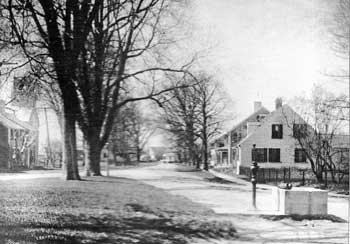
Still River Green in the 1800s
The Willard name resounds through four centuries of Still River history and lives on today into the fifth. At one point in the mid-to-late 1800s, it seemed as though almost everyone in the village was a Willard, or related by marriage, giving to the community a close, tight-knit feeling. William Bowles Willard, who grew up at his father Abel's homestead and later raised his own family there, was father to Louisa Harrod (Willard) Bateman, whose journals the Society recently acquired, and grandfather to local historian and painter Eleanor Willard Merrifield. A very colorful Willard was Orsamus, third cousin to William, who at age 19 went to work at the City Hotel in New York where he went on to become known as America's first celebrity bartender. When he returned to Still River after a 27-year career, he purchased 221 Still River Road where, according to F.S. Savage ("The Men and Their Descendants Who Made Harvard What it is Today"), "All the rooms had a number plate on the door, same as in a hotel." All these Willards from the past will greet tour-goers.
From farm to village
Still River Green, now diminished from its former size, lies at the center of the village, where the "two greatest roads meet and come together" (Nourse), one being Still River and the other Still River Depot, which used to go to Lancaster. The village followed the 19th-century movement away from agriculture toward industry, reflected in the growth of residences and barns on small house lots. Most every house had a store in it (and all stores could sell spirits), and some had a tavern. A Haskell family occupied 3 Still River Depot Road and, according to Nourse, "the Haskells monopolized Still River trade from this prime business location on the corner of two major highways for several generations." Gustavus Newell operated a store on the depot road, and Henry Harrod a blacksmith shop. Both burned in an 1883 fire, about which more will be learned on Sept. 22. The village had an academy, the columned house at 222 Still River Road, whose classical look was perhaps meant to inspire learning. In 1855 a postmaster was appointed and the nomadic history of the Still River post office began. Several physicians lived in the village, so many that some had to supplement their income by running a trade shop adjacent to their home.
Perhaps the centerpiece of the village was the Baptist Church, founded in 1776 by 14 worshippers under the leadership of Dr. Isaiah Parker. Six years later the members purchased a meetinghouse at auction in Leominster and had it taken down, moved, and rebuilt on the site at 215 Still River Road. In 1832, the greatly expanded membership voted to move that meetinghouse across the street and to erect a new building on the site of the old but a few feet nearer to the street. The old building was moved across the street and used as a parsonage until it burned in 1910. Revered Parker presided for 22 years, a dedicated preacher but a man embroiled in scandal over deeds and debts.
During World War I many tearooms sprang up in both the center and Still River. A Mrs. Holland ran the Red Maple Inn, and Helen Stone had the Still River Tearoom at Stonecrest (one of the houses now owned by St. Benedict Center). Both will be on the tour, but without the tea. In 1930 Chester Willard ran a guest house and tearoom at 204 Still River Road, known as Twins' Tavern.
In the 1920s Still River became a summer resort, where, according to Savage, "One by one the city people came to old Harvard to locate." A Mr. and Mrs. Ball owned Rosemary Cottage, and the Boston Globe reported on a housewarming party there in 1924, where "the genial host and charming hostess prepared a delightful program and decorated their house and grounds with flags and mottos appropriate to the observance of the anniversary of the Battle of Bunker Hill and also to note the formal opening of their new home."
In July of 1957 Father Feeney and Sister Catherine purchased the old Willard homestead and 17 acres of land for their religious order, The Slaves of the Immaculate Heart of Mary. Begun in Cambridge in 1940 as an educational lay organization teaching Catholic affirmations, Saint Benedict Center welcomed Jesuit Father Leonard Feeney as its spiritual leader in 1945. With increasing zeal Father Feeney and his followers preached the doctrine of "No Salvation outside the Catholic Church." Feeney incurred censure from the Church, and the group became a new religious congregation. They met with opposition on many fronts and began to fear for their safety in Cambridge. The farmlands and quiet of Still River offered them the opportunity to serve their faith in a different way.
The Society's event on Sept. 22 will cover much of this history in greater depth and introduce attendees to some of the more interesting "characters" from the past.
The walking tour, which will not include going into the homes, will be followed by an old-fashioned picnic with food, games, and music by local musicians on the meetinghouse grounds at 215 Still River Road. This will be a fundraiser to support programming for HHS and maintenance of its collections.
The afternoon will begin at 2 p.m. in the meetinghouse with a brief overview of the history of Still River. Reverend Parker, the first minister of the former Still River Baptist Church, will discuss the history of the church and ring the bell from Harvard Yard. From there, the tour will loop around the village, as far north as "Brickends" at 200 Still River Road, and as far south as the Abbey, stopping at several specific houses to hear their former occupants tell stories.
An old-time 'chowder'
Back at the meetinghouse will be local musicians, badminton, croquet, hoops, and more. Clam chowder will be served, along with cornbread, drinks, and apple crisp from Carlson's Orchard. Attendees are welcome to bring whatever other food and beverage they may want, as well as a folding chair or blanket for the picnic.
To help with tour logistics and with planning food, the Society is asking people to make a reservation by emailing the Society at curator@harvardhistoy.org. or by leaving a message at 456-8285. Attendees will pay the day of the tour with either cash or a check made out to HHS. A "ticket" is $7 for adults, $5 for kids five to 12, and free for kids under five. Without a reservation, the price will be $10 for adults on the day of the event. The admission includes the walking tour, bowl of chowder, cornbread, Orsamus Willard "cocktails," and dessert.
If it pours that day, the event will be held inside the meetinghouse. Parking is on the grounds of 215 Still River Road and down Still River Depot Road, if necessary. The society asks tour-goers not to park along the road or in anyone's driveway.
Information in this article draws on works by Nourse and Savage, material in Harvard Historical Society archives, Doug Cregar, and Tammy Alfano. Carlene Phillips is a member of the Board of Directors of the Harvard Historical Society.