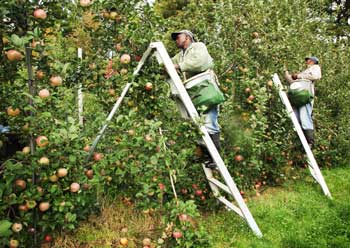
Jamaican workers pick apples at Carlson Orchards. (Photo by Lisa Aciukewicz)
When Carlson Orchards was audited by the Department of Labor (DOL) in April, 2012, the last thing Frank Carlson expected was to receive a bill for $23,000 in unpaid overtime for his workers. But that is exactly what he got. Over the past few years, the Department of Labor has been auditing small farms across the country, and many are being hit with bills for unpaid overtime that they thought they were exempt from. A recent article in the Boston Globe brought this issue to light.
According to the Fair Labor Standards Act of 1938, employees working more than 40 hours a week must be paid time and a half. But agricultural employees have always been exempt. Recently, the Department of Labor has been interpreting the term “agricultural employee” to mean someone who handles only the crops of their employer. As soon as an employee touches a crop from another farmer’s farm, the agricultural exemption no longer applies. But farmers typically buy produce from each other, either when they get an order for a variety of items, some of which they don’t grow, or if they don’t have enough of one item. That was the case with Carlson.
A surprise from Labor Department
“We had packed a load of apples from a grower in Maine,” Carlson told the Press recently. “When the DOL came in, they asked to see all of the accompanying documents concerning that order. When they started auditing the payroll, they could see that some of our packers worked more than 40 hours that week, and they wanted to know the exact days that we packed the apples for the Maine grower.” And, according to Carlson, the DOL informed him that even if a worker packs someone else’s apples for one day, “they come under the time-and-a-half law for the week. Not just for the day they packed those apples, but for the whole week.” This was news to Carlson.
The audit continued, covering all of 2012 and 2011, leaving Carlson with a huge bill for unpaid overtime as well as a civil penalty that “was not as big as it could have been. We wrote the check that day and sent it back.” The DOL will be back to audit him every year for the next five years.
Carlson is now more careful about where he puts his workers, but sometimes he needs to use the hard-working Jamaicans in a situation that will call for overtime pay for the week. “We slice apples for bakeries every Wednesday. We slice a lot of our own, but we don’t have a lot of our own right now, so we buy in from other farms. We have some temp workers slicing, but they’re not very experienced, so we have two Jamaican workers helping slice because they know what they’re doing. Those two Jamaicans come under time and a half for the whole week. And they’re here to work. The cost adds up,” explained Carlson.
Increased wages mean higher packing fees
As a result of this increase in expenses, Carlson has had to raise the packing fees that he charges other growers. “My main goal in packing other people’s fruit is in keeping the big wholesale customer that we have,” said Carlson. “But it also helps out the other farmer because he doesn’t have an outlet for all of his fruit. It’s a good situation for everyone.” Carlson sometimes packs fruit from Westward and Doe orchards, as well as orchards in Littleton and Groton.
“The biggest thing is not necessarily our little packing operation, but all farmers who use other people’s products. The Farm to School Program is one example where that happens,” said Carlson. According to the U.S. Dept. of Agriculture, one mission of the Farm to School Program is “to bring local or regionally produced foods into school cafeterias.” It’s easier for most schools to deal with a single farmer, so many farmers who participate in the program look to other farms for crops that they themselves can’t supply. Those crops need to be packed and in some cases peeled and sliced for the schools. Farmers now have to pay time and a half to workers who work with other farmers’ crops, and for some, it’s just not worth it. “I know some farmers who are getting out of the program because they don’t want to deal with this anymore. You’ve got the USDA pushing the Farm to School Program, and you’ve got the DOL throwing up these roadblocks,” said Carlson.
Threat to Farm to Schools program?
While Bromfield Chef Paul Correnty doesn’t participate in the Farm to School program, he’s a one-man farm to school program himself, and some of the farms that he buys from may be affected by the DOL’s new rule interpretation. On weekends, Correnty travels to local farms to buy produce for school lunches for the week. One of those farms gets a lot of its root vegetables from farms in the Connecticut River Valley. “The soil around here is rocky, so you get these little nubby, gnarly carrots,” said Correnty. “But out there they have river soil, and the parsnips and carrots are second to none.” He also buys salad bar vegetables from a local farm that purchases fruit elsewhere. Both of these farms are in the same situation that caused Carlson to be blindsided by the DOL. Correnty commented, “I’m sure that what happened was that one factory farm violated the law, so they did a one-size-fits-all rule for everybody. It’s a shame.”
H2-A woes
This is not the only government roadblock that faces Harvard’s farmers. Stephanie Waite of Westward Orchards spoke to the Press recently about the growing difficulties Westward faces hiring H-2A workers from Jamaica every year. According to the Department of Labor, H-2A is “a program that allows agricultural employers who anticipate a shortage of domestic workers to bring nonimmigrant foreign workers to the U.S. to perform agricultural labor or services of a temporary or seasonal nature.” To apply for H-2A workers each year, large amounts of paperwork must be submitted within a small window of time, and any discrepancy can raise a red flag. Red flags take time to resolve, and if the window closes, a farmer may be out of luck. “That happened to me once; the way that I wrote two of my dates didn’t match, and we didn’t get our workers that year.” said Waite.
Labor Department mistakes cost the farmer
Even when it’s the DOL’s mistake, it can end up costing the farmer. “One year I asked for workers with a month of experience. My application was denied. They said I couldn’t ask for that.” She knew another orchard had asked for the same amount of experience, and their application, submitted earlier than hers, was approved. The New England Apple Council, a nonprofit organization that represents New England apple growers, went to court for Waite and won. “But that set me back,” said Waite. “I got my guys a month later than I asked for. It seems like they don’t make it easy to do the right thing.”
In addition, yearly inspections of the H-2A workers’ living quarters are extremely thorough. Waite gave some examples: “They look at everything—the bed linens, the pillows, the pots and pans, the utensils. They’ll ask us to replace something as small as a chipped dish.”
Evolving rules impact workers, too
The workers themselves also face adversity from evolving government regulations. In 2010, a law was passed requiring H-2A workers to pay federal income tax, not just for 2010, but for 2008 and 2009. Workers were shocked to find that they owed thousands of dollars in back taxes. “These are people who don’t have a lot of money. It was a hardship for them,” said Waite.
Will anything change for the better? As far as H-2A goes, the immigration reform bill, if passed, would have an impact on that program, possibly replacing it with an agricultural guest worker program. Whether or not that would be an improvement remains to be seen. As far as the DOL’s new interpretation of “agricultural worker,” it’s not something that small farmers have the time or financial resources to fight. Carlson thought that there might be some work going on behind the scenes by the USDA, but “whether it’ll amount to anything, I don’t know. It’s one of those things you have to live with, and we’re trying to adjust to it.”