—Joe Schmidt,
commissioner,
Parks and Recreation
Like a late-night family argument that just goes on and on, the layout of the town beach continued to embroil the town in an ongoing debate last week that bordered on civil unrest. But by Monday, the Parks and Recreation Commission had made changes that promised to separate at least two groups of regular weekday patrons—afternoon swimmers and Bare Hill rowers—whose activities have been at odds ever since crew season began after Labor Day.
The changes were visible on Monday, as skies cleared and crew team members arrived for their afternoon practice. The dock on the right-hand side of the beach, which is used to launch the lengthier sculls of the Bare Hill Rowing Association (BHRA)—the so-called “eights”—had been shifted to point toward the lane to the right of the beach that is used by kayaks, canoes, and motor boats throughout the year.
Swim area designated
In addition, a “swim line” had been added, marked by a string of floats stretching diagonally for 100 feet from the middle of the beach to the site of the “No Wake” drum, a familiar site to swimmers and boaters during the summer months. Under the new scheme, swimmers can swim freely to the left of the line, while BHRA crews are asked to launch toward the boat lane and avoid the swimming area altogether.
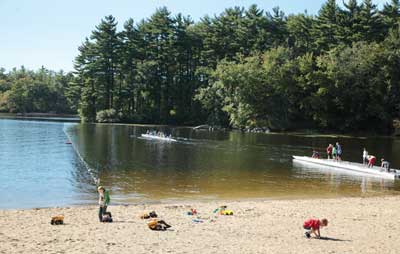
Children play on the beach as crew boats launch on the afternoon of Sept. 17. The area to the left of the buoys is reserved for swimmers. (Photo by Lisa Aciukewicz)
As the practice week began on Monday, the beach was nearly empty, save for the 80-odd rowers making their way in groups from the parking lot to the dock. But the scene was very different last week, when three incidents involving crew members and swimmers put everyone on edge, leading to rumors of “appalling behavior” and “civil disobedience,” as well as two calls to the police and a discussion at the Monday night meeting of the Parks and Recreation Commission.
Blocking the crew dock
On Monday Sept. 9, according to eyewitnesses, when two girls boats were returning from practice, they were blocked by five Harvard residents—four women and a man—who were seated next to the crew dock and who asked the rowers to land elsewhere. According to BHRA coach Holly Hatton, the two crews were forced to row their eights to the cement boat launch to the right of the beach and remove their paddles and shells there. It was a danger to both the girls and the boats, she said. “It was a bad idea. We won’t do that again,” she told the Press.
A second incident occurred on Thursday afternoon when, according to BJ Pessia of the Parks and Recreation Commission—who heard it second hand from the coxswain of a girls boat and others—a man was seen videotaping his wife, who was swimming “very close to the boats.” The crew member told Pessia she thought the woman wanted to purposely interfere with their docking. The incident was reported to the police, who did not follow up (See the Police Log for Thursday, Sept. 12). The BHRA also received two calls from parents who reported their daughters were “creeped out” by the videotaping, Hatton told the Press
However, another male frequenter of the beach who was present that day, and did not wish to identify himself, said he saw a different woman swimming in the area as well. “[She] was doing laps,” he said. “No swimmer would do anything as petty as to interfere with the boats.” But, he added that from his point of view, the rowers “did not seem to be cognizant that others were using the beach.” He said he had spoken to coach Scott about his concerns.
Parks and Rec Commissioner Joe Schmidt told his colleagues at their meeting this week that when he went to the beach to investigate the videotaping incident, he had found two residents seated in chairs in front of the crew dock, a repeat of Monday’s incident.
A sunny day; a canceled practice
Crew team practice was interrupted a third time on Wednesday by a big turnout of swimmers and sunbathers, drawn to the beach by the hot afternoon weather. “There were more than 100 people on the sand, in the water, and even on the crew dock,” BHRA coach Pat Scott told the Press. “I knew that trying to launch our boats would not end well,” he said, so he canceled the practice and sent the crew home.
The disruptions of last week spilled into the Parks and Recreation Commission meeting on Monday night. The commissioners bemoaned the lack of neighborliness among the people competing for beach access, but also blamed many of the problems on a lack of adequate space, an unforeseen consequence of changes made by the Pond Committee in implementing its new stormwater drainage system.
“We’re getting complaints from every conceivable angle,” said Chairwoman Pat Nelson. “The fishermen are livid because there’s no place to park their trailers. …The canoe and kayak people are unhappy because they have to lug their [boats] through a maze of space, hitting their heads, with no place to beach their boats…The crew boats are up in the parking lot. It’s a problem.”
In addition, noted Schmidt, “There is a group of swimmers out there, god bless them, and … they plan to swim through October. We have some polar bears. “
“That’s the same group that was there last year,” said Nelson.
“But the dock’s in a different place,” said Commissioner Anne McWaters. “It used to be in the lagoon.” In its current location, the structure is anchored at a spot favored by seniors who wish to avoid the press of children in the center of the beach.
“New layout is not workable”
“The new layout is not workable,” said Commissioner Joe Schmidt. “Shame on us, shame on everybody in the town for not saying, ‘hey, what in the heck are you guys doing?’ It’s cut beach space. It’s made the beach even smaller than it had been before.”
But, Schmidt continued, “From my point of view the problems that we’re having now—none of them are associated with Bare Hill Rowing. I don’t know what’s going on here, but we’ve got to start to ratchet all this pressure down and start acting like good neighbors… and try to make everything work because we’re in a difficult situation.”
Harvard Harbormaster Bob O’Shea, also present for the meeting, agreed. “We’re all trying to share a common resource,” he said. “The decisions we make about shared resources should be based on the usage and the limitations of the equipment. Everybody is going to have to compromise….You’re going to get a complaint from everybody.”
Current arrangements at the beach don’t seem to please anyone. But if that’s the case, what’s their origin?
The design of the stormwater drainage system that was built this summer was arrived at after public hearings, was approved by the Pond Committee, its sponsor; the Conservation Commission and the Parks and Recreation Commission. But the design pictured the crew dock remaining on the inlet, where it has been for the past few years. The plan also clearly shows space for two crew boat racks to the right of the boat launch.
Tom Cotton, a member of the BHRA Board of Director, wrote the Press that he and coach Holly Hatton had walked the beach with the Pond Committee as the changes were being planned.
“They wanted to make sure all the parties’ concerns and needs were addressed. I was on at least one site visit with all the parties. I thought that, based on pacing out distances, there would be sufficient space by the new swale for both the BHRA rack and the town’s canoe and kayak racks.”
“In the spring, once the pond filled back up,” says Cotton, “it was clear there was no space for the BHRA rack by the swale, nor would a corridor to access the dock in the lagoon be possible.”
The one person who was not consulted was Harbormaster O’Shea, the one who determines where docks can be placed on the pond. In the permit that he issued the BHRA this year, he allowed for docks to be placed on the lagoon, the beach, or near the boathouse foundation. Once it became clear that using the old lagoon site was not feasible, Parks and Rec decided to place that dock on the beach, where it sits today. This time it was swimmers who were apparently not consulted.
While the commissioners hope the newly designated zones for crew and swimmers will provide a temporary solution for the rest of the fall, the commission also reaffirmed its decision to engage GPR engineering of Ayer at a cost of $1,200 to look for more permanent alternatives. “Let’s see what [GPR] can do to give us more space,” said Nelson. The solution, said Schmidt, will require the collaboration of the Pond Committee, the Conservation Commission and Parks and Recreation. “We’re all going to have to put our heads together, ” he said.