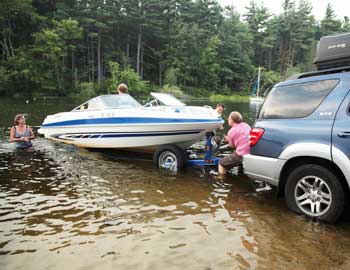
The Mitchell family pulls its boat out of Bare Hill Pond after a day on the water, Sept. 1. (Photo by Lisa Aciukewicz)
Keeping Bare Hill Pond weed free and unpolluted, but still usable by boaters, swimmers, crew teams, sunbathers, and sunset-watchers, is a continuing challenge for the several committees whose responsibilities meet and sometimes overlap at the water’s edge. Add canoers, kayakers, water-skiers, ice skaters, fishing derby competitors, and nature lovers of all sorts to the mix, and the issues become even more complex.
Use of the pond falls in various ways under state laws, town bylaws, and the jurisdiction of several town bodies, including the Bare Hill Watershed Management Committee, the Conservation Commission, the harbormaster, and the Parks and Recreation Commission.
Battling weeds
The most visible changes to the beach area this year were the result of projects implemented by the Watershed Management Committee, usually referred to simply as the Pond Committee. From its formation in 1987, the Pond Committee has struggled to reduce weed growth in the pond, using weed pulls, a mechanical harvester, and–most recently–winter drawdowns. In the late 1980s, a mechanical harvester gathered up as much as 690 tons of invasive weeds in one year, according to a feasibility study prepared for the committee. In 1999, Bare Hill Pond was placed on the state’s list of endangered ponds.
Rick Dickson, who has worked with the Pond Committee on weed eradication, says this is the first time in 20 years that there has been no need for a public water chestnut pull. He himself has still put in about 50 hours of weed pulling this year, he reports, but that is down from 80 hours in recent years.
Over the past four years, the Pond Committee has spent nearly a million dollars in grant money to reduce the amount of run-off that reaches the pond from roads, woods, parking lots, and athletic fields. Those projects came to completion this year, leading to substantial changes around Bare Hill Pond, including different parking places, new landscaping, and a reconfigured boat launch.
Redoing the boat ramp
The new boat launch and ramp were perhaps the most contentious of the changes. While the project was still in its early stages, Littleton Road resident and longtime boater Dick Ohlin raised questions about the configuration of the launch ramp, the reduction in parking spaces, and the use of coarse riprap (painful to bare feet) in areas where people carry canoes in and out of the water.
Harbormaster Bob O’Shea of Old Littleton Road says he has heard most complaints about the shallow angle of the launch ramp, which forces boaters to back in so far that their whole rear axle is in the water. In a letter to the editor (August 23) Darrell Wickman of Willow Road said that the ramp was so shallow as to be a hazard.
Christopher Ashley of Woodside Road came to a similar conclusion, saying “My experience is that changes at the beach make it harder to queue up and get in and out of the launch area.” Ashley said his 18-foot boat is similar in size to many family boats he sees on the pond. The shallow slope of the ramp, he explained, means that he has to back too far into the water, with effects that are not good either for the car or the pond.
Pond Committee Chairman Bruce Leicher acknowledged that the pitch of the launch is currently a problem, but he said that the ramp was designed correctly. He explained that the poor slope results from an excess of fine gravel that the Department of Public Works (DPW) added at the launch area. The gravel was added to turn the coarse riprap at the sides of the launch into a smoother surface for better footing. Leicher said that the DPW plans to remove about six inches of gravel at the foot of the launch ramp when the area becomes accessible during the winter drawdown. He expects that to fix the problem with the slope.
Leicher noted that the three-year project to reduce the amount of run-off that reaches the pond from roads, woods, parking lots, and athletic fields has led to a 50-percent drop in the amount of phosphorous in the water. Excessive phosphorous is one factor in the growth of algae and weeds. He noted that native plants were returning to the area of the pond around Bowers Brook, replacing invasives such as millefoil.
Finding storage space for boats
As a recreation facility, the town beach also falls under the jurisdiction of the Parks and Recreation Commission. At a meeting earlier this summer, members of the commission walked around the beach in the evening and pondered how to better arrange the canoe racks now snugged up close against the shore beside the boat launch. The racks provide storage for 100 canoes and kayaks, with long and short ones projecting randomly at all levels. This summer the racks were set so close together that people were likely to bump their heads on the longer canoes while walking between the racks, according to complaints that had reached the commission and the harbormaster. Parks and Rec members proposed organizing the canoes and kayaks by length, so that there was less hazard at head height.
Harbormaster O’Shea said in a conversation with the Press that the plans for the reconfigured beach area had shown the canoe racks placed farther back in the woods. At their meeting, Parks and Rec members discussed several plans for moving some of the racks farther into the wooded area. But there they are limited by yet another group that watches over the pond.
Cutting trees and managing drawdowns
The Conservation Commission has a limited but crucial role in protecting the pond and its surroundings. Under the town’s protective bylaw, any activity within 200 feet of the pond (or any other body of water) requires a permit from the Conservation Commission. A permit is required, for example, for building a deck or a dock, putting in a driveway, or cutting trees. Removing trees at the pond would pose a particular problem because tree roots prevent erosion and run-off into the water. So simply chopping down several dozen trees to make room for more canoe racks would not be an option.
The commission also collaborates with the Pond Commission in the timing and extent of the winter drawdown. According to conservation agent Liz Allard, the commission’s main concern is protecting the condition of the wetlands downstream of the pond. Another concern is the animal species that live in the pond. For example, some turtles overwinter by burrowing in the underwater mud. It’s important that the drawdown be complete before they do so, or their burrows may be exposed to the freezing winter air.
Every aspect of managing the pond for beauty, recreation, and environmental health is a complex process of balancing a wide range of interests and jurisdictions. “You don’t have to look far,” says Conservation Commission member Wendy Sisson, “to see ponds in other towns in bad shape, ponds you wouldn’t want to swim in or live next to.”