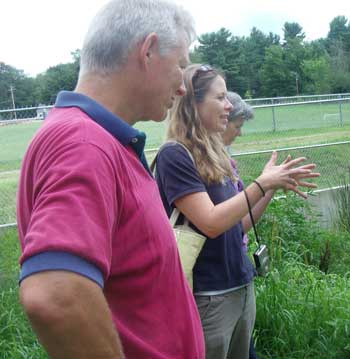
DEP Grant Administrator Jane Pierce (far right) and former Selectman Bill Johnson listen, as Stormwater Project Manager Michelle West (center) from Horsley Whitten Group explains how one of the new town center storm water diversions works. (Photo by Sydney Blackwell)
Harvard’s Stormwater Management Program, most evident in the revamped Town Beach, caps a decade of Bare Hill Pond water quality improvement projects driven by the Bare Hill Pond Watershed Management Committee, more commonly known as the Pond Committee.
Last week, to celebrate successful completion of a decade of projects, current and former Pond Committee Chairmen Bill Johnson and Bruce Leicher organized an afternoon of recognition and appreciation for those involved in the work, as well as a tour of stormwater management installations and the Willow Road Pump House. The many groups and individuals who attended could be read as shorthand for why the projects were successful: committed volunteers, collaboration, professional expertise, perseverance, and grant money.
Among those present were representatives from the Pond Committee, Conservation Committee, Board of Selectmen, and Department of Public Works, as well as state Department of Environmental Protection (DEP) grant administrators, and Horsley Whitten Group members. Sen. Jamie Eldridge, conservation agent Liz Allard, and other interested individuals were also present. However, the Parks and Recreation Commission, whose chairman, John Lee, resigned last week, was not represented at the event, although its contributions have been significant.
“Harvard is a showcase of what can be done,” said Mass DEP’s Jane Pierce, who administers a grant program authorized under Section 319 of the federal Clean Water Act for projects that limit nonpoint source pollution in water resources. Among Massachusetts towns, Harvard stands out for what a committed collaboration of volunteers, town government, and professionals can accomplish, she said.
Fifteen years ago, Bare Hill Pond was added to the state’s list of impaired lakes and ponds, after the level of phosphorus in the pond was assessed to be too high—44 mcg. per liter, against a state recommended limit of 30 mcg. Phosphorus levels are considered a factor in excessive pond vegetation and loss of oxygen in the water. Tests this April and May showed phosphorus levels of 20 mcg., well below the state’s recommended limit.
Johnson and Leicher credited three very different projects with success reducing weeds or the phosphorus that feeds them: water chestnut eradication, the Pump House Deep Drawdown project, and the Stormwater Management Program.
Rick Dickson, one-man weeding machine
“The pond’s biggest friend is Rick Dickson,” Johnson told the gathering.
Longtime seasonal resident Rick Dickson and his canoe accomplished what years of organized weed pulls could not—ridding the pond of invasive water chestnuts. Day after day for more than six years, in all kinds of weather, Rick Dickson left his seasonal home on Sheep’s Island to hand pull water chestnut plants from the pond or clear them with town’s weed harvester that he pestered DPW into repairing. Where chestnut infestations were once taking over, particularly in the southwest and northeast coves, few can be found, and the plants’ spiny, foot-piercing seeds are no longer the beach hazard they were.
The Pump House Gang
The dam at the north end of the pond raises the water six and a half feet from its natural level, creating a third of the pond’s 318 acres. When the Pond Committee wanted to reduce the water level with a winter drawdown to affect the milfoil and fanwort growth, the drawdown was limited to only three and a half feet, because a higher culvert under Still River Road had replaced the earlier, lower one.
To get a deeper drawdown, the committee developed plans to pump water from the pond over the dam and into the wetlands between the pond and Still River Road, and north via Bower’s Brook. It was a daunting and expensive proposition. Then Pond Committee Chairman Johnson spear-headed the project, pulling in a large group of committed volunteers, town officials, and professional experts, and leveraging federal Section 319 Clean Water Act water quality grants. S.319 grants require 40 percent matching funds that the committee met with some money from the town and an extraordinary number of “in kind” volunteer hours.
The 125-horsepower pump can draw water from an 80-foot-long pipe into the pond and over the dam at rate of 10,500 gallons per minute, though it is run at a slower rate. Volunteers built an unobtrusive, natural-shingled, cabin-like building with a removable roof to house the enormous pump.
Managing runoff
Because phosphorus collects on roadways, where it adheres to fine particle sediment, and enters the pond from road runoff, the Pond Committee turned its attention to reducing the amount of phosphorus entering the pond by reducing and treating runoff from the town center. Again the committee leveraged state-administered federal EPA funds, town Community Preservation Funds and town allocations, and volunteers’ hours. Environmental engineers at Horsely Whitten Group designed and oversaw the creation of nine best-practice sites to remediate the runoff from Mass Ave. and Pond Road.
On a tour of the project last week, Johnson and Horsely Whitten Group’s Stormwater Project Manager Michelle West pointed out the largely hidden installations and explained their functions. Much of the recent Town Beach redesign was driven by stormwater management requirements. Water redirection, natural vegetation, and hidden swales keep phosphorus and pollutants from entering the pond in visually appealing ways. Theoretically, they will also help reduce the pond weeds, bane of bathers and boaters. A bonus is improved drainage in the Pond Road and Mass Ave playing fields.
A giant bathtub
Keeping phosphorus from entering the pond is very important, but Leicher and Conservation Commissioner Wendy Sisson agree the big phosphorus reduction is mostly likely from the annual deep drawdowns that flush out the pond’s water.
Sisson explained that springs in the Bare Hill Watershed feed fresh water into the pond from several points, including Bowers Brook and Clapps Brook.
“It is like a giant bathtub that drains and fills,” she said.