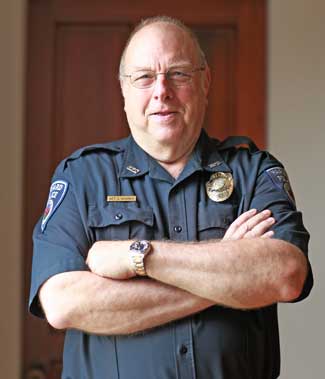
Detective Greg Newman (Photo by Lisa Aciukewicz)
When Detective Greg Newman retires from the Harvard police force on July 20, it will mark the end of an era. Newman grew up in town, has lived here for six decades, and admits to being partial to the old ways.
Growing up in the 1950s and ’60s, Newman recalls having a great deal of respect for the police, not so much for what they might do to an unruly teenager like him, but because of what his parents would certainly do if they found out he was in trouble.
Police respected,
but parents feared
Back then, “Police were respected and parents were to be feared,” he says. “It was nothing to get slapped in the head” by the police chief, “but please don’t tell my father.” Greg’s parents, Phyllis and Churchill “Chick” Newman, owned and operated New Manor Hall, a rest home on Bolton Road, where everyone enjoyed warm summer evenings on the spacious front porch. Whenever the tranquility on that porch was disrupted by the unmistakable sounds of Greg and his friends reveling at the pond, or of his car racing up Bolton Road to get home, Chick would simply take the car keys for a week—a punishment far worse than anything the police could dish out.
Nothing in Harvard has changed more than that, Newman says, lamenting what he sees as a steady decline in parental authority and respect for the police. He attributes the change to a permissive culture and to “parents who think their kids can’t do anything wrong.”
Changing attitudes towards drug use
Newman knows otherwise, but he has been around long enough to take the long view. He has seen kids grow up and outgrow problematic behavior, and he fully understands why parents want to avoid police intervention if possible. What he doesn’t understand is why some parents don’t seem to care about their children’s drug use—don’t see it as a problem. As a police officer, drug investigator, and first responder in medical emergencies, Newman is acutely aware of the real-world consequences of substance abuse in Harvard—and not only among teenagers.
Asked to name the most difficult part of his job, Newman hesitates, but only for a moment. “Dealing with domestics, especially when you’re dealing with people you know,” he says. More often than not, substance abuse plays a big part in domestic disputes, which seem to be on the rise, he adds. “When you know the family well, it’s hard not to get emotionally involved in a domestic problem,” he relates. “Sometimes you have to recuse yourself and let another officer handle it.”
Liability has replaced leniency
In almost 30 years with the Harvard police—starting as an auxiliary officer in 1984—Newman has seen enormous changes in law enforcement as traditionally practiced in a small town. Not so long ago, it was not uncommon for patrol officers to allow an inebriated town resident—someone they knew—to drive home, or be driven home, on his or her word that they’d stay off the road until sober. Reports of domestic assault were often handled informally as well, with on-the-spot counseling and perhaps a suggested cooling-off period. But the issue of liability has changed all that, Newman says, and officers can no longer take a chance that such lenience won’t result in tragedy.
Spread of scanners alters dispatching
Another big change for patrol officers was the advent of computer technology. Every officer has a laptop now with instant access to the Registry of Motor Vehicles and to the dispatcher, which enables “silent dispatching,” Newman says. “Scanners are a problem,” he explains, in that so many people have them, including dozens of teenagers who serve as EMTs. So when a complaint about a loud party comes in, it makes sense to dispatch a cruiser by computer rather than by a broadcast that anyone with a scanner can hear. Otherwise, there’s not a sound by the time the cruiser arrives, which might satisfy the neighbors but masks what could be a serious situation for underage partiers.
Growing up in Harvard has its advantages and disadvantages in doing police work here, Newman says. A clear advantage is that he knows many families very well—at least the ones who’ve lived here awhile; he’s watched their kids grow up, fixed their cars when he worked as a mechanic years ago, and has a hometown understanding of their circumstances. Sometimes that can be a disadvantage, too, when personal feelings make doing a hard job even harder. But Newman says he loves coming to work every day and he’s nowhere near ready to stop doing it. Nevertheless, retirement is mandatory for police officers at the age of 65, a milestone he’ll reach early next week.
What’s next?
So what’s next? What does a Vietnam veteran, experienced mechanic, drug investigator, firearms instructor, and retired detective do with a big chunk of leisure time? Long a competitive marksman, Newman plans to enter upcoming pistol competitions in Florida and Las Vegas, a shooting vacation of sorts. He’s also going to spend more time fishing, enjoying the pond and however many bass he can haul out of it.
And in the fall, he hopes to be appointed a special police officer so he can do road details, assuming that the state legislature approves Harvard’s enabling home rule petition as expected. That gives him another five years in uniform, which might just be long enough to see the Ayer Road bridge work finished.