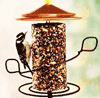
I get many questions about feeding birds. There are different schools of thought as to the advisability of doing so. In general, birds do not depend on home feeders, as there are usually ample natural resources. The reason I feed birds is to attract them to the farm so I can easily enjoy watching and studying them. An important benefit of creating a bird-friendly habitat is that the birds glean a lot of what some people consider bothersome or harmful insects. Among my barn swallows, tree swallows, bluebirds, and other insect eaters, we have few mosquitoes and can dine on our terrace every night in the summer without being bothered by them. Having a pond producing dozens of dragonflies also helps, as they are voracious insectivores. Rather than using harmful chemical insecticides and herbicides, I would rather let birds do what they do best—eat bugs.
If you have a barn, please consider leaving it accessible to barn swallows. I can think of at least six barns that have been demolished in Harvard over the years. This is a major reason that barn swallows are in decline as these beautiful birds are dependant on barns for nesting places.
Birds have different food preferences: some species eat seeds and berries, others insects, and some, like vultures, dine on carrion. Some birds, such as bluebirds and tree swallows, shift their diet to high-fat berries and fruit before migration to increase their fat reserves for their long flights. Birds adjust their food preferences to what’s available. For instance, phoebes prefer insects but will eat seeds when insects are scarce.
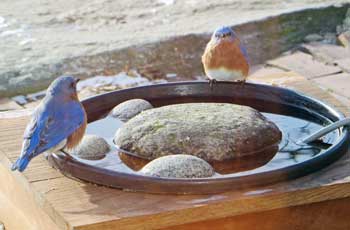
Winter bird bath (Photos by David Durrant)
I would suggest that you do not even think of feeding birds on your property if you have a free-roaming cat. It is estimated that cats kill 1.4 billion to 4.7 billion birds a year and are the biggest cause of bird mortality.
Natural plantings: Probably the ideal way to attract birds to your property is to create a bird-friendly habitat. Plant fruit- and berry-bearing trees that birds enjoy; let your grass grow to provide cover and seeds for seed eaters; develop bushy areas for cover and food; and leave brush piles. Plant flower gardens that not only you will enjoy but will also attract hummingbirds and butterflies. Leaving dead snags in your woods will provide food and cavities for cavity-nesting birds. I would recommend “The Audubon Society Guide to Attracting Birds,” by Stephen Kress, as a very informative reference book for creating natural habitats for properties large and small.
Do not use chemicals on lawns and gardens. Remember DDT? If you do feed birds, hang the feeders close to a tree or a bush to provide natural cover from predators. If you place feeders close to the house it is best to position them no more than two or three feet from a window. This helps alleviate window strikes. Window strikes are the second most prevalent killer of birds after cats.
Just about all birds need and enjoy water. We have several birdbaths that I have chiseled out of pieces of granite. I have a thermostatically controlled heater that I put in one of my containers for the winter months. Birds are more attracted to water if there is a slow drip or a small fountain. One of my summer projects is to build a water feature with a small pump to provide a little movement. We have a pond and stream that attract great blue herons, kingfishers, and ducks, but having the birdbaths right on the terrace lets us enjoy the sight of birds taking baths and drinking water.
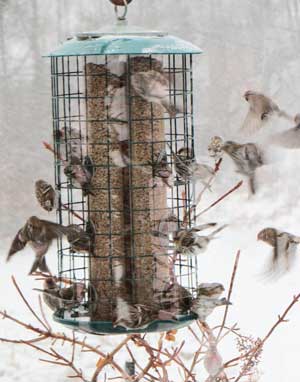
Tube feeder with common redpolls.
Sunflower hearts: These are expensive, but they do not leave the mess of hulls under feeders that result from the use of seeds. They can be placed in any tube-type feeder and hung from a nearby tree on a long wire to deter squirrels. Every feeder I own—except for those I have built and one other—I have found at the dump.
The birds attracted to sunflower hearts at my feeders are bluebirds, red-breasted nuthatches, white-breasted nuthatches, tufted titmice, chickadees, goldfinches, redpolls, pine siskins, and, my favorite, (being English), English house sparrows. Larger birds like blue jays, grackles, and red-winged blackbirds will also eat the hearts, but they have a harder time getting to them because of the design of the feeder.
Sunflower seeds: Cheaper than hearts, but these will not attract smaller seed eaters, as birds must crack open the shell to get at the meat.
Mixed birdseed: This seed is usually a mixture of millet, milo, corn, and sunflower seeds in various proportions. This can be put in tube feeders or scattered on the ground to attract ground feeders. If you do scatter on the ground, do it in small quantities so as not to attract varmints. I built a platform feeder blueout of an old window screen and put it on a pole. This still attracts ground feeders and would be a good solution if your dog eats your seed off the ground as Carlene’s does.
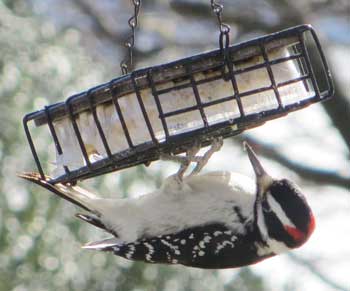
Suet feeder with hairy woodpecker.
Birds that use this feeder are blue jays, red-winged blackbirds, grackles, morning doves, cardinals and— if you are lucky—towhees.
Niger or thistle seed: This seed needs a specially designed feeder for this small seed. It will attract the smaller finches, like goldfinches, pine siskins, and redpolls.
Suet: You can buy suet at the market but you can get a lot more for your money if you go to one of the local slaughterhouses—Bloods in West Groton or Adams Farm in Athol. If I run out of regular suet, I have a stash of suet blocks that you can buy at Ericksons Grain Mill, Aubuchon Hardware, and many other places. You can buy wire frames (see photo to left) to hold your suet, or the blocks, at most hardware stores. When using the blocks, I leave the mixture in the plastic container (strip off the plastic wrap) and hang it so that the open side faces the ground. This does a couple of things: it deters the larger birds from perching on the cage and gorging themselves, as they are not as adept as the smallest birds in hanging upside down to get the suet, and it also protects the suet from the elements.
Birds that enjoy suet include all woodpeckers, chickadees, nuthatches and titmice.
Suet mixture: This is a recipe that I got from Julie Zickafoose years ago to feed my bluebirds. Melt together 1 cup lard (yes, you can still buy that stuff at the supermarket), and 1 cup of cheap peanut butter. Turn off the heat and stir in 2 cups quick oats, 2 cups yellow cornmeal, and 1 cup flour. Spoon into a storage container and it will keep quite well in the pantry. I initially had problems feeding this to the bluebirds as the blue jays and larger birds cleaned out the platform feeder. To thwart them, I made a feeder that only the bluebirds (and occasionally my favorite sparrows) could get in (see photo below).
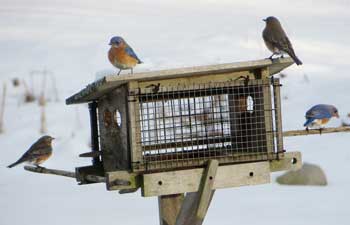
Bluebird feeder.
Many other birds are attracted to this mix if you place it on your platform feeder.
Road kill: This is not for the faint of heart, but with so many squirrels, woodchucks, and other varmints killed on our roads, try picking one up and placing it on a platform feeder. If you are lucky, you may attract turkey vultures, ravens, crows, and even some raptors.
Nectar: Most everyone is familiar with hummingbird feeders. The trick to these is to change the sugar water often and not to buy commercial red-dyed sugar water. The dye is harmful to the birds. You can make a mixture of sugar water by adding one part sugar to three parts water and heating until the sugar dissolves. Let it cool before you put it out for the hummers. Along with the ruby-throated hummingbird, I have seen Baltimore orioles and even a baby downy woodpecker at the feeder.
Fruit: A lot of birds like fruit, but my favorite is the Baltimore oriole. A few days before they are due to arrive (I check my records for previous years), I put out a couple of orange halves. I built a simple feeder to hold the oranges and, invariably, the first day the birds arrive for the summer, they are enjoying fresh-squeezed orange juice.
It is important to keep all feeders and the ground around them clean so as to lessen the chance of transferring any diseases. With a variety of feeders and habitats around your house, you will attract a good variety of species of birds to watch and enjoy.
Througout the years, we have seen and enjoyed around 90 species of birds.
David Durrant lives with his wife, Pamela, on East Bare Hill Road at Micheldever Farm, where they watch birds—their own peacocks, chickens, and wild birds.