

The Civil War statue framed by chestnut blooms.
(Photos by Lisa Aciukewicz)
The national observance of Memorial Day began on May 30, 1868, and was originally a tribute to the Union and Confederate soldiers who died in the Civil War. Since then it has grown to be a day of remembrance for those who served in all wars of American involvement and for those who died in that service. Harvard has placed three war memorials on the Town Common, where they are in constant public view, and these will be honored on Memorial Day. But other memorials have been relegated to obscurity or have disappeared altogether, raising questions about Harvard’s stewardship of past tributes to its veterans.
In 1864 a group of citizens formed an organization to raise $300 to erect a memorial to the fifteen Harvard men who had died in active duty during the Civil War. Since the memorial was not erected until 24 years later, one assumes that the money was difficult to raise, although many groups gave whatever they could over the years. Finally, in 1888, the town’s efforts came to fruition, and on Memorial Day of that year the monument was dedicated with what Henry Nourse calls “appropriate ceremonial.”
The Civil War monument stands on the Common across from the old library. A female figure draped in white marble, head bent downward, rises atop a polished granite pedestal on a square base of hammered granite. She represents Memory in the act of strewing flowers upon the names of the soldiers inscribed below. Such a figure seems unusual for a war memorial, most others in Massachusetts being obelisks or a soldier figure representing all the soldiers lost in the war. She is impressive in her uniqueness, and she speaks poignantly of both the sorrow of the war and the lasting tribute to the dead soldiers.
Another memorial to the Harvard soldiers who fought in the Civil War is far less accessible to public view. When the Free Public Library was built (1887), provision was made for memorial tablets to bear the names of all the veterans of the Civil War. These marble tablets were affixed to the vestibule wall on either side of the entrance to the library, each bearing two columns of names; above the names is the legend: “Harvard to her brave sons who fought for the union in the war of the rebellion.” When the entrance to the library was moved to the side of the building in order to make the building handicapped-accessible, the tablets were relocated to the lower level, where they remain in relative obscurity.
The Press talked to Harvard Veterans’ Agent Dennis Lyddy, who said he is concerned that the town has no plan to move the tablets to a suitable location. According to Lyddy, the library has said it has no room, and Town Hall has made no accommodations. He comments that placing a tablet on either side of the Civil War monument itself would be an appropriate spot for them.

The World War I memorial.
WW I Soldiers’ Memorial
At the Annual Town Meeting in February of 1920, citizens voted to raise and appropriate $1500 to erect a memorial to the soldiers of World War I. Clara Endicott Sears and two other prominent women in town added gifts to this account. Two years later Soldiers’ Memorial WW I was erected at the southwest corner of the Common. The base is made of artificial granite and the flagpole of steel. On the north side is a bronze tablet inscribed with the names of those in service from Harvard. On the south side another bronze tablet pays tribute to the single Harvard casualty in that war.
Lyddy reports that both the pole and the base of this monument need repair or replacement. He would also like to see spotlights to light the flag at night, as is standard practice, and he regrets the fact that since Paul (PJ) Johnston’s death in 2009, there has been no one to raise and lower the flag, according to protocol.

Monument to World War II, the Korean War, and the Vietnam War.
WW II, Korean War, Vietnam War
The third war monument stands at the southeast corner of the Common, against a backdrop of plantings by the Garden Club of Harvard. The face of this granite, domed monument shows the dates of three wars: World War II, the Korean War, and the Vietnam War. The monument is located on the site of an earlier tribute to those who served in WW II. Lyddy says that he finds it “interesting that a town that has contributed so many to military service has a simple set of plaques and not an honor roll of individual names.” He would like to see the town create a “circle of sacrifice” around the flagpole, where each war would have an honor roll identifying service members.
Although no monument acknowledges those who served in the Revolutionary War or wars before it, Lyddy says a three-year program, conducted largely by volunteers, has identified 152 veterans’ graves in the Burying Yard, now known as the Center Cemetery. Lyddy comments how great it would be to have the scouts or Bromfield seniors make some sort of kiosk in the cemetery, indicating the location of veterans’ graves. Each of these graves now has a flag holder in front of its marker, many of them displaying the year “1775” or “1776.” A flag has recently been placed in each holder to celebrate Memorial Day and will remain there until Veterans Day. On Memorial Day, Girl Scouts will place geraniums in the Center and Bellevue cemeteries.
Poor Farm and Shaker sites
One lone grave on conservation land on Poor Farm Road pays tribute to “Captain Benjamin Stewart of Boston who died of the small pox June 16, 1775 in the 45 year of his age.” A flag honors his grave. Folklore has it that his body was carried out from Boston and no town would take it for burial until it reached Harvard.
There are also seven veterans buried in the Shaker Cemetery, and a symbolic flag will fly in their honor. These are mostly men from the Civil War whom Lyddy thinks suffered from post traumatic stress and found comfort in joining the Shakers when they returned home. Eight or nine veterans, mostly from WW II are buried at St. Benedict Abbey, and Harvard will offer help to honor these servicemen, too.
On the small green in Still River village, a flag marks the memorial to Corporal Skillings, who was killed in the Korean War.
Missing memorials
Over the years some war memorials have disappeared, and no one seems to have an authoritative explanation. The Press would be happy to hear from any readers who have information.
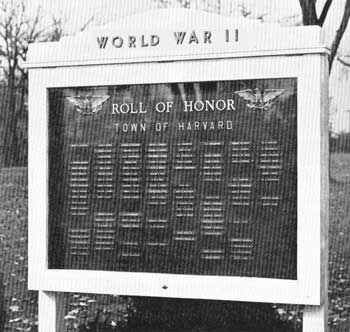
The original World War II memorial. (Photo courtesy of Harvard Historical Society)
One of these is the wood-framed, white World War II monument that stood on the site of the present monument to WW II, Korean and Vietnam wars. The dedication of the Harvard Honor Roll was held on November 5, 1944. Records at the Historical Society show that auxiliary and special police sponsored a fund for a local honor roll. They published the names of donors in newspaper articles. One document states, “To the best of the committee’s knowledge the following list of men in service from Harvard” followed by 101 names. (A later compilation done in 1963 by R.S. Atkins, curator of Harvard Historical Society, lists 134 names.)
It makes sense that a wooden monument would not have weathered well on the Common, but what happened to the Honor Roll? Why wasn’t it preserved? Lyddy comments that with Harvard’s affinity for history, why not replace the Honor Roll. It seems a further mystery that the earlier memorial to WW II veterans, honoring each individual serviceman and paid for by Harvard citizens, was replaced with an impersonal monument honoring three wars.
Cannons and a Liberty Pole
Old photographs and postcards show two cannons flanking the Civil War monument. No one seems to remember when they disappeared and no one has an answer to what happened to them. Lyddy has his suspicions that they may have been sold to re-enactors, commenting that this happened in other towns. According to Lyddy, two additional cannons stood near the flagpole.
A Liberty Pole, paid for by a group of citizens, was erected in 1892 on the southern edge of the Common. Old photographs show a narrow metal pole with a base of metal prongs. No record seems to remain of when or why it was removed.
This Memorial Day, as the town pays tribute to its veterans by laying wreaths at the war monuments on the Common, it might also rededicate itself to the stewardship of memorials present and past.