Recently, the Press spoke with long-time Harvard residents and Town Meeting regulars Audrey Ball and Fran Maiore about why Annual Town Meeting is important to them.
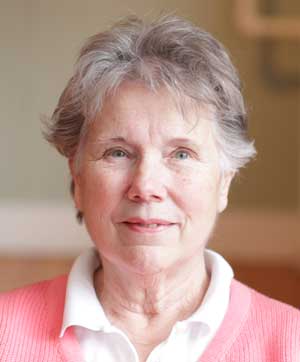
Audrey Ball (Photo by Lisa Aciukewicz)
Audrey Ball
Oak Hill Road’s Audrey Ball moved to Harvard in 1966. All four of her children attended Harvard public schools. Over the years Ball has participated in many volunteer roles. One of the first groups she became involved with was the Harvard League of Women Voters. As a 47-year league member, she has taken part in planning candidate forums, doing outreach for the league at the local, state, and national levels, and assisting with Town Meeting. For the last 20 years she has also served as the league’s paid administrator.
Press: Besides the League of Women Voters what other volunteer work do you do in Harvard:
Ball: I am involved with Harvard Help, answering the telephone one day a month. I am actively involved with the Harvard UU Church, and some of those activities serve the community, such as Loaves and Fishes, Bargains in the Belfry, planning and working on the annual Fair Trade Fair, participating in the Partakers Program (College Behind Bars). I am still involved with the Harvard Conservation Trust. I am involved with Harvard Trust Non-Profit Properties. Although one property we owned and administered as affordable housing was lost (The Inn), we still own and manage Great Elms. Some activities with the League of Women Voters are volunteer work. I work at the Columbus Day weekend flea market as a volunteer. And there are occasional single events, such as being a “toe truck” driver for the Good Friday walk.
Press: What town committees and boards have you served on?
Ball: I have served as an election official for more than 20 years. I remember counting votes back in the days before the [ballot] reader. I can also remember times when it was midnight or later before we finished! I’ve also checked voters in and out on election days or at town meetings. And I was secretary to the committee planning for the new library—not to the building committee, but to the committee before that. I’m not sure what its official name was.
Press: In your words, what is Annual Town Meeting for?
Ball: It’s a part of the legislative procedure of a town, where policies might be voted on, and especially where the budget for the coming year, plus individual financial items, are voted on.
Press: Why is it important to Harvard and to you?
Ball: Primarily, I attend Town Meeting to serve as a resident and voter in the Town. This is a part of the democratic process that we here in New England are privileged to participate in. I grew up in the Midwest, where the town meeting form of government doesn’t exist. This is an opportunity for the people who live here to have a voice in what goes on. And it’s an opportunity for those who serve on committees to hear what townspeople are thinking.
Press: There are a lot of new families in Harvard. What would you say to them about the Annual Town Meeting and why would you encourage them to attend?
Ball: This is an opportunity to both observe and participate in democracy in action. It is a chance to hear our elected officials present the articles we are going to vote on, to hear our friends and neighbors speak their minds or ask questions, to express our own thoughts or questions at the microphone, and finally to express our opinions through our votes. It is unique to New England and we are fortunate to have this opportunity for grassroots involvement. It is both a privilege and a responsibility.
Press: What changes have you seen in Harvard over the years in relation to town elections?
Ball: When I moved here, I was impressed by the large number of people who turned out to vote at elections. Excellent participation still exists, especially at national and state elections, but less so on local elections. One circumstance I see as a problem is that since Proposition 2 1/2 passed, requiring some financial items to be approved both at Town Meeting and at the polls, a greater number will vote on election day (usually in opposition) than will attend Town Meeting.
Press: What is your most memorable story from Annual Town Meeting?
Ball: I don’t have a specific story, but I can tell you there were many years that an issue came down to one or two votes. It just demonstrates that every vote does count here and how important it is to attend Town Meeting.

Fran Maiore (Photo by Lisa Aciukewicz)
Fran Maiore
Fran Maiore has lived in Harvard for 33 years. She raised four children who all attended the Harvard public schools. She worked for many years with the CASE Collaborative as a special education teacher in Harvard. Now, two of her grandchildren live nearby and attend Hildreth Elementary School. Although Maiore has never served on a town board or committee, she has served as a checker at Annual Town Meeting for many years. Her duties as an election official, according to Town Clerk Janet Vellante, are essential to making ATM a success. “Fran had to go through a great deal of training to accept this role,” Vellante told the Press. “She was appointed by the Board of Selectmen and then attended a state program to learn the guidelines and processes. She is sworn in every year. She and the other volunteers spend countless hours at ATMs, caucuses, elections, and special town meetings, helping out. Other towns pay their election officials. We are lucky in Harvard to have volunteers. It saves the town a great deal of money.”
Press: Besides your work with the town elections, what current volunteer work are you involved with?
Maiore: I volunteer with Loaves and Fishes, Harvard Help, and the Friends of the Library book sale.
Press: Have you ever served on a town board or committee?
Maiore: No, but my husband, Rick, has for many, many years, and I have always been there to support him and the town. Sometimes it is hard to watch. Especially when people say hurtful things. I know how hard he worked and how much time and energy he put in. I want to stand up and say, “Hey!” In spite of that, it is fun to watch him do his work. It’s great to be in a small town. If you want to volunteer, you can. Now my son is part of this process. It’s wonderful!
Press: In your words, what is the Annual Town Meeting for?
Maiore: Its purpose is to enact warrant articles presented by town boards and citizens as well as passing the operating budget.
Press: Why is it important to Harvard?
Maiore: ATM is where the direction of the town, including the schools, is decided. It is how you get a sense of what people want. It is also a good place to go to help and connect with your neighbors and friends. I would encourage folks to stay at ATM for as much of the meeting as they can. The various boards and committees have worked very hard to present their reports and warrant articles, and we should hear what they have to say. Also, we sometimes have to vote in the Town election on articles brought before ATM and we are better informed if we have attended ATM.
Press: Why is it important to you?
Maiore: I find the voting process very exciting. Especially when I see a long line of people waiting to be heard. I say to myself, “Everyone is part of the process and every vote counts in Harvard.”
Press: There are a lot of new families in Harvard. What would you say to them about ATM and why would you encourage them to attend?
Maiore: The town meeting form of government gives each citizen an exciting opportunity to participate and have a say in town decisions. Harvard is a small town and every vote does matter. There is no better way to know about and be part of what is going on in town.
Press: What changes have you seen in Harvard over the years in relation to town elections?
Maiore: Town elections and ATM have become more acrimonious and contentious, which often prevents consensus and problem solving. I’m disappointed in the less-than-civil tone of neighbor speaking to neighbor.
Press: What is your most memorable story from Annual Town Meeting?
Maiore: One year there was a man in the audience who kept raising his hand and asking questions and voting. Finally, the moderator asked the gentleman his name and what road he lived on. The man replied with his name and said, “Oh, I don’t live in Harvard. I’m from Leominster.” He was told very nicely that he couldn’t vote anymore. I guess he thought his voice could be heard better in Harvard than in Leominster.