
Fruitlands Museum marked the start of its 99th season last week with the opening of two new exhibits, one called “Rethink! American Indian Art,” on loan from the Berkshire Museum in Pittsfield, Mass, and the other titled is “Visions: Tim Hetherington,” a collection of photographs taken by photojournalist Hetherington in the weeks before he was killed in Libya on April 20, 2011.
The two exhibits were introduced on Sunday, April 20, by Dr. Mike Volmar, chief curator, in a talk at the art gallery, where he paid tribute to Hetherington’s memory.
“Rethink! American Indian Art” asks us to see that American Indian art is not a thing of the past; it did not end with the closing of the frontier and the movement of American Indians to reservations. It features work by six contemporary artists, artifacts from the Berkshire collection, and additions to the exhibit from the Fruitlands Native American collection, demonstrating that Indian artists continue to express themselves in a contemporary world, continuing a long history of making objects that are functional and yet also intrinsically art.
The large gallery that holds the exhibit is alive with color. The large interpretive and biographical panels are themselves awash in a vibrant turquoise, the color itself expressing a connection between traditional and modern. Many of the pieces, old and new, are made of colorful material and decorated in bright dye or paint and glistening beads. Just the contemporary look of the exhibit belies the conception that American Indian art is a collection of artifacts of a people now long gone. It proves instead that “the living presence of Indian people is captured in the art that is still being made today.”
Interpretive panels explain that the Berkshire Museum invited six American Indian artists to spend time at Berkshire “to review and reflect on the museum’s collection and the relationship of their work to that collection.” The outcome was an exhibit that pairs a piece of contemporary art with a traditional one from the Berkshire collection. When the exhibit came to Fruitlands, additional pairings were made that feature work from its Native American collection.
Historic and contemporary stories

Bently Spang’s “The Modern Warrior Series War Shirt 1998” (Courtesy photo)
The focal point of the exhibit is a freestanding display in the center of the room. Volmar points out that of the three pieces here, two are historic and one is contemporary. What they have in common is their shape as an article of clothing, their colorfulness, and the fact that each tells a story, although in different ways. At one end is a frontiersman coat and at the other a Lakota Dakota shirt, both from the Berkshire Museum. The coat is decorated in intricate patterns of dyed porcupine quills, while the back of the shirt tells a story of conflict in beaded figures and animals sewn into the leather. Between them is Bently Spang’s “The Modern Warrior Series War Shirt 1998,” with arms outstretched, telling his story of self and family in photographs and pieces of film.
On the wall behind this display hangs a large, black object that looks like a shield but is obviously not utilitarian. Surprisingly, it is made of glass, heavy and opaque. Titled “Symbolic Wealth,” its surface shows a faintly etched design of an eagle. Volmar explains that in Northwest Indian culture, a large shield was a symbol of wealth, and important chiefs would display one. In his modern rendering, the artist Preston Singletary has captured the essence of this older tradition.
A cool day job
Another arresting piece by Singletary is in a case at the northeast corner of the gallery. Also in glass, though again one would never guess because of its dark, opaque look, this is called “Eagle Boy” and in itself shows an historic subject and shape rendered “modern” by its medium. Singletary says, “At 19 years of age I fell into glassblowing because it was a cool day job, and I could do it to support my own music habit. Eventually I tied the material of glass to my cultural background.” While he works in a new medium, he has a “visual vocabulary that has been part of his people’s culture for generations.” In the southeast corner of the gallery is Singletary’s clear glass totem called, “Eagle Bear Totem” paired with a whalebone totem from the Fruitlands collection. The tall, conical shapes etched with drawings of animals are similar; only the medium is different.
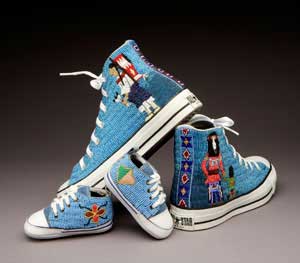
“My Family’s Tennis Shoes” by Santa Fe artist Teri Greeve (Courtesy photo)
A glass case in the center of the south wall displays historic moccasins of leather and colorful beading paired with what Volmar calls “the coolest sneakers ever.” These sneakers—covered in shimmering beads of various shades of blue—are “My Family’s Tennis Shoes” by Santa Fe artist Teri Greeves. At the end of the case are two intricately woven baskets made of ash. One, from the Fruitlands collection, is Northwest Micmac, of natural color but distinguished by a rather elaborate raised design on the exterior of the basket. The other is a round, domed basket by Jeremy Frey. Again, the distinctive feature is the exterior design, this one of alternating ridges of black and white, looking like tiny accordion pleats.
Rethinking tradition
The east wall has a series of prints by Diego Romero. They are stylized but also modernized by the influence of pop culture heroes and the use of art for social or political commentary. A panel quotes Romero: “I am heavily influenced by comic books and use narrative and storytelling which go back thousands of years.”
This rich exhibit calls into question the definition of “traditional’ and asks us to rethink tradition as something fluid. Romero expresses this idea: “I see tradition and culture as these ever-changing currents that flow through time. The one thing about tradition is that it is not static . . . tradition is in constant change. Humans relate to it as a current life experience.”

Photographer and filmmaker Tim Hetherington works at a rally in the rebel stronghold of Benghazi in eastern Libya, March 25, 2011. The co-director of Oscar-nominated war documentary “Restrepo,” Hetherington died in the besieged Libyan town of Misrata. (Photo courtesy Finbarr O’Reilly/Reuters)
In the smaller north gallery is the collection of Hetherington photographs, large, vivid witnesses to the revolution in Libya, taken in March and April of 2011. Volmar has a personal connection to Hetherington and to this exhibit. Over two years ago, he had discussed with Hetherington having an exhibit of his work at Fruitlands. Things were well underway when Volmar got the tragic news of Hetherington’s death. Volmar has kept in touch with Hetherington’s mother over the past two years, and when this show was being put together at the Bronx Documentary Center, she talked to him about having the exhibit come to Fruitlands.
An interpretive panel says that Hetherington is considered by many to be the finest multimedia journalist of his generation. He had a 15-year career, which took him to Liberia, where he lived for three years, working in a school for the blind and trying to further humanitarian ideals. His Oscar-nominated film “Restrepo” changed the way Americans viewed the Afghan war. The panel goes on to say, “He never lost sight of the human dynamics behind the violence he documented. Indeed, human behavior in the face of war was his primary interest.”
Photos that connect with people
As Volmar talks about the photos, it is apparent that he has a deep respect for Hetherington and others like him. “It’s a scary thing that they do,” Volmar says. He observes how we take for granted that we will be kept informed of what’s going on in the world, and yet war correspondents and photojournalists put their lives on the line to do that for us. Volmar describes how Hetherington used a film camera and had to crank the camera to shoot each frame. “Tim wanted to get a photo out of a picture, not just get a shot. And above all, he wanted to make a human connection. Tim is best known for breaking down images that people associate with war and trying to make a connection with the people.”
These are the last photos Hetherington took; his friends got them from his camera. The very last picture, dated April 20, 2011, the day he was killed, shows a helmet on the ground with a bullet hole in it. Clothes and tarps of different sorts are strewn in the background. A comment on one of the panels captures the sad irony of Hetherington’s death “. . . felled by the very artillery barrages that he documented.”
In addition to the photographs, visitors may view on an iPad several interviews with Hetherington. On May 2 at 7 p.m., in conjunction with the exhibit, Fruitlands will show a new documentary film, “Which Way Is the Front Line from Here: The Life and Time of Tim Hetherington” directed by Sebastian Junger for HBO.
Both of these exhibits will run through June 16 in the Fruitlands Art Gallery.