
Part one of a two-part series
Long before it was known as the Appleworks, the sprawling warehouse at 325 Ayer Road had a colorful history and deep roots in Harvard’s agricultural past. Back in the 1950s and early ’60s, the future temporary Town Hall was the bustling nerve center of Hawbuck Orchards, one of the largest apple growers in the Nashoba Valley, a region famous for the quality and quantity of its apples.
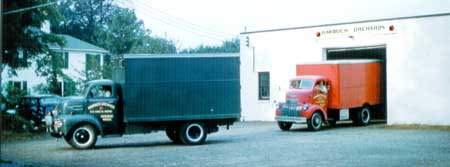
The Appleworks building circa 1950. (Courtesy photo)
Hawbuck’s story began 100 years ago, when Freeman C. Doe, a Boston physician who lived in Lexington, bought a house and about 30 acres on Ayer Road. That house sits just south of the Appleworks building on a busy stretch of road not far from the Ayer town line. But back then it was a rural retreat, where Doe’s family came to enjoy country life. They liked it so much that a few years later they bought another 30 acres and the family moved here permanently. Freeman’s son, Orlando C. “Bud” Doe, began farming the land not long after that.
Bud Doe worked his way into apple growing gradually, starting first as a “truck farmer,” says his grandson Larry Doe. He grew vegetables, raised chickens, had horses and a milk cow, but the family also made time for pursuits not normally associated with truck farming. There was fox hunting, tennis, and the kids rode the train to private school in Concord. Bud’s wife, “Tex” (who came from Texas), loved to play tennis, so in 1921 they built what was then “probably the best clay tennis court in New England,” Larry says, the ghost of which still stands just across Ayer Road from the old farmstead. According to family lore, the court was constructed by workers building the Ayer Road bridge over Bowers Brook, who had a few days off for some reason. Tex asked if they’d be willing to build a tennis court, so they hauled clay from the bridge excavation and did the job.
Does get serious about apples
At some point, the family got serious about growing apples; a 1933 aerial photograph shows apple trees in the property’s northeast section, where today’s Doe Orchards now operates. Bud and Tex Doe had a daughter, Suzie, and two sons, Whit and Bill, both of whom went off to college—and in Bill’s case, to war—then came home to help run the fast-growing Hawbuck operation. At one time, the Nashoba Valley was the densest apple-growing area in the country, Larry says, and Hawbuck eventually had 300 acres in production, including 100 acres in Pepperell and smaller orchards in Lancaster, Westborough, Ipswich, Temple, NH, and scattered parcels in Harvard. The hub of the operation was the ever-expanding apple-storage warehouse now known as the Appleworks.
The building began in 1950 as a modest structure about one-tenth the size it is now. There was room for apple storage but little else, so an addition was built in 1955, then another in 1958, then a much larger expansion in the early-to-mid 1960s. The sprawling facility was then a maze of controlled atmosphere (CA) rooms for apple storage, bunkhouse facilities for pickers, and a huge mechanized packing line with 30 to40 employees. The equipment was state-of-the-art, Larry recalls, at a time when many growers didn’t have access to the latest storage and handling practices. Hawbuck was the first grower around to use 15-bushel bins instead of moving and storing apples in bushel boxes, which was a big labor-saving advantage. Bill Doe ran the packing house, while his brother Whit took care of the orchards, but the overall operation was growing too unwieldy for the family to manage.
The strategy of having orchards in far-flung locations is to minimize the risk of crop failure due to frost or other localized factors, Larry explains. But by the late 1960s it was getting too hard to haul equipment and work crews from one place to another. And the crews themselves were a problem: after years of using skilled pickers from Nova Scotia and Jamaica, orchardists were under government pressure to hire unemployed urban workers, and the results were disastrous, Larry says. Add to that a couple of bad crop years, on top of sizable bank loans for the building, and Hawbuck was coming apart. One orchard after another was sold or leased to other growers; then finally, in 1973, the warehouse and surrounding orchard were sold, leaving Bill and Whit Doe with just their houses on either side of the cavernous edifice.
Gringeri and Forge Village
Joe Gringeri of Acton was the new owner, at first acquiring just the building and the land across Ayer Road, then eventually the whole orchard and Bill Doe’s house, the original homestead. Gringeri owned a trucking company—Gringeri Brothers Transportation—but he intended to work the orchard and use the building for apple storage, taking in apples from other growers as well as his own. According to Larry Doe, Gringeri bought all the apple-packing equipment and packed apples on a much smaller scale than Hawbuck had, but he still felt the need, in the mid-1970s, to add another big chunk to the back of the building. He had a trucking contract with McDonald’s but lost that contract and ran into trouble with the town for zoning violations. Then in 1978, Gringeri’s bank seized all his trucks for failure to make loan payments, and he was declared bankrupt. A friend of the Does, a man named Nick Storrs, held the note on the orchard adjacent to the building and foreclosed, recovering the land. Then Larry and his brother Jay pooled their savings to make a down payment and, along with their father Whit, bought the 60-acre orchard back.
That left the 83,000-square-foot building, which went up for auction, but nobody wanted to buy it.
Access and zoning deter buyers
At that point it was owned by a bank and occupied by a scattering of tenants. The largest of these was another trucking company—Forge Village Transportation—which fought tooth and nail with the town, with the Does, and with other neighbors for the right to use the building as a warehouse for cold and dry storage. The main issue was access—there was no legal access for trucks to the back of the building, nor room for them to turn around in front, but there were other problems as well. Gringeri had never applied for the special permit needed to build the 1975 addition, and the entire building was now in violation of the zoning bylaw. Nevertheless, town officials were fearful of having an abandoned “white elephant” on their hands and encouraged its use for apple storage—the only use that was grandfathered.
In early 1980, the town zoning inspector issued a cease-and-desist order, banning trucking operations at the warehouse; and the bank began eviction proceedings against Forge Village, which in turn appealed the ZBA order in Worcester Superior Court. Two weeks later, the town filed its own suit to stop Forge Village from using the warehouse, a tactic that eventually succeeded.
One promising prospect appeared that summer with newspaper reports that New England Apple Products (Veryfine) of Littleton was interested in buying the building to store apples, frozen raw materials, and its own finished products. But with no solution in sight for the zoning problems and access issues, Veryfine dropped out of the picture.
Options running out
By late 1981 a new bank had taken over the property, but there was still insufficient access to the back, and the bank was unable to reach an agreement with the Does for additional land and easement rights. A few tenants remained, but the bank’s options appeared to be running out, and so were those of the town.
This is part one of a two-part series. Next week: Enter Bill Cory