Three candidates are running this year for two open seats on the Board of Selectmen: Leo Blair of East Bare Hill Road, Don Graham of Stow Road, and Stu Sklar of Scott Road.
Leo Blair has lived in Harvard for 15 years. He is the current chairman of the Harvard Municipal Affordable Housing Trust and a former member (and chairman) of the Harvard Board of Selectmen. He has also served on the Planning Board and is a member of the Community Preservation Committee. Blair is CEO of RT Engineering.
Don Graham is a relative newcomer to the town, having moved here four years ago. He is a a technology project manager with Accenture, a Fortune 500 consulting firm. He is an assistant Boy Scout master of Harvard Troop 1.
Stu Sklar has lived in Harvard for 12 years. He has served one term on the School Committee, chairing it for one year, and is currently a member of Harvard Cable TV. This spring he introduced a citizen petition to exempt town buildings from Harvard's protective bylaw, which passed overwhelmingly at Town Meeting. Sklar is a medical sales and marketing consultant.
Following the candidates debate of April 11, sponsored by the Harvard Press and the League of Women Voters of Harvard, the Press interviewed each of the three candidates to tease out more details. Here are excerpts from those conversations.
Leo Blair
You explained your reasons for resigning from the Board of Selectmen in August 2009 in a recent letter to the Press. Do you wish to say anything more about that?
I don't. I have two little kids. And it was a health issue that fortunately resolved itself OK, but at the time could have gone the other way. And it would be troubling to them, if that were ever made public. So that's why I never said anything about it.
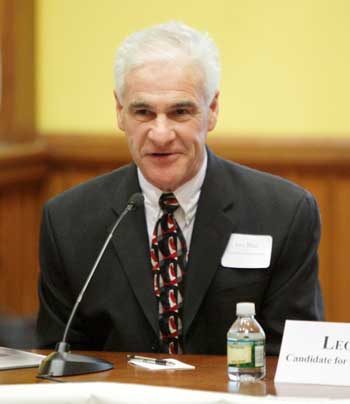
Leo Blair (Photos by Lisa Aciukewicz)
What would you say to voters who might doubt you would finish out a second term on the board?
I'd say that given the convergence of circumstances, the likelihood of that happening is about the same as a comet striking the earth. I actually liked being on the Board. And if I were reelected, I look forward to serving, obviously, for the full term and maybe beyond that if the people wanted me too. I'm confident I'll be able to do that.
People were surprised by your comment about the commercial district at the candidates' forum. Tell us what you really think.
When I said of the commercial district that I just don't think it's worth it—I don't think it's worth it. For $300,000 or $500,000 in new revenue, the investment in the infrastructure would be massive and it would drive people crazy. So why? And I know a lot of people have put work into that, and I don't disrespect their work. The question I would ask is, 'Is it worth it to you—is $500 grand in new revenue worth it to you? And if it isn't, let's stop worrying about commercial revenue in town. It's not a game changer for us. If the same amount of effort on the Devens [school] contract would result in massive benefit to the town—and it did—then I think sometimes we're focusing on the peas and missing the steak.
Regarding Town Hall, do you think there needs to be a new building committee to oversee construction?
I do. I think some of the members need to stay on. But I also think having someone appointed who is a project manager, somebody who's done this on a big scale, would be helpful. And there are a couple of people in town who are pretty expert at that. The process for Town Hall I think was a mess.
Where do you think it went off the rails?
I think that whenever we're going to propose something that has both a financial impact and is an emotional issue—and building renovations are both of those things—first I would go to Finance Committee and ask the most important question, which is, 'What can we afford?' Knowing that, I would definitely come back to Town Meeting with options. So I would have come to Town Meeting with two or three options for town hall, and then let the voters direct where to go next.
It was obvious that something went wrong because I've built a lot of projects in my lifetime, and I would say that the idea you don't check zoning first is remarkable. Literally, the first question you ask is 'What can I do, what is permitted?'
You had a big role in bringing the OPEB (Other Post Employment Benefits) issue to the town's attention. What other issues do you expect to deal with on the board if you are elected?
I want to be a selectman because we're at a point where the decisions we make in the next couple or three years are probably going to set the direction for the town. We have three or four things going on right now that will all converge. We have rapidly declining school enrollments. We have a Devens school contract, and the Devens contract is going to change because it's going to get renegotiated at some point. And when it does, it's going to get worse. While that is occurring, we have the OPEB issue, which is going to drain cash. A relatively insignificant expense is going to become a major line item in our budget. And we're investing in buildings. One of the things I'm critical about is when we talk about investing in buildings, we don't talk about the cost of the debt service.
When you take all of these things and then add the Devens question to it, you've got enough variables that I think you need people which I would describe as nimble in town government, because it is not easy to predict how all these things are going to converge.
You're opposed in the selectmen's race by an experienced project manager and an experienced salesman. What special skills do you think you bring to the table as a CEO?
I know how to delegate and I know how to let other people do their jobs. The greatest limitation of the Board of Selectmen is its irresistible desire to get involved in the business of other boards. And you just don't need to be. The Planning Board needs to do its job. The School Committee does its job. The Board of Selectmen leaves the School Committee pretty much unmolested. And the results are fantastic. You couldn't have a better result. There's this tendency to micromanage these things. I try to avoid that at any cost.
Within the board, my approach was to take those things where someone had a special expertise, and say, 'Run with it', and then bring it back to the board when it's ready for discussion and vote on it. We took roughly 210 votes while I was on the board, and 204 or 205 of them were unanimous. There were four that were 3-2. All the rest were 4-1, 3-1 or unanimous. And we weren't talking about the Ducky-Wucky Race. But you can come to a consensus, especially when people who are coming to those meetings come with ownership of the idea. The biggest management flaw we have on the Board of Selectmen is when a chair tries to impose a specific set of goals, without getting the buy-in. Then it's what we've seen recently. Which is just chaos.
The bottom line is that I think I have skills that are honed to a little bit more precise tolerance than others, because I've been doing this a long time.
What do you wish voters knew about you that they don't?
I think the thing that people don't know about me is that I really have absolutely no bias as it relates to their ideological orientation. We're in a very small boat. in a very large ocean, and my interest is to keep the boat upright and keep it from swamping. My interest is Harvard and the people who live in Harvard.
I had a lady come up to me at the end of the forum [with a question that she had wanted to ask, but didn't]. The question was basically, 'You're a no-good stinker and you're mean to people. Why should I vote for you?' I said, 'You should have asked that question. I would have loved for you to ask that question. [Because] if I come across that way, it's because I'm passionate about trying to do the right thing.' And I said, 'I gotta tell ya, I get that from both sides.' The life lesson I got from [my parents] was, 'Say what you mean, and do what you say. And that's not the style these days. The style is to couch your words. In Harvard, a lot of it is style over substance. And I'm not a politician. I hate politicians. I hate the obfuscation, I hate the equivocation. You're on the Board of Selectmen to get something done. Just get it done.
Don Graham
You've said that the skills you've acquired as a project manager are well suited to the job of selectman. What's the connection you see?
I've been with [my consulting firm] for seven years. I do large projects for them. These are multimillion dollar projects that sometimes are as short as six months, sometimes as long as two years. More often than not, I'll be running multiple projects at the same time, with different start and end dates.
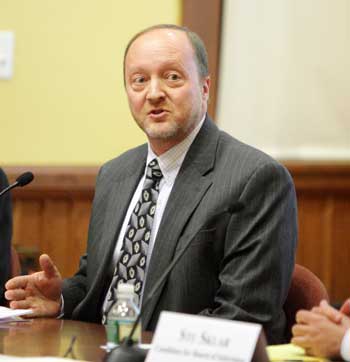
Don Graham
[We use] a very structured project methodology, and of course I'm a certified project manager. The art of project management is really getting people to work together toward the same goal. It's bringing people together who have expertise in a lot of different areas. You start off saying, well, our objective is to do this. What are the things that need to be considered? So you're really going to the people who are the experts in those areas, getting their input, bringing it together, and you're listing out all the things that need to be done, the timing of them, the dependencies, and you're putting together a schedule, and then you start putting together the teams. Who's going to work on the project to get that accomplished?
I really think the Board of Selectmen does some of the same things. There are a lot of different things going on. I see the Selectmen as the piece that drives and makes sure everything moves forward. I think my career skills are something that I could leverage as a selectman.
Some worry that because you are vice chairman of the town Republican Committee you will bring a partisan agenda to the Board of Selectmen.
I don't think [party politics] should have anything to do with this level. At the national level and the state level, but at the local level, I don't see any place for politics. There may be some loyalties because of party politics at the local level, but I don't see a role that it should play. I think people sometimes get hung up on [party labels] and we kind of lose focus that we should be discussing ideas and not teams.
Do you see yourself tilting the board in a particular direction?
I see myself as a clean slate. I have personal opinions, but I'm not here to push things in their direction. It's a starting place. I'm not here to change anything that might have been done. If I thought there was a specific problem with one of these school committees or boards, I'd be running for that. I'm really running as a selectman to be a facilitator and to help the board move along in the direction we need to go. I'm not coming in to say, 'I know the answer, I know what we need to do;' I'm coming in to say, 'Let's ask everyone who's the subject matter expert in these areas, let's see what they think, let's get some of the town input, and then let's talk about these ideas.' Out of the discussion process we'll come up with the right answer.
I don't think I'd be tipping the board one way or the other. I'm on the Republican board because of some of the national issues. I'll go out on a limb and say that some of the positions our national party takes I don't fully support. At the national level, these things matter; at the local level, they don't. I'm not coming in with ideas at the national level to try to apply them at the local level. I don't see how they fit. When the decision was whether to renovate Town Hall or not, I don't see how anything from either party could determine what needs to be done or how that could drive a decision. So anyone who has any concerns, no. No hidden agenda.
What do you make of the declining attendance at Town Meetings? You've said that you want to reach out to residents, get them more involved in town matters. How do you do that?
I don't have an answer yet. The population is not dropping off, so you do have to wonder why attendance is dropping off. Is there something we can do differently to get people excited and jazzed up, and to participate? Is it because we've got too many things going on? Are we asking the public for input on too many details? I don't know. Should we keep it at a high level and get more participation, and then go into details and recommendations? I see the problem. I would agree that if this were a trend and were to continue, at some point you would get a few people running the boards, running the committees, making all the decisions. [But] everybody's paying for it, and no one wants to get to that point.
How do you get buy-in on the big projects you manage?
It's about finding the right representation. You've got your stakeholders who are funding or pushing for the project; you've got your subject matter experts and your stakeholders from the impacted areas. You can have stakeholders with agendas. It's an art to get people to come back to the purpose of the project.
On the local level, the buildings, the renovations, all these miscellaneous projects, how do you get people to come back to say, this is our town? Everyone is paying for these projects, so everyone is entitled to have their opinions and their input into the process. So we need to find out. Are people feeling that their opinions aren't being heard or being listened to? Maybe that's what's driving them away. These projects are part of the town. They're not for a particular selectman, or a particular community or person. I don't think anyone on the School Committee is putting in programs that benefit themselves. They're being done for Harvard.
How do you get that pride? People want to get involved because it is their town. How do you get people jazzed up for that, to say, yes, we want the renovation of the Hildreth House. You know, I heard a lot of people talk about the community pride. The rural character, all these things, the same things I believe in. These things are for us and we need people to say, 'I'm paying for it, it's part mine, and I want to be here for the rest of my life, so I want some input into it.' Sometimes I think the minutia drives people off. I don't think there should be any barriers keeping people who want to participate in projects that affect them. If we have policies and procedures in place that are putting up barriers, then those might be worth discussing. If two of the [candidates] are going on record to talk about [the open meeting law] then maybe it's something that needs to be discussed.
Who's your campaign manager by the way?
His name is Don Graham.
Since you're new to town and not as well known as others, what do you wish voters knew about you?
Generally, I'm a nice guy. I get along with a lot of different people. I have friends of all political stripes. I feel like I can work with anyone. I'm not perfect. I tend to err on the side of caution. I think that anyone who votes for me is going to get someone who—if they don't trust me—is someone who's going to earn their trust. I've had different departments come back and ask for me specifically to work on another one of their projects. I hope to do the same thing here. I'd like to leave [with people feeling] that I did what was right and that I represented them.
Stu Sklar
At the candidates' forum, you and Leo Blair seemed to agree on more issues than not. How would you differentiate yourself from him?
Leo and I have worked together. We were both chairs of committees at the same time. I was chair of the School Committee, he was chairman of the Board of Selectmen. We won't agree on everything, but I think we can disagree amicably and even come to a consensus and pull other people into that consensus. I never mind healthy debate.

Stu Sklar
What's your view on Leo's comment that we should leave the commercial district alone?
I was shocked. I thought we had a real distinct difference there. I'm happy to see we don't, because I agree with him. I've looked at the numbers fairly extensively, and I don't think there's that much revenue to be had. It's a quality of life issue. Is it what people in the town really want? Especially the people in north Harvard, from whom I've heard repeatedly that they don't want a big development there. I would just like to see build-out without sewer. You can't stop development when you have a sewer.
I don't think anyone moved to Harvard, or lives in Harvard, for the conveniences. It's rural. We like it. I've lived here 12 years. I'm used to driving 12 minutes to the store now. I lived in Bolton nine years before that. This is what it is. This is what you've chosen for a lifestyle if you live out here.
If that's the case, should the EDC be disbanded?
I haven't given it thought. It would be nice to have a definitive report from the EDC. What would be the maximum revenue if you did X, Y, and Z? And then what costs would be associated with X, Y, and Z. But again, I don't see the town of Harvard supporting becoming Westford or Route 9 Natick.
But doesn't the town need more revenue?
We need more revenue. The Capital Planning and Investment Committee, the CPIC, is made up of some of the most fiscally conservative people in Harvard politics. They're saying there's going to be a need for an override for capital projects within two years. To keep the minimal number of services that we have, something's going to have to give.
One of the things that I didn't mention at the Forum [on April 11] is that just in the last five years, state aid to Harvard has gone down 40 percent. That's from Massachusetts Budget and Policy Center. That's their number. And if you go back 15 years to the late '90s, it's gone down over 70 percent, I believe. It's astounding. And that's why over the past 10 to 15 years, property taxes have gone up so dramatically.
We've been very lucky this year. We've had extra circuit breaker [i.e., state aid] money, the Devens contract kicked in a lot of money to the schools. We had level services instead of a level-dollar budget. There was no override. There was little acrimony at Town Meeting. There was no debate on town budget; it just flew right through. It was a good year for Harvard, and many towns aren't in our situation. We've been very prudent. No paid ambulance squad. An all-volunteer Fire Department. We're very lucky that there are people who step up to do those things.
What's your view on completing Town Hall and renovating Hildreth House?
My difference with Leo is that Leo doesn't entirely endorse the idea of Hildreth House. Of the two properties that we had to work with—the old library and Hildreth House—the old library was never going to work as a senior center. Hildreth House gives the town more room to maneuver, and it seems the Council on Aging wants that. I'm ready to support that. People over the age of 60 have been the fastest growing segment. That demographic fact isn't going to change anytime soon.
As for Town Hall, when Town Meeting votes to do a project, it's the selectmen's job to see that it gets done. That's it. End of discussion. Like the project or don't like the project, it's time to do it, as cost effectively as possible.
The problem was the selectmen. The Board of Selectmen caused the problem. The MBC (Municipal Building Committee) was doing a very good job. The process was too politicized with the bylaws and now we're not going to have that issue to deal with. It was gratifying to me to see [the citizen petition initiated by Sklar to exempt Town Hall from the protective bylaw] pass by an overwhelming majority at Town Meeting. A-two thirds majority is not an easy hurdle, and it wasn't even close.
What do you think should be done about Devens?
My one preconception is that it can't be negotiated without getting input from the town. I think that was 2B's downfall [a previous vote on the disposition of Devens], which was the last time we had a serious discussion. We need to know what we want. I want to understand Harvard, Harvard residents in Devens, and Mass Development, because ultimately [in 2033] if people really can't get their act together, everything goes back to the original towns. I'd like to get this process going and get people really engaged.
Blair says he wants to start by collaborating with Shirley and Ayer through the JBOS? Is that the way to start?
I'm all for JBOS. [Devens is] a juggling act. There are a lot of balls in the air. But ultimately, the Selectmen are representing Harvard, and that's where my focus is. You can negotiate all you want with JBOS and Mass Development and bring it back to the town, but if they don't like it, it's going to fail. It can't be a top down process. It needs to be a bottom up process, because you need people to come and vote for this.
To observe that a salesman, a project manager, and a CEO are running for a seat on the Board of Selectmen, feels like the start of a bad joke. What can someone with the skills of a salesman bring to the Board of Selectmen?
Salespeople spend their lives getting people to yes. You always have to listen more than you talk. I'm willing to listen to anything. And I could change my mind like that [snapping his fingers]. You have to be open minded. I like to talk to people in the town, because I like to believe I can get them around to my point of view.
When you're CEO, you get to tell people what to do, and they get to follow your way. It's not always a debate. Apple is a benevolent dictatorship, and we all like their products. But that's not the right way for government.
I've spent my whole career getting to yes. Sometimes you're successful, sometimes you're not. I'm a negotiator. [When a colleague recommended he should read "Getting to Yes"] I read it. It's a short book. But this was my life. There was no information in there for a guy who has been in sales for 25 years. Being a salesman is ideally suited for being an elected official in a small town.