
The one-year term for Planning Board is a contest between Conservation Commission member Jim Breslauer and selectman Bill Johnson, both veteran volunteers in town government.
Johnson will let his term as selectman expire this year, preferring to join the Planning Board because “the hardest challenges in the coming years are in the lap of the Planning Board, not the selectmen.” If Breslauer is elected to the Planning Board, he will keep his seat on the Conservation Commission, which he says would have the effect of “improving communication between the two land-use boards.”
Nine-year resident Breslauer has served on the Conservation Commission for the past eight years, and volunteers at the town’s new cultural center and for two dog-rescue organizations. He served on the Master Plan Steering Committee that completed Phase One of the Master Plan in 2012. Breslauer and his spouse Deb Thomson, who raised their son in Lowell, live on Poor Farm Road with their cats and dogs, three of each. His career has been spent as a legal aid attorney, helping, he said, “the most vulnerable members of our society.” In recognition of his public service, Breslauer was chosen to receive the 2013 Massachusetts Bar Association’s Legal Services Attorney Access to Justice award, which is “given to a public or agency attorney who has made contributions beyond his required job responsibilities,” according to the association’s website.
Since moving to Warren Avenue from Sudbury 16 years ago—where he and spouse Laura raised their family—Johnson has served as a selectman and on committees sufficient in number and variety to make alphabet soup, including Bare Hill Pond Watershed Management and Harvard Cable TV, and the Fiscal Impact Analysis and Economic Development Analysis teams, both precursors to today’s Economic Development Committee. After retiring before the age of 50 from a career as an executive in the semi-conductor business, Johnson worked with the New England Handicapped Sports Association to fund and build a new facility for that organization.
Jim Breslauer
What attracted you to Harvard?
Breslauer says that over-development in Lowell, where he had settled with his family in 1981, sent him looking for quieter shores in 2004, which he found in Harvard.

Jim Breslauer (Photos by Lisa Aciukewicz)
“What do I like about Harvard? I love Paul [Willard’s] corn and the fact that a change box can be left out unguarded. I like the General Store where friends and neighbors can sit and have a good cup of coffee and better conversation. I like that I can ride my bike in relative safety while enjoying our beautiful land and viewsheds. Bare Hill Pond, where I can be in my kayak at 7 a.m., in silence except for the birds. And, of course, Town Meeting: pure democracy in action.”
What motivates you to run for Planning Board?
Breslauer says he is running to “help the town learn about the pluses and minuses of resuming governance of Devens and then to complete the Master Plan.”
Like all the other Planning Board candidates, he says he hasn’t made his mind up in advance about Devens.
“I am running because I don’t have an agenda one way or the other for Devens. I really want to work with other members of the Planning Board, the new town planner, and consultants to gather information on how the resumption of jurisdiction would affect Harvard, both economically and culturally, distribute that information to town residents, and then be guided by their preference.”
Another motivating factor for Breslauer is his perception that the people’s will is not sufficiently respected by some town officials.
“My major concerns for Harvard revolve around the certainty of some individuals in government that they are [so sure] of their ideas that they will pursue them even after the town has decided otherwise. The delays caused by such individuals for the Town hall project is just one example. I know I’m not smarter than the collective wisdom of our town residents and as a member of the Planning Board will do my best to ensure that such obstructionism will not prevail.”
What are your concerns about development in the commercial district?
Breslauer advises a cautious approach, with a focus on preserving the character and resources of the town.
“The Economic Development Committee has done some great work. A lot of what they have done can and will be used in the completion of the Master Plan. But their work has had a relatively narrow focus. We need to explore other avenues for economic development, always with an eye on how proposed development will affect our town: its culture, its water resources, its neighbors, its traffic. We should wait on further commercial district work until the next phase of the Master Plan is completed. If we decide to try to resume jurisdiction of Devens, our commercial development potential will be very different. A one-year wait on the C district will cause no harm, while rushing ahead may cause lasting damage.”
Although he did not support the hiring of a planner “at this time,” Breslauer said that “since Town Meeting decided otherwise,” he wants to help hire a planner “with skills to help us with the Master Plan.”
Bill Johnson
What attracted you to Harvard?
Without a moment’s hesitation, the candidate responded to this question, “We came for the pond.” Because they love water sports, living near the water was a priority for Johnson and his wife when they decided to move on from Sudbury. On Bare Hill Pond, the couple enjoys waterskiing, swimming, and especially kayaking.
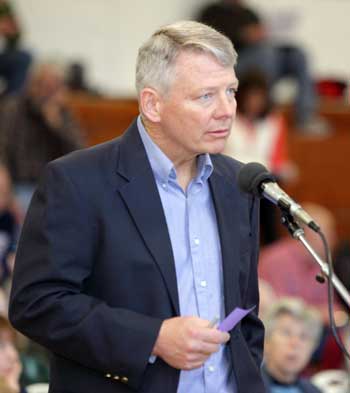
Bill Johnson
What motivates you to run for Planning Board?
Johnson sees the Planning Board as a board that could benefit from his “problem-solving and organizational skills,” and the challenges faced by the board appeal to him.
“For my whole life and in my career I’ve always been drawn to challenges, especially ones that require new approaches and have eluded solving. Joining the Pond Committee and tackling the weed problem, the phosphorous levels, is an example of that.” Johnson was part of the committee that obtained grants for a significant weed eradication program at the pond.
Frankly, Johnson says, the Planning Board needs him.
“The Planning Board has a bunch of bright and committed people who struggle to achieve the minimum critical mass to be successful—critical mass of collective institutional knowledge and collective time availability. I think I can personally make a big difference in helping them to achieve critical mass.”
What are your concerns about development in the commercial district?
As the principal proponent for a town planner and as selectmen’s liaison to the Economic Development Committee (EDC), Johnson has been supportive of the idea that exploring development on Ayer Road is a wise course of action. He dismisses the idea that the EDC wields undue power over the process, as some have claimed.
“You have to appreciate the diversity of the boards. Some have regulatory power, and others do not. The beauty of the EDC is that they can analyze [development options] while allowing the Planning Board to be the enforcer. So it’s a great opportunity for a good cop, bad cop synergy for the two boards,” he said.
Johnson points to the recent change to the sign bylaw as an example of this synergy. The zoning bylaw for signs was amended under the Planning Board chairmanship of Kara Minar after business owners complained of undue restrictions on the size and placement of signs.
“Businesses had nowhere to turn, and the EDC and Planning Board worked together to solve the problem,” he said.
Unlike candidates Breslauer and Minar, who caution that increasing commercial development may not always or automatically relieve the residential tax burden, Johnson strikes an upbeat tone when discussing the potential fiscal benefit to developing a commercial base. The Planning Board, he said, should “help effect a broadened commercial tax base to relieve the residential tax burden.”
What are your achievements in town government?
Johnson observed that he “joined town government for public service, but found a lot of personal politics.” He said he “just stayed focused on the tasks I signed up for and delivered the results I promised.” The candidate listed those results for the Press, including the pump house for the pond as part of the weed control program; the securing of a town planner for the Planning Board; the implementation of a five-year strategic plan system for all town boards; and, as part of work for the Fiscal Impact Analysis Team, “a set of recommendations for structural debt reduction.”