From left: Board of Selectmen candidates Leo Blair, Don Graham, and Stu Sklar. (Photos by Lisa Aciukewicz)
What do you get when you bring together an executive, a project manager, and a salesman? You might expect the answer to be—a difference of opinion.
But when the three candidates for two open Board of Selectmen seats met last week to debate town issues, their differences seemed as much a matter of style as substance.
The candidates were Leo Blair, a former Harvard selectmen and CEO of a Boston-based manufacturing firm; Don Graham, a project manager with a Fortune 500 management consulting firm; and Stu Sklar, a former member of the Harvard School Committee and a medical equipment salesman.
The occasion was “Meet the Candidates 2013,” a forum sponsored by the League of Women Voters and the Harvard Press, and held last Thursday, April 11, in Volunteers Hall at the Harvard Public Library.
In a series of questions prepared beforehand, the candidates were asked to explain why they were running and then to respond to five other questions covering the renovation of Town Hall and Hildreth House, the disposition of Devens, development of the Ayer Road commercial district, and the alleged absence of civility on town boards. Questions from the audience dealt with Harvard’s looming OPEB (Other Post-Employment Benefits) liability, open meeting law, and a proposal once advanced by Sklar to replace a portion of town property taxes with an income tax.
All three candidates extolled the virtues of Harvard. Graham said he had moved here four years ago because of the schools.
“Harvard has it all,” said Sklar: “A beautiful setting, a great school system, abundant conservation land and a deep sense of community.”
For Blair, “Harvard is like a college town without the college.”
Finding solutions through process
Blair and Sklar seemed to agree broadly on many issues, though their answers differed in style and emphasis. Graham gave answers that drew on his experience as a project manager, rarely stating a definitive opinion, preferring to describe the approach he would follow to gather information and form an opinion rather than prejudging the result. “I’m not a politician,” he told the audience. “I’m a better listener than a speaker,”
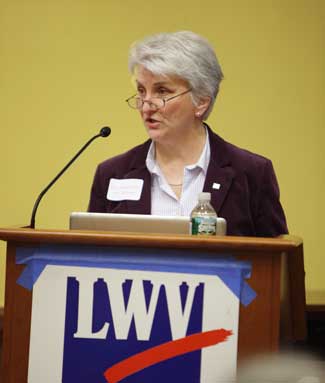
Erin Pastuszenski, of the Concord-Carlisle League of Women Voters moderates the debate.
When he was asked, for example, what role the selectmen should play in efforts to build out the Ayer Road commercial district, which stretches from the Route 2 interchange to Ayer Circle, Graham answered that the selectmen should “help coordinate … to make sure that we’re moving forward this process of looking at the viable alternatives to present to the voters.” He said he thought the expertise of the planner that Town Meeting voted to hire two weeks ago would be “instrumental ” in recommending steps Harvard would need to take to attract commercial development.
Sklar and Blair, however, both questioned the wisdom of commercial development. Sklar said that the Planning Board should lead the way in studying the matter, but that prior investigation of commercial development along the Ayer Road corridor promised no more than $300,000 to $400,000 in additional tax revenues. “If we’re really looking for tax revenue, the way you get revenue is by building office space,” he said. “If we want revenue…we need to look at buildings, office parks. If we want convenience [e.g., a supermarket or pharmacy], let’s everyone be aware there’s going to be a trade-off [in increased traffic and cost of town-provided services].”
Blair was the most forthcoming of the three, warning that some in the audience wouldn’t like his answer. “I don’t think increased commercial development… is worth the money,” he said. “There’s not that much money in it,” he stated. The town should “take the position of developing for convenience—a drugstore, a supermarket, a bank, maybe a bar or two…or three,” Blair said, to laughter from the audience. But he claimed that other Massachusetts towns he loved, such as Lincoln, Dover, and Carlisle, had no commercial tax base. “Harvard’s a great town,” he said. “We should leave it alone.”
When it came to Devens, no candidate was prepared to offer a definitive answer. “The town is divided,” said Graham. “There are historical ties [to the former base]. There could be some financial benefits,” he said. “The Board of Selectmen needs to make sure the process keeps moving forward and that we get all the information we can out to the public.” At some point, he added, “We’ll have the information we need to make a decision. At this point, I don’t think we should be doing anything more than what we’re doing now, finding out what does and doesn’t work.”
‘Devens is a journey’
Blair said he didn’t think it is “possible to know what our position should be.” “I think Devens is a journey,” he said. “We’re dealing with Mass Development, which has an enormous stake in the property, and we’re dealing with two towns and residents who live there and who are mainly Harvard residents.”
“The way Devens is structured,” said Blair, “if we can’t get everyone to agree, there is very little we can do. Blair said his approach to Devens would be to start a “process of cooperation now. Start working together; start working on things.”
During the question and answer period that followed, outgoing Selectman Tim Clark, who is also Stu Sklar’s campaign manager, asked the candidates what their positions had been on the two Town Meeting articles this year that created an irrevocable OPEB trust for the town and transferred $250,000 to the account. All three candidates said they had supported the measure, though Blair had to leave before the vote was taken, due to the altered order of the warrant. “It was a good first step,” he said.
Open meeting law
Deborah Skauen-Hinchliffe of Still River attempted to criticize Sklar for a violation of the open meeting law that occurred while he was a member of the School Committee, but she was admonished by the moderator and asked to rephrase her question as one that all three candidates could answer. That question was whether the panelists were prepared to follow the state’s open meeting law, which prohibits private conversations between town officials.
Sklar said he intended to follow the law and noted that his one violation had occurred when a third member of the School Committee appeared at an informal meeting he was holding at which he had been soliciting public input on a committee proposal. The violation was remedied, at the request of the District Attorney, by publishing the minutes of that meeting.
Blair said he too intended to comply with the law, but that the rules made it difficult for board members to conduct business. He suggested that every public official should be given an email account, whose messages could be accessed at any time by the public.
Graham answered the question by saying that he would err on the side of doing the right thing.
Marie Sobalvarro asked the panel whether they would favor a tax override to fund the many capital projects the town will undertake over the next five to ten years. “We’re going to spend the money anyway,” said Blair. “Having a dedicated source of funding is a good idea.”
“If CPIC (Capital Planning and Investment Committee) thinks it’s a good idea,” said Sklar, “I’d probably go for it.”
‘A talking point’
The last question of the evening came from Tina Allen, campaign manager for Leo Blair, who asked what the candidates thought of an idea floated by Sklar to raise some of Harvard’s revenue through a local income tax. Sklar said the idea was one of several he and others had explored six or seven years ago to help seniors. Seniors, he said, are faced with properties with high assessed values but are constrained in their ability to pay taxes by lower incomes. The notion of an income tax, he said, was “a talking point.”
“It’s not going anywhere,” he said, “but it’s important to explore new ways of helping the seniors in town.”
The selectman candidates were preceded by Chris Ashley and Kara Minar, who are running for an open three-year slot on the Planning Board. Jim Breslauer and Bill Johnson, candidates for a one-year slot on the same board, had also been invited to participate. But because Breslauer was away on business, the two were invited to submit two-minute statements. Breslauer’s was read by the moderator, and Johnson read his in person. A report of the debate between Ashley and Minar will appear online later this week.
The moderator for the evening was Erin Pastuszenski, a member of the League of Women Voters for 20 years, and Voter Service Director for the Concord-Carlisle League. The prepared questions of the night were handed to the candidates on cards, then read aloud by the moderator, while the audience viewed them on a screen at the front of the hall. Roughly 40 residents attended. Others watched the discussion on Harvard’s Cable TV or on a video recording posted later to YouTube. HCTV station director Robert Fernandez said there was no way of knowing the exact number without polling viewers.