Administration explains how it is addressing identified problems
On Wednesday, April 10, Bromfield Principal Jim O’Shea and guidance counselor Drew Skrocki walked roughly 120 parents and other attendees through the results of last spring’s 2012 Youth Risk Survey, a study conducted every two years at area schools to assess the extent of risky behavior among middle and high school students.
The purpose of this presentation, held in Cronin auditorium, was not just to share the survey results, but also to explain what Harvard schools are doing to address the problems the study identifies. The presentation focused on the five areas that faculty deemed most important: alcohol and substance abuse, sexual activity, harassment (bullying), stress, and self-harm.
A semi-annual study
The survey began in 1998 with funding from Emerson Hospital. It has since been conducted biannually in several towns across Massachusetts. The Harvard and Nashoba school districts are part of an aggregate that includes Acton, Acton-Boxborough, Boxborough, Concord, Concord-Carlisle, Littleton, and Westford. Students in grade 6 and grades 8 to 12 took the surveys in March of 2012. Before students took the survey, parents were informed about its contents. As a result, some asked that their child not take it. The questions students encountered included topics such as: safety, violence, stress, suicide, tobacco use, alcohol use, drug use, gambling, HIV/AIDS education, sexual behavior, and physical activity.
Understandably, parents’ reactions to the information were mixed. Some were intrigued and receptive, while some seemed skeptical and almost combative in their questions.
Many parents questioned the students’ honesty in taking the survey. Principal O’Shea addressed this at several points during the presentation.
“There probably is some dishonesty,” he said. “Some kids may think, ‘I’ll look cool by answering this way,’ but really no one’s going to know how they answered because it’s anonymous.” He admitted, “We hit a patch in the survey questions where they asked about cocaine, prescription drugs, and heroin. There were four students that chose the maximum—30 times a month—every question. That’s where you could say, ‘Yeah. There were four kids that were just saying it.'” He was quick to point out that while there is room for error, the survey results should be taken seriously.
Unreported alcohol incidents a concern
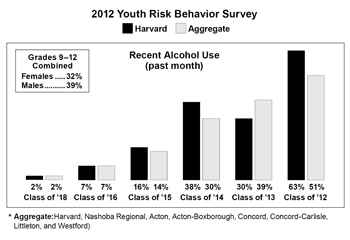
Alcohol use was another popular topic of discussion. One question on the survey revealed that 63 percent of Bromfield’s seniors admitted to recent alcohol use last spring; the average percentage in grades 9 to 12 was 35 percent. Principal O’Shea took this opportunity to address two recent incidents involving intoxicated students at school dances. When word got out about these incidents, several citizens wondered whether the students involved were arrested and why the consequences were never reported.
CLICK IMAGE TO ENLARGE
O’Shea explained the procedure for dealing with intoxicated students. If a faculty member suspects a student of being under the influence on school grounds, the police come and assess the student. “They’re not there to arrest our students,” O’Shea explained. “They’re there to help me ascertain whether these students are under the influence. Once we have the information we need, they [the students] get the school consequences, and I contact their parents.”
Due to these recent incidents, faculty members will be “much more vigilant” at future dances, he said. There will even be a breathalyzer at prom. “As soon as I have the thought that they might be under the influence, I really own their behavior after that. If I were to not do anything and let them leave and drive away in a car…I can’t let that happen,” O’Shea explained.
There were similar concerns on the topic of drug use. When asked if he had ever encountered students selling drugs on school property, Principal O’Shea responded, “I’ve never heard of any kids selling drugs on school property. Have I found kids under the influence? Yes. Have I found kids in possession? Yes. Have I heard from parents that some student is offering their child drugs? Yes. We’ve never picked someone up for selling.” The survey question that asked about recent marijuana use showed that the highest percentage was once again in grade 12 with 40 percent. The average reported use in grades 9 to 12 was 22 percent. O’Shea once again emphasized that the consequences for such actions are not intended to ruin students’ futures. “We have an outstanding relationship with Harvard PD. We work really closely with them…we want to help our students make the best decisions possible. We also want to protect them.”
Risk of suicide a surprise
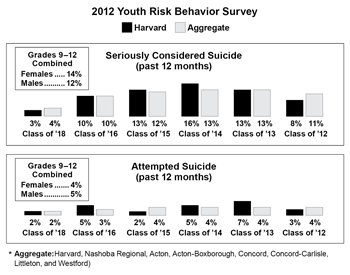
One topic’s results seemed especially shocking to parents: suicide. When the first slide went up, the Cronin auditorium went silent. The question was whether the student had ever attempted suicide. O’Shea pointed to grade 10’s statistics. Five percent of students had said yes to that question. He pointed out that if each grade has 100 students, that percentage equates to five kids. “You might say five is inflated, but even if you cut it in half, that’s two kids,” he said soberly, “There are two children that are dealing with some serious things.” The next slide was equally disheartening. It asked students if they had seriously considered suicide. The highest percentage was in grade 10 at 16 percent; the average of grades 9 to 12 was 13 percent.
CLICK IMAGE TO ENLARGE
After finishing the slides, O’Shea called several faculty members to the front of the auditorium: guidance counselors Drew Skrocki and Sarah Merrihew; school nurse Colleen Nigzus; school psychologist Susan Downing; and Elaine Beckett, health and wellness instructor. Merrihew first discussed the group called G+ (Guidance Plus), consisting of the above-mentioned faculty. The group meets weekly to discuss students that may be at risk, she said. This allows for a group, rather than one person to monitor students for whom they may have concerns. Within this group there is also a crisis team that identifies students who need immediate attention.
The school has also added new health and wellness courses tailored to the students’ needs, which were gleaned from the results of the survey. Beckett, the health and wellness instructor, said, “The classes have been really successful. The students have been enjoying it. I think the information is getting across.” She is currently planning a class called “On Your Own” which will teach students valuable life skills like career planning, writing resumes, and financial planning. Additionally, she plans to run a R.A.D. (rape aggression defense) class for female students this spring. The school has also planned several informative presentations for students for the remainder of the year.
Due to overwhelming parental demand, Principal O’Shea offered to post the results of the youth risk survey online. At the end of the presentation, student members of S.A.D.D. and World of Difference led small group discussions about the five issues that the presentation focused on. These student volunteers gave parents advice on how to approach sensitive topics with their children, what signs to look for, and ways to stay involved in their children’s lives.