
The Willard twins at an earlier post office on the present site. (Photo from the Harvard Historical Society archives)
It is welcome news that the Still River Post Office is staying put for now, especially since it has had such a nomadic history. Although the first postmaster of Still River was appointed in 1855, it took a century for the U.S. Postal Service to officially record the post office at its present location. For much of its existence, the Still River Post Office was a "village post office," exactly the kind of place that is becoming more and more popular today, according to Michael Foley (see related news article).
According to Henry Nourse ("History of Harvard"), "Before the establishment of a Post Office in Still River, for several years it was customary for the postmaster at Harvard to send mail belonging to Still River people to the store of H.N. Smart by any chance messenger. There it was thrown into a box from which every comer helped himself as he pleased." It is probable that the store Nourse refers to was located at what is now 6 Still River Depot Road.
The first postmaster
In 1855 William Bateman was appointed Postmaster of Still River and he kept the mail at Lee's store, which was most likely at that same location. After a few years, Bateman moved the post office to his house (now 202 Still River Road). A news clipping in the Historical Society archives quotes a letter from Fred Sprague, who grew up in Still River and was just finishing high school in 1887. Sprague wrote of the post office: "Unlike many others, this office had no barrel of crackers to play with. The post office was kept in a private home, known as the Brick Ends House because of brick veneering on its ends."
"Postal arrangements were crude," he continues. "[T]o get your mail you entered the wood shed and turned left to the kitchen door, which like Dutch doors of New York had a swinging upper panel covered with glass. The wooden inner portion had its face stuck full of pins upon which the letters were propped up. To pick up a letter you pulled the jingle bell cord and a member of the household would come and open the window and hand it to you. Papers were left on the shed table and you helped yourself."
At William Bateman's death in 1877, his widow Louisa succeeded him as postmaster. As Sprague's letter explains: "About 1886 Mrs. Bateman moved to another home in the village, taking the post office with her. [This was the current 222 Still River Road, the former Girls Academy and later known as Rosecroft.] At this time, a regular line of post office boxes was installed. An additional expense was the hauling of the mail a matter of half a mile twice daily from the trains. This was done by Mrs. Bateman's brother-in-law, by aid of an old white horse and spring wagon. The horse, by the way, was said to have attained an age of 35 years or more before quitting."

Post office annexed to general store at 6 Still River Depot Road. (Photo from the Harvard Historical Society archives)
Mrs. Sarah Newell succeeded Mrs. Bateman in 1894, and the post office was annexed to the general store she managed at 6 Still River Depot Road. The store had been rebuilt on the site after a fire in 1883 destroyed the original. William Viles managed the store and served as postmaster from 1899 to 1922.
Crossing the highway
An entry in the records of Ida Harris, who updated the history of Harvard to 1940, states that in 1922 the post office moved across the street to "a building owned by the late Howard Stone and Helen Stone who is postmaster. Mr. Stone bought the property in order to make it over for a post office for his daughter Helen. The mail is now carried by truck to Harvard Station and Worcester."
The building Harris cites is 211 Still River Road, adjacent to the Historical Society, and here the post office remained until it once again moved across the street, probably around 1930.
The late Harvard historian Elvira Scorgie recorded, "The present post office building [206 Still River Road] began life as a gas station with a very small building. The Willard twins, Hazel and Alma, were in charge. I do not remember if they sold anything except oil and gas. (1920-1944) Charles Simmons who had it later sold Sunday papers and I think cigarettes." Since the dates seem unattached to either sentence, it is unclear when the twins took over the post office and when Simmons succeeded them.
Meeting the mail train
An account by Donald Foss, who grew up at 20 Fairbank Street in the 1930s, also mentions the Still River Post Office. "My father had the Star Route contract for the post office. This entailed leaving Harvard each morning to meet the 7 a. m. train at the Harvard Depot. This meant first going to the Still River P.O. to pick up their outgoing first class mail bag and parcels. In the winter the morning run was long before any plows were out, and cold as the devil. Chains and mud hooks were the kings of the road and the darn things were always snapping and banging the fenders. In my household everybody got up and shoveled if there was a storm during the night—the mail had to go! The Still River P.O. was nothing more than a gas station with two pumps (started by the Willard family) and a small variety store inside with a tiny spot for the post office. After pick up it was over Prospect Hill to the Depot. You hoped the train would be on time, but that was not too often. When it arrived, you'd throw on the outgoing mail while the man in the railway mail car threw off the Harvard mail. Then it was back to the Harvard P.O. via Depot Road. Why not Still River? That was a Class C post office, which meant that you did not pick up your mail there; Walt Dickson delivered all Still River mail by RFD. You could send mail from Still River, but not receive."

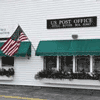
The Still River Post Office today. (Photo by Lisa Aciukewicz)
A permanent home
It is not clear when mail delivery in Still River stopped, probably sometime between 1947 and 1950, as Scorgie writes that "Mr. Anderson must have enlarged it [the present post office building] as his son was postmaster here." She goes on to say, "When Robert Shepard 1950–1973 first bought it he had a small village store and was postmaster but found it more profitable to specialize in the sale of window shades. His wife Marion took over the postmastership."
It must have been under Marion's watch that the Still River Post Office became officially recognized, 100 years after the appointment of its first postmaster.